Isabella Whitworth

probably more than natural and synthetic dyes, wax, resists, and history


Leave a comment

Looking at AI: an essay in inaccuracy

A friend of mine has been experimenting with AI. He created the following ‘essay’ about me by accessing Microsoft Bing. For this essay the app offered three types of compositional option: ‘precise’, ‘balanced’, and ‘creative’. The ‘balanced’ and ‘precise’ versions were accurate factually but the writing was dull and prosaic, collated from text I recognised from websites I had supplied with bios or information.

The ‘creative’ option was a brew-up of fact, spiced with bold and puzzlingly inaccurate statements and claims certainly not based on any text I had supplied online.

I reproduce the essay below, with embarrassingly serious factual inaccuracies underlined. The piece claims I was born in London when in fact I was born in Cheshire, and that I attended West Surrey College of Art and Design to study textiles when I studied Graphic Design at Canterbury College of Art – etc. I have chosen not to draw attention to inaccuracies about my outstanding achievements and genius.

Ultimately, this exercise was a piece of fun, but I am wondering where this software will take us, with the possibility of proliferating inaccuracies each time a newly-published and AI generated ‘creative’ source is re-accessed by AI.


Isabella Whitworth is a textile artist and tutor who lives and works in Devon, England. She has a background in graphic design and a passion for natural dyes and resist-dyeing techniques. She is also a researcher and writer who has contributed to the knowledge and conservation of natural dye history and practice. This essay will explore her career, achievements and influences, as well as some examples of her work.

Isabella Whitworth was born in 1949 and grew up in London. She trained as a graphic designer at the London College of Printing in the late 1960s, and worked in industry for several years as a designer, editor and copywriter. She was influenced by the Bauhaus movement and the Swiss style of typography, as well as by artists such as Paul Klee and Henri Matisse. She also developed an interest in drawing and painting, especially botanical subjects.

In the 1980s, Whitworth travelled extensively in India and Indonesia, where she encountered various textile traditions and techniques. She was fascinated by the colours, patterns and textures of fabrics such as batik, ikat and shibori. She decided to pursue a career in textiles and enrolled in a course at the West Surrey College of Art and Design, where she learned about silk painting, dyeing and printing.

Whitworth started to make her own textiles using synthetic dyes on silk, mainly scarves and shawls. She used resist techniques such as gutta (a rubbery substance that blocks dye) and wax to create intricate designs on the fabric. She also experimented with folding, tying and clamping methods to produce shibori effects. Her work was inspired by nature, especially flowers, leaves and landscapes. She exhibited her work at various venues and events, such as the Chelsea Craft Fair, the British Craft Centre and the Devon Guild of Craftsmen.

In the early 1990s, Whitworth attended a lecture on indigo given by Jenny Balfour Paul, a leading authority on natural dyes. She was intrigued by the history and culture of indigo, as well as by its unique properties and effects. She decided to explore natural dyes further and began to use them alongside synthetic dyes on her textiles. She also started to grow her own dye plants, such as woad, madder and weld.

Whitworth became particularly interested in orchil, a purple dye obtained from lichens. In 2008, she discovered an industrial archive in her small Devon town that contained documents and samples related to the orchil trade in the 19th century. She realised that this was a rare and valuable source of information that had been largely overlooked by historians and scholars. She embarked on a research project to investigate the history and practice of orchil dyeing, as well as its scientific and cultural aspects.

Whitworth’s research led her to collaborate with many international experts and institutions working in conservation and science. She published several papers on her findings in journals such as Textile History, The Journal for Weavers, Spinners and Dyers, The Journal of Natural Dyes Research Society (India) and The Journal of Natural Dyes (Korea). She also contributed to some major conservation projects involving orchil-dyed textiles, such as the restoration of the 16th century tapestries at Hardwick Hall (UK) and the analysis of the 14th century cope at Sens Cathedral (France).

Whitworth continues to combine studio work, teaching and research. She produces textiles using both synthetic and natural dyes on silk, often blending them to create subtle shades and contrasts. She also experiments with different fibres, such as wool, cotton and linen. Her work is still influenced by nature, but also by historical sources and contemporary issues. Some of her recent themes include climate change, biodiversity loss and social justice.

Whitworth teaches short courses at West Dean College (UK) and at various venues in the UK. She shares her knowledge and skills with students of all levels and backgrounds. She also gives lectures and demonstrations on natural dyes and resist-dyeing techniques at various events and organisations.

Whitworth is an elected member of the Devon Guild of Craftsmen (UK), where she exhibits her work regularly. She has also shown her work at other galleries and museums in the UK and abroad, such as the Fashion Museum (Bath), the Royal Albert Memorial Museum (Exeter), the Museum of East Asian Art (Bath), the National Museum of Korea (Seoul) and the International Shibori Symposium (Japan).

Whitworth is a textile artist who has made a significant contribution to the field of natural dyes and resist-dyeing techniques. She has created original and beautiful textiles that reflect her artistic vision and values. She has also conducted rigorous research that has enhanced the understanding and appreciation of natural dye history and practice. She is an inspiring teacher who has shared her expertise with many students and audiences. She is a respected member of the textile community who has collaborated with many professionals across disciplines.

Isabella Whitworth is an example of a textile artist who has combined creativity, curiosity
and commitment throughout her career.

Source: Conversation with Bing, 30/05/2023
(1) Isabella Whitworth – The Loom Shed. https://theloomshed.com/meet-the-team/isabella-whitworth/.
(2) Our Makers | Isabella Whitworth — MAKE Southwest. https://makesouthwest.org.uk/textiles/isabella-whitworth.
(3) Isabella Whitworth – West Dean College of Arts and Conservation. https://www.westdean.org.uk/study/tutors/isabella-whitworth.


Leave a comment

Three historic purples: Tyrian Purple, orchil, and Perkin’s mauveine

dyetrio

Top: blue-purple samples: mauveine-dyed using a shibori technique; lower pair of silks: orchil-dyed in redder shades; threads on orchil-dyed silks: dyed with Tyrian Purple

Here is an image showing an extraordinary trio of historic, and historical, purple dyes. Two are the natural dyes Tyrian Purple and orchil, whose histories are so ancient their origins are unknown. The other dye is a recreated mauveine, the first synthetic dye to be commercially developed, after synthesis in 1856.

All three dyes play a part in an archive I have been researching, which relates to a dye manufacturer based in Leeds. The company began when a young chemist called James Bedford started making orchil and cudbear, later forming a company named Wood & Bedford in around 1850. Through various changes of names and expansions, the company became a major international dye and chemical manufacturer, finally folding in 2004 under the name Yorkshire Chemicals. You can read more about the history by following links below.

Orchil was the natural, lichen sourced dyestuff on which the company’s fortunes were founded by James Bedford. But by the late nineteenth century, William Henry Perkin had discovered and patented his synthetic dye mauveine, signalling the gradual demise of natural dyes in commercial use and the beginning of chemical manufacturing. There was a family connection between the Bedford family and the Perkins’: WH Perkin’s son Arthur G. Perkin married a Bedford daughter. The Leeds company managed to weather the transition from natural to synthetic products and its archives are a fascinating record of how they achieved their success.

As to the Tyrian Purple, perhaps the most unexpected items from the archive are the genuine shellfish-dyed thread samples found in a small envelope. You can see one of the two samples in the image above. Again, please read their story by following links below.

Mauveine dyeings

I was contacted earlier this year by Dr John Plater, a Senior Lecturer in Chemistry at the University of Aberdeen. John has made a study of mauveine and has come to several interesting conclusions about Perkin’s dye. It seems that not all mauveines were / are the same. To read about John’s research, please follow the links below. John had read about my studies in orchil and was curious to know something of the versatility of mauveine in working practice. I sent him shibori-tied silks so that he could experiment with dyeing them, suggesting he try an immersion method on one set of samples, and separately apply dyes with an eyedropper. I find the eyedropper method very successful with synthetic dyes as it gives great control of the dye, and is very economical. You can judge which you think most effective from the page below. Immersion dyed are on the left.

mauveine

The archive’s new home

Later this week I will be presenting a paper at the DHA (Dyes in History and Archaeology) Conference at the Royal School of Needlework, Hampton Court. It will describe the entirety of the Leeds archive, part of which I have been studying. It is now available for public study through the West Yorkshire Joint Services (WYJS) facility at Morley, near Leeds. I will write a separate blog about this after the Conference.

Links

Story of the Leeds Archive on this blog 

Tyrian Treasure Part One

Tyrian Treasure Part Two

Dyes, history, and a chilly trip to Yorkshire

Some articles about the work of John Plater:

Detective work uncovers Perkin’s deep understanding of first synthetic dye

Meet the Researcher: free online article from Au Science magazine, (p 21)

Purple’s Reign

‘Accidental chemist’ who brought colour to Victorian society was ‘far ahead of his time’


7 Comments

Fit – for some kind of purpose

There can’t be many households in agricultural areas which don’t have some baler twine in their house.  It’s used by farmers principally for the binding of hay or straw bales. Wikipedia states: Baling twine or baler twine is a small diameter sisal or synthetic twine used to bind a quantity of fibrous material (notably hay or straw) into a more compact and easily stacked form. Tensile strengths of single-ply baling twine range from 95 psi (0.66 MPa) to 325 psi (2.24 MPa).

IMG_6275

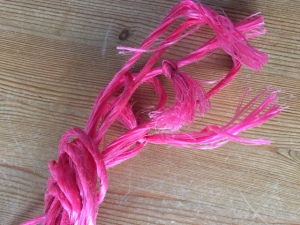
Synthetic baler twine: dropped by roadside ready-wound into a length to be used for an as yet unknown task

Down here you can find useful discarded lengths of it in the hedgerows, on the moors and in the fields. I’ve seen the multitude of uses to which it is put: holding a fence together; as a temporary gate-hinge; keeping a car-boot lid closed; as an improvised dog-lead; in birds’ nests and more crucially, holding up a farmer’s trousers. People collect it where it drops, saving it for a multitude of future unknown tasks. There is a kind of simple human optimism in this.

Here in Devon, local farmers have been completing the harvest, which includes baling and the generous distribution of baler twine to keep errant boot-lids down and trousers up. Recently they have been cutting moor grassland to use for animal bedding. The grass is cut and allowed to dry before being baled into cylinders for storage and I recently noticed a group of these, bound up in what looked like black and white stripes of baler twine. Only they weren’t, and it wasn’t.

I had a look up close to discover the ‘twine’ was actually a wide plastic mesh. It contracts widthwise when wound onto the bales under tension. I was intrigued by its structure and complexity, wondered who sat and designed it, where it is made, and whether its structure was solely suited to this one baling process. I started to research it online – and found it’s called bale netwrap and is sold by suppliers of agricultural bindings, such as good old baler twine. Not so useful in the trouser department, I suspect, and might be hazardous for birds that become caught up in it.

I have been moderately unfit for purpose myself recently, hence my lack of posts. Now I’m better and I have just completed teaching my final course of the year at West Dean, only to return with a heavy cold. Unfortunately I can think of no way in which baler twine will alleviate the symptoms.

My March 27th – 30th  2015  course Rhythm and Pattern is nearly full so if you want a place, contact West Dean as soon as possible. I will be teaching a further course from 17th – 19th July 2015.


2 Comments

Harvesting Japanese indigo

photo

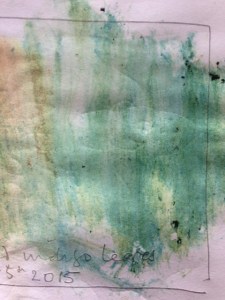
Blue stains which developed after rubbing Japanese indigo leaves onto paper

I planted out my Japanese indigo (Persicaria tinctoria) several weeks ago, having grown it all from seed. This week I picked some leaves and rubbed them on the page of my sketchbook to see if any blue appeared. It did (ignore the buff coloured stain to the left of the image, which is nothing to do with it). From this I knew that I could make a vat from the crop.

I began by picking half a bucketful and testing it as a small vat. I achieved a very good blue, which was used to overdue some cochineal-dyed scarves I had shibori-tied ready and waiting. You can see the result in the gallery below.

On the second vat I used a whole bucketful of leaves, rammed down hard. I just pick the tips, like tea: not the whole stalk. I sometimes weigh the leaves before processing but the material was wet after rain and there didn’t seem much point. I don’t always strip the leaves from stalks either, so a known dry weight is somewhat academic because the stalks don’t, as far as I know, produce any colouring matter.

On the day I dyed the second bucket I live-tweeted the various stages with images and received a good response. I think more and more people are trying to grow, and dye with, their own indigo.

With colleague Christina Chisholm I co-authored a piece on growing and using Japanese indigo for the Journal for Weavers, Spinners and Dyers in 2011. It was a free download and you can still access it here so I don’t have to write it all out again. We included some information on growing the plant in two distinct climates (Devon and north east Scotland). Christina has much more experience with dyeing wool, so fibre dyers might find her comments useful. If I were to be able to edit the article I’d make a couple of additions / amendments: 

1. I have since found that I don’t always see a blue froth when I whisk up the strained dye bath. Instead, the sherry-coloured liquid darkens and looks greener – but the froth is often colourless. Why? No idea. These days I have stopped using soda crystals and use washing soda instead. Maybe that’s the reason. 

2. I have found that leaves are often ready whether or not they have the red/blue tinge shown in the Journal download document. What I have heard since (but don’t know if it’s true) is that you need to use the leaves before the plant produces flowers.  

3. I try to encourage flowers for seeds each year and there is some urgency about this as in the UK the plants die with the first big frost. I mark a few vigorous stalks early on by tying a conspicuous ribbon round each one. Then I can’t pick them by mistake. I let these stalks develop flowers as early as possible.


Leave a comment

Summer schools…

No posting recently because I’ve had a month of intensive teaching followed by intensive feet-putting-up. I ran three courses at Ardington in Oxfordshire and then four days in Nether Stowey at the studio of Janet Phillips.

At Ardington School of Crafts I taught my synthetic dyes shibori day, plus two one-day (repeated) courses on natural dyes. The natural dye course is a taster to a fascinating subject with some practical work at the dyepots, but also intended as an eye-opener to textiles seen at a stately home, museum etc. It’s even relevant to looking at paintings: I often wonder what dyestuffs were used on garments represented (with pigments) in a historic portrait. We had to move fast, with all fibre and fabric pre-mordanted, and an indigo vat ready to go. Most students dyed a scarf using simple immersion methods. We used madder, weld, cochineal and two indigo vats (one weak, one strong).

At Nether Stowey, I taught a three-day-dye course to several of Janet’s graduates from her Masterclass.  On day one they learned some shibori folds using steam-fixed dyes; day two gave them a taster of wax resist, and day three was a full day with indigo. At the same time as I taught dyes, Janet was teaching ‘shibori on the loom’ to students from the London Guild. In this technique, removable weft threads are incorporated into the weaving. They are later used to draw up the cloth tight. According to how the shibori threads are woven, patterns emerge after the piece is dyed, then opened up.

Students used coloured and plain warps, on different pieces. Some of this shibori work was put into my indigo vat on day four; others used Janet’s fibre-reactive dyes which were applied by placing woven pieces into a short length of gutter (brilliant idea) and painting by hand.  I am used to folding, tying and clamping for indigo work and although I have seen loom shibori before, I haven’t watched the whole process from start to finish. A combination of enthusiastic and knowledgeable students,  Janet’s teaching and the imaginative arrangements made by Janet and Nigel made for a very enjoyable week. Did I mention glorious weather?


Many thanks to students at Ardington and Nether Stowey for permission to use images of their work.

Teaching in 2015

Dates of next years’ courses are accumulating. I will be tutoring two courses at the Association of Guilds of Weavers, Spinners and Dyers Summer School in August 2015 at Moreton Morrell. Details of the entire event can be seen here and there are details on this page.

I am teaching a new one-day introductory course in wax-resist at Ardington School of Crafts in 2015 as well as days on shibori scarves, indigo dyeing.  The Vibrant World of Natural Dyes proved very popular this year and I will be teaching it again in 2015: I have one course at West Dean scheduled for March. If you want to sign in, do so soon because my October course has been full since April.


2 Comments

Shibori: Caterpillar to Butterfly

DSCF6723

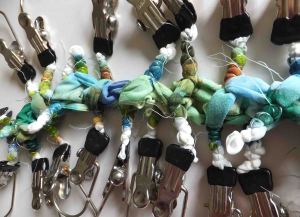
Work laid out during dyeing with individual twists held in position

A recent picture posted on Twitter gained me  more re-tweets, follows and favourites than I’ve ever had. I’d been excited to share a caterpillar-shaped tying-and-dyeing which emerged like a butterfly into unpicked daylight. I was using a new set of folds, twists and ties and had a feeling it was going to be successful. While working the piece (and others like it, as left) my studio dyeing area looked like an operating theatre, with clips and ties keeping twists weighted down, or held out of the way so that nothing bled together. Dyeing took me a long time, adding colours one-by-one with an eye-dropper. I then had to wait until it was completely dry before unpicking, which was like eyeing up an interesting-looking present under the Christmas Tree.

Unpicking was a forensic job where a seam-picker and total concentration was essential so I didn’t make an accidental hole in the fabric. I unpicked before steam-fixing, so I also had to keep the work bone dry.


After the work was unpicked, I had, with regret, to iron out the beautiful bumps and wrinkles. Work must go into the steamer rolled flat. Although steaming will help set wrinkles, it isn’t really an option for me. Strong wrinkles last only as long as the work remains dry and I plan to sell these pieces as wearable and washable scarves.

The silk was a georgette 8 (I tried using a 10, but the increased density left me with less interesting dye ‘migrations’). I use dental floss or tape for tying and the metal clips were from shopfitting suppliers Morplan. I think they are used for displaying pairs of socks…. but I use them for endless studio jobs. Morplan don’t still stock the ones I show at the top, above, but there is s similar design online. They are especially suited to work with dyes as the grips can be wiped clean.


Leave a comment

All in the Background

I’ve been working on a set of scarves in which the first layer of dye is more than usually vital. In layered wax-resist one works by blocking out, or outlining, existing dyed areas. This effectively ‘leaves them out’. One then adds more dye for the next layer of the design. This sequence of dye – wax – dye – wax can go on more or less indefinitely until there is no room left on the fabric, or the silk is saturated with dye and will take no more.

In this way the first layer of dye, if applied in a lively and varied way, can still work its magic when the silk is covered with several more layers. If wax outlines are used in a design, these, or the areas they define, will appear as interesting as the layer of dye they cover or isolate. This new design, which I’m calling Fish and Fowl, relies on lines, outlines and areas of lighter and dark tone.

I was teaching the principle last week at West Dean on my Brilliant with Pattern course: it’s hard to explain to students verbally and far easier by means of examples, demonstration and encouraging them to ‘have a go’ on experimental sample silk pieces.

My October course at West Dean is already full, but if you would like to learn the wax and dye technique along with some basic shibori, it’s worth adding your name to the waiting list. A further course is sometimes arranged if there are several people waiting.

Otherwise, I will be teaching Brilliant with Pattern at West Dean again at the end of March 2015.

If you want to book, look out for the Winter short courses programme which will be available from the West Dean website.


4 Comments

Brilliant with Pattern

Brilliant with Pattern is the title of a course I teach at West Dean College, and I’m off again tomorrow. The course always runs under this title, but I never tutor it the same way. It’s partly because I’d get bored teaching an identical course and so I take different ideas along, but also because the creativity of individual students infuses the group, making each outcome entirely different.

Preparation for these intense weekends is extensive, in terms of assembling boxes and general ‘stuff’, but also in the thinking about how I will approach them. This week I completed two days’ teaching at Ardington School of Crafts (see some images on Facebook here) and finished up with a visit to a friend in Oxford. She took me to see the recently completed courtyard of the Mathematical Institute.

There I saw the work of someone truly ‘brilliant with pattern’. Professor Sir Roger Penrose, mathematician and physicist, works at the Mathematical Institute and his brilliance shines on fields beyond my understanding. But his work on non-periodic tiling  (yes, I had to look it up too: try here for some assistance) is exhibited in the form of a pavement outside the entrance to the Mathematical Institute. It’s pattern: constructed, mathematical, non repeating, and compellingly beautiful. The steel, mirrored sections work especially well, reflecting sky, birds, or passers by.


On the same day I was able to spend a short time in the Pitt Rivers Museum, perhaps my favourite museum in the world. The newly-cleaned and restored glass roof of the Natural History Museum lit a path to the Pitt Rivers, which has no external public entrance. I know I will always discover something new in the Pitt Rivers: going there is like Christmas. This time it was a collection of resist-dyed eggs, the kind I wrote about in my previous post. The Pitt Rivers collection of these eggs was made at the turn of the 20th century in Galicia – not Spanish Galicia, but the one that is now part of  Poland and Ukraine.


Leave a comment

The Journal and a few bossy leaves

I’ve recently been up to London to the first Journal meeting of 2014. Whatever time of the year, this long day trip involves a very early start to drive to the station and travel up to London. We start at 11 am and the whole day, even lunch, forms a meeting to discuss Journal matters and plan forthcoming issues. On the chime of 4 pm the meeting ends and the room empties so swiftly you’d think we were all going to turn into pumpkins.  Members disappear to catch their trains – and occasionally, their planes. There is a great intensity to Journal meeting days, quite a few biscuits are eaten and sometimes it’s a bit frustrating. One has the day-long company of interesting textile-y people with whom one exchanges no more than a sentence or two of nothing-to-do-with-Journal conversation. But that’s the way it is. We are all volunteers giving time for a registered charity / organisation and we keep our expenses to a minimum: most of us are able to complete our round-trip to London within the day. If  you don’t know the Journal, have a look at the website.

Australian Journey: Leaves at Katherine

Australian Journey: Leaves at Katherine

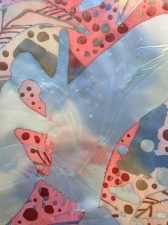
Back at home I have been working on a new piece of wax-resist work which started off with one idea in mind but was intruded on, in a most impolite and insistent way, by the shapes of eucalyptus leaves. The direction of the work (and my hand) changed totally. It’s weird when this happens and is, I assume, a luxury not open to certain types of craft work such as weaving, which require more advance planning.

I’m not sure whether the bossy leaves idea will work, but I have dewaxed the silk and it will go into the steamer this week, along with several shibori scarves of a – thankfully – more compliant nature. Then I will creep up on the leaf-piece and see if it’s any good.

This new work is part of the series I call Australian Journey because the designs are based on colours, shapes and ideas from our trip to Western Australia in 2012. There is a bit more about it here and you can find other posts and images by clicking the Australian Journey link in the tag cloud.


5 Comments

Some bits I like: shibori and wax

Extreme Ironing takes place at the start of making folded and clamped shibori and if I’m not in the mood, it can be tedious and exhausting. The next bit is great as it’s working with dyes, but the best is the Christmas Stocking moment of opening up each dyed scarf. That comes after the ironing, but before the steaming.

With wax it’s the other way round. You do the evil stuff after the creative work with wax and dyes is complete. There’s a lengthy sequence of de-waxing, steaming, cleaning and washing out residual wax, etc before the scarves are ready.

despatch

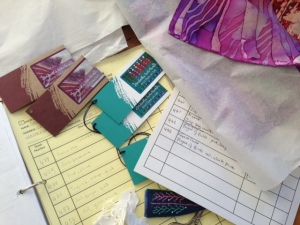
Labels, lists, tissue paper and scarves for despatch this morning

But however they are made, all scarves need a sewn-in label, a personal label / swing tag and a price tag with a stock number. My personal tags were designed for me by Chameleon Studio, a local Devon company. We chose recycled card and vegetable-based inks for the two types of label. I have one for natural-dyed and another for synthetic-dyed work; they look different but the design is related. On the left, you can see the two types of label. The buff label with plummy-coloured ink is the one I use for natural-dyed work. The full-colour image on an individual label is actually a sticker which I attach one by one. It was a brilliant idea of the designer’s to reduce costs on printing because sheets of sticky labels are much cheaper than full-colour printing on card. Once everything is labelled and listed for despatch to a shop or gallery there is always a list to fill out and a package to make up, followed by a trek down the hill to the local post office. Post-dog usually helps with this part of the process.

The latest batch of work has gone down to the Devon Guild of Craftsmen whose Christmas Show ‘Make 2013’ begins at the end of this week. It’s open daily from 10 am – 5.30 pm.