Isabella Whitworth

probably more than natural and synthetic dyes, wax, resists, and history


2 Comments

Year Ending

How long have I been dyeing? Not as long as I have been rubbish at maths. A recent experience, when I messed up percentage calculations of mordant, has reminded me how useful it is to keep records. (If you aren’t a dyer, these percentages refer to the mordant weight required against the fibre/fabric weight to be dyed).

My end-of-year project has been to test my Rubia cordifolia, or Indian Madder. I ordered it in the summer from KMA Exports of Tamil Nadu, but haven’t yet had time to use it. A week or so ago I mordanted two Merino wool scarves, calculating the mordant at  8% alum + 5% cream of tartar. Only it wasn’t: my notebook later confirmed I had mordanted at about 1% each. Results on the first set of dyeings were disappointing (it was a surprisingly good red, considering inadequate mordant, but certainly not eye-popping) so I checked out my notes and revealed the serious mistake.

At this dark end of the year I was hoping to dye the cheery Meltdown Orange achieved with Indian Madder on the Carmarthen Association Summer School Workshop, run by Deb Bamford, in 2013. In trying to convey Meltdown Orange on this blog, I hit a regular problem. Colour inaccuracies accrue between camera, screens and editing programmes. Obviously, colour portrayed via a screen isn’t going to look the same as the actual item, but my phone and camera come up with strange slants on reality which I often have to rectify when trying to pin down a ‘true’ colour. It can be vital if I’m working with a researcher or conservator, or a client who needs to know the exact colour of a scarf they propose to buy.

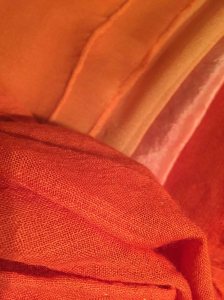
There are three images below. In the image of wool dyed with Rubia cordifolia from Carmarthen (image 1), the colour on my screen is as near as possible to the original yarn I hold up against it. That’s because I fiddled with the settings. I have no idea what you will see.

I had a nerdy idea. With the MyPANTONE app on my phone, I used a photo of the dyed yarn to see how MyPANTONE could analyse the colour range. Image 2 is a screenshot from MyPANTONE. By the time the image has cybered from the yarn to the phone to MyPANTONE to email to an editing programme to WordPress and the screen I see here, it seems that the image had shifted to something stronger and sharper. On the app itself, I had selected what I thought were three typical ‘hues’.  This is done in the same way as an ‘eyedropper’ is used to select colour on an editing programme. The colours I chose were Warm Red C, Pantone 179 C, and Pantone 171 C. They are shown at the bottom of the screenshot (image 2) and seemed a reasonable representation of Meltdown Orange seen through my own, and MyPANTONE’s, eyes.

From a former life in the graphics industry I retain a printed Pantone set of colours. I checked the MyPANTONE colours against my printed set and compared the yarn to each printed colour. Warm Red was ‘too red’, Pantone 179 was brownish and Pantone 171 too weak. But Pantone 172, one shift away from 171, was an accurate representation. This is shown in image 3.

I am not sure what any of that proves, except that colour is a tricky old business.
Silks and wool dyed with various strengths of Indian Madder (and correct mordant)

Silks and wool dyed with various strengths of Indian Madder (and correct mordant)

Reverting to the dyepot story, I repeated the dyeing with correct percentages of mordant and was rewarded by much sharper and more intense orange-reds, on silk and wool. As well as recording the mordant I kept notes on the percentage of dyestuff needed to achieve deep shades on the scarves and found it to be higher than expected – at about 20%. That’s one fifth of a weight, I shall remind myself. I’ll try to do the calculations better next time.

Links: My blog about buying Rubia cordifolia here.

KMA Exports

Deb Bamford (The Mulberry Dyer)

MyPANTONE (for iPhone)

MyPANTONE (for Android)
Pantone UK


5 Comments

A Scottish Post

I’m just home after a fortnight in Scotland, which started at the annual DHA (Dyes in History and Archaeology) conference at the University of Glasgow. I tend to know people by their research – and that’s how they know me. Someone at DHA greeted me as Mrs Orchil: she could also have hailed a Dr Indigo, a Ms Madder and Professor Purple. It’s a friendly conference attended by many world experts in the fields of dyes and pigments, but it welcomes independent scholars like me as well as dyers and textile makers.

I wasn’t giving a paper this year so it was an entirely stress-free conference and I sat back and enjoyed it, or at least, all the bits I understood. There are always some technical papers at DHA concerning dye analysis; the ones packed with acronyms, graphs and molecular structures streak comet-like above my head. But factual gems can lurk amongst figures and statistics, so it’s worth not totally tuning out.

I took a small ‘suitcase’ exhibition with me about orchil and my research studies; most delegates came to look at it and talk to me, and as a result I learned new things about orchil from new perspectives.

The conference tour, after two packed days of papers, took us to Glengoyne Distillery for a fortifying wee dram preceding a tour of the plant, and thence to Stirling Castle where we visited the Tapestry Studios to see the final piece in the Unicorn Series nearing completion.

Sherry and tannins

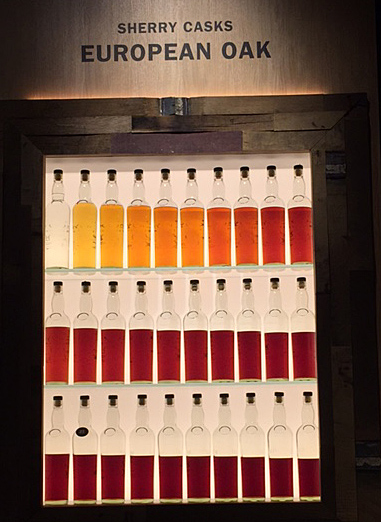
The Glengoyne tour outlined the lengthy procedure for ageing whisky in casks. Casks are made from different types of oak, but have once held sherry (and some, if I remember correctly, Bourbon). The ageing whisky gradually absorbs colour and flavour from the sherry, and the tannins in the oak cask. The two images above illustrate ageing over thirty years in two different types of cask, with coloration intensifying every year. Evaporation is also evident, with around half the liquid being lost over the period. This lost alcohol is called ‘The Angels’ Share’.

Textile Tweets

About the pictures

Above is a small selection of textile-related images from Scotland, most of which I tweeted during our trip. My obsession with dye lichens was rewarded by finding Ochrolechia tartarea alongside Loch Ewe, and Lobaria pulmonaria  at Oban; Parmelia saxatilis and P. omphalodes were growing at many locations.  Note: I was looking, not collecting. A Gaelic-English Dictionary in a hotel room confirmed that in Gaelic crotal refers to boiling water method lichens, but corcur to orchil lichens. If you want to know what orchil is, or read more about my research and views on dyeing with lichens, please visit this page.

Turkey Red

I spent a week with Deb Bamford (aka The Mulberry Dyer) learning how to dye Turkey Red at a Summer School in 2013. Read about it from this blog post forwards. In Scotland I found remnants of the Turkey Red industry buildings at Alexandria, on Levenside. There is a great website about the Turkey Red industry here. And read this wonderful book:

Colouring the Nation: The Turkey Red Printed Cotton Industry in Scotland c1840-1940 by Stana Nenadic and Sally Tuckett. Published by National Museums Scotland. From Amazon here.

Unicorn Series: Stirling Castle and West Dean Tapestries

For more on the Unicorn Series, go here for the Stirling Castle story, and here for West Dean’s version.

 Glengoyne Distillery, Dumgoyne Glengoyne Distillery


4 Comments

Oddments

photo

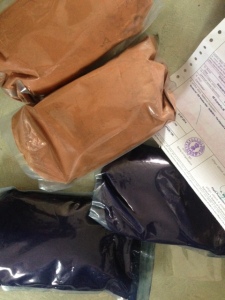
Packs of indigo and Rubia cordifolia, (Indian madder) shown with Phytosanitary Certificate

My latest excitement is today’s arrival of a parcel from India, containing indigo and Indian madder (Rubia cordifolia) from the excellent KMA Exports. I am sharing the consignment with a friend because the freight is expensive and costs more than the dyestuff, but it took just one day to arrive from Tamil Nadu. Sometimes a parcel takes longer from Okehampton. It would have been here earlier but import regulations into the UK now require fumigation which takes a bit longer; the Phytosanitary Certificate confirms that my consignment is free of Khapra beetle (Trogoderna granarium) and other quarantine pests.

Having tried Rubia cordifolia with Deb Bamford at Summer School last year I can’t wait to have another go. It produced the most astonishing colour on wool.

A highspot of recent weeks was a short trip to Finistère in Brittany, in the glorious weather also enjoyed in the UK that week. I enjoyed seeing fine examples of Breton embroidery, something about which I knew nothing, in the Musée Bigouden, Pont l’Abbé. There is an informative page about traditional Breton costume here from which I’ve learned a lot. You can see a photo of the embroiderers of Pont l’Abbé at the top of the page. Until I studied the caption I thought it was a very old photo, but it is dated to 1976, when I was about the age of some women in the picture. Perhaps that does make it a very old photo, come to think of it.

Several walks along the coast west of Douarnenez offered stunning views over the sea and as always, I was on the lookout for lichen. I don’t collect it, but I like to find it; my views on actually using lichen for dyeing are here. A knowledgeable colleague has told me that one of my images probably shows an orchil lichen, one of the Roccellae, which cheers me up now I’m back and the weather has changed.

The historic cork floats and netting tools, which I found rather beautiful, were in the window of shop selling fish in Audièrne. Without a given explanation, I must assume the carved names once indicated owners of nets. When I lived on the west coast of Scotland I remember several vitriolic exchanges over ownership of creels, buoys and nets. This appears to be a simple way of marking equipment.


I’m teaching three courses at Ardington School of Crafts from Wednesday. Natural dyes on Wednesday 9th and Thursday 10th, and shibori with synthetic dyes on Friday 11th. If you’re coming, I look forward to seeing you there.


7 Comments

Pysanky and a kystka

On the recent Brilliant with Pattern course at West Dean one of my students had brought along something unusual. It was an Eastern European kystka. These small tools for applying hot wax are used, particularly in Ukraine, for the decoration of Easter eggs known as pysanky. I’d heard of a kystka but never seen one and until I started to research today’s post I knew nothing of the pysanky tradition. Wikipedia has a page on it here; it is a full and fascinating read which explains symbolism in the colours, the motifs and the actual giving of the eggs. It describes the ancient heritage of the craft, how patterns and methods were handed from mother to daughter, and the tools used. The list of pysanka recipients each Easter is especially interesting, revealing ‘life priorities’ of the givers. It includes a gift to the beehive, and eggs to the graves of deceased family members.

A list of natural dyes in traditional pysanky includes familiar names, such as alder buckthorn (Rhamnus frangula), Dyer’s Broom (Genista tinctoria) and green walnut husks from Juglans nigra. The Wiki article introduced me to two new words in the language of symbols: scevomorphic and cosmomorphic. To find out what they mean, follow those links to a website about pysanka tradition.

And in case you’re wondering how to pronounce pysanky, this is what the pysanky website says:

Despite what you may have heard on the Food Network or in a local class, ‘Pysanka’ is pronounced ‘PIH-sahn-kah’  (with the plural ‘pih-sahn-KIH’),  with all short vowels.  The term ‘pysanky’ is not, never was, nor will it ever be correctly pronounced ‘pie-SAN-kee’!!!!


My West Dean student (not the lady in the image above!) showed me how she uses her kystka on silk fabric. I was impressed because it was clear that the tool adapts well to applying fine lines to fabric and it doesn’t drip. I have never felt wholly at ease with a tjanting, although it produces beautiful fine lines in expert hands. The reservoir and spout of the kystka is made of brass but looks similar to the ‘rotring-style’ heads I used to use to apply spirit-based gutta resist in pre-wax days. The reservoir is small and the hot wax would soon run out, but one can adapt to this. I am wondering if I could improvise my old, now-unused gutta nibs into home-made kystkas. But brass may be a preferable metal with hot wax than steel ‘rotring’ nibs and I’ll have to try it out.


A greeting to Ukraine  This post sends a special greeting to L, a reader in Ukraine, who has been a regular visitor to my blog until all the current distractions. I send warmest spring and Easter wishes at a time of continuing anxiety.

Update: a reply from Ukraine I had a reply from my reader L, recalling their grandmother using onion skin dyes to make krashanky, which are one-colour-dyed eggs. The skins were collected well in advance of Easter so that there were enough to make deeper colours. In Ukraine, the kystka is called a pysachok.  My Ukrainian correspondent also recommended a great website here. Teresa Mihalko Harbert is The Real Thing when it comes to decorating eggs and the Trypillian culture, which provides some of her inspiration, a source of some superb patterns. Thank you L.


Acknowledgments: The image of Olga Kryway is by Robert L. Stone from the State Archives of Florida which allows reproduction for educational use. Florida Memory, http://floridamemory.com/items/show/108313

Thanks also to R for allowing me to reproduce an image of her family’s beautiful collection of decorated eggs and to A for the generous gift of a kystka.


8 Comments

It’s all gone a bit Rumsfeld..

“… there are known knowns; there are things we know that we know.
There are known unknowns; that is to say, there are things that we now know we don’t know. But there are also unknown unknowns – there are things we do not know we don’t know.” 

United States Secretary of Defence, Donald Rumsfeld, 2002 


With the Christmas break just round the corner I know that if I don’t hit certain things right now it will be endlessly harder to pick them up in the New Year. So I have stopped making new work (see above) and am  organising the references for my co-authored DHA paper.

I am into Harvard References. I don’t have an academic background but occasionally I stray into Dark Territory and have to abide by the mighty rules, one of which is correct referencing. Writing up the DHA paper has meant revisiting texts read and absorbed maybe five years back. I have been favoured with a good memory and this means I sometimes remember very well that I know something, but don’t remember how or why. If I recognised the need to know at time of reading I will have taken a note of a source.  But as is the way with research, sometimes I don’t always know the relevance of a fact or a comment until a few years down the line. Then it can become vital – and that’s when it all goes a bit Rumsfeld.

So to his much lampooned statement (which I have always felt is more sane than many suppose) I’d add the following:

“… there are known knowns; there are things we know that we know. We just don’t know where we read them…”

And I recommend the University of Exeter’s helpful online resource here.


8 Comments

Head-switching

I’m crunching a lot of words these days. As a voluntary editor for the Journal of Weavers, Spinners and Dyers I normally spend at least part of my day reading and commenting on articles, corresponding with authors, checking facts and figures, proofreading or generally nitpicking. I happen to care about commas, colons and how to spell practise. (If it’s a verb, use an ‘s’. That’s if you’re British).

Writing up part of the co-authored DHA paper from La Rochelle (see previous post) is also a priority and it’s a lengthy task which may stretch to several thousand words.

My main computer is in the studio and it’s here that Journal, editorial and some research work happens. The studio is also where I keep dyes, brushes, wax pots, frames and silks. Theoretically it’s the place I make things too – but studio work has suffered heavily over the past months from the quantity of research and editorial commitments.  I consider everything I do absorbing, but there is only one of me.  And there’s the question of changing heads.

From art college training I realised, and perhaps learned, the intense concentration needed to draw or paint. If I have to interrupt work on a drawing or experimental textile, creative thought-trains chuff-chuff deep into irretrievable tunnels by the time I get back, and I lose the metaphorical plot, as has this sentence. Essentially, I find it intensely frustrating to be interrupted when I’m working on something new.

With an established design, it isn’t so difficult as it’s only half new. Sometimes I can change heads from the particular analytical demands of editing, and work on a  textile. I know what I’m aiming at, and although each textile is unique it’s like being guided by written music. Instructions have been established; technique and interpretation are what matter.

This week I’ve been constantly switching heads. I’ve been editing articles on shipwreck dye cargoes, medieval woad vats, or working on the history of a Leeds dye manufacturer: then I migrate two metres to wax pot, silk, frames, dyes and an established design theme. In three paces I unscrew Nitpick Ed-Head and replace it with Agent Zig-Zag. Zig-Zag, because that’s the design I’m working on this week.

I can’t always do this head-switching lark. I can’t always manage to ban the activity I’m not doing from my thoughts, and then nothing works at all. But this week it’s going OK.


2 Comments

French Connections

I’m back from a trip to the DHA (Dyes in History and Archaeology) Conference in La Rochelle. La Rochelle hosted the ISEND Conference in 2011 and so I was already familiar with the conference venue – a former fishmarket, now the exhibition and conference centre  L’espace Encan.

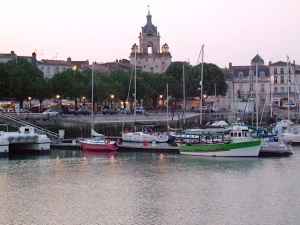
This is a text-heavy post, so here’s a picture of La Rochelle to keep you going.

LaRochelle

La Rochelle

A DHA conference annually attracts a wide variety of delegates from various disciplines. This year there were about 90 of us. Our number included chemists, conservators, artists, historians, researchers working with natural dyes, and students at various academic levels. At a DHA conference you can find yourself sitting next to someone from the British Museum, the Louvre or the Rijksmuseum, or an independent scholar who is simply passionate about parchment. It is a friendly assembly and all are welcome. Even if, as a non-chemist, you sometimes sit boggle-eyed through muscular technical papers full of graphs, analysis and molecular data, there is always something to be learned. I’m told that in early DHA days (this was the 32nd meeting!) there was a heavy bias towards these more scientific analytical papers but that nowadays the balance is more even, with a good mix of historic /scientific presentations. The selection committee who choose proposed papers must have an intensely hard job. Of the 24 or so papers accepted, several intrigued me but as none have yet been published this handful of comments remains general.

Purple Parchments

One paper involved the analysis of  purple-dyed parchments. Very little work has been done to analyse the source of the purple colour in such codices and as far as I understand, there is currently no scientific evidence that shellfish dyes were used on the parchments. Non-invasive methods are normally used in their analysis, essential if precious manuscripts are to be studied without damage, and these methods can make it more difficult to identify dyestuffs. (With a parchment it isn’t so easy to remove a physical sample as it can be from a textile, where a loose fibre may be available).

There was a mention of dyeing parchment with orchil, and my ears twitched. Last year I was asked to dye some parchment samples with orchil – and dye they certainly did. But it was apparent that the temperatures and immersion involved in dyeing with orchil stiffened and damaged the parchment quality. I felt that this method wasn’t viable. Cold-dyeing seemed to yield a more sympathetic result but I have no idea to what extent the parchment quality was affected as I was only sent miniscule pieces of parchment to dye.

In the post-presentation question session it emerged that the term ‘dyeing’ means different things to different people. Some delegates considered ‘dyeing’ could be the layered painting on of dye and not dyeing by immersion, as working dyers think of it. Now, I should say that I tried painting orchil on too, but soon lost the will to live. It would be immensely protracted to paint on sufficient orchil to build up a good colour. That’s not to say it would be impossible, I just didn’t have the time or the resources to continue.

It will be interesting to learn more about this research. Maybe at Glasgow and DHA 33 next year? The dates are October 30th – 31st 2014.

Shearings and Clippings

Magnified images had been studied by the presenters which showed lumpy-looking particles in the red lake used in several medieval paintings. These indicated that they were reclaimed dyes from red-dyed wool, made into lakes for painting. The reclaiming of red lake pigment dyestuffs from clippings of dyed wool revealed that it made good economic sense to extract the dyes and to reuse them as painting materials. The dyeing of red, from whichever dye source, was expensive and thus waste material might be reprocessed. Again, I encountered problems with a mutual understanding. Initially I was confused by the words ‘shearings and clippings’ which were used by the presenters. I associate these words primarily with sheep-shearing!  In the paper the words referred to waste dyed cloth after cutting woven material – or yarn.

The finding of these ‘reclaimed reds’ isn’t in itself new. A 1996 paper by Jo Kirby and Raymond White goes into great detail (find it here) and also lists a  number of paintings in which red lake pigment dyestuffs have been found. Have a look. You may be amazed.

Networking

A couple of years ago, at DHA in Lisbon, I presented a paper about the trade in dye lichens from Angola through Lisbon. I have yet to publish this, for several complicated reasons. But I had an interesting conversation with another delegate which led me to sending a very small quantity of dye lichen and a recipe to the University of Évora. I heard no more, and forgot all about it. At La Rochelle my Portuguese colleague and  her team presented a paper in which they had measured and tracked the breakdown of the depsides and depsidones (the dye precursors) in the orchil preparation process until purple chromophores formed. Chromophores are the part of the molecule responsible for colour. The chemistry was patiently explained to me in a coffee break and I now understand rather more about the process that before – although I wouldn’t like to take an exam just yet. DHA is great for this kind of contact and co-operation.

DHA=GFZ: A Gremlin Free Zone

If you read the previous post you will now that I was co-presenting a paper at DHA 32  and I wrote about the snaggly-toothed IT gremlins that lurk for unprepared presenters. I am pleased to report that my eminent co-author, Zvi Koren, had done an admirable job on gremlin-bashing (he’s ace at puns too) and everything loaded and presented totally as expected. So did everyone else’s, and we all benefited from calm, unobtrusive technical expertise delivered by Florent Glatard of ARRDH- CRITT Horticole. Our presentation was really well-received but I will not be writing about it until formal publication.

Thanks to DHA 32 organisers Anne de la Sayette and Dominique Cardon

Anne de la Sayette is the Directrice of ARRDHOR – CRITT Horticole, a ‘centre of research, innovation and technology transfer in horticulture’. Dominique Cardon is well known to most natural dyers as author of Natural Dyes: Sources, Tradition, Technology and Science. She is also Emerita Senior Researcher at CNRS, the French national centre of scientific research. CIHAM UMR 5648 CNRS  (an institution, not a mathematical  equation..)  is one of the most important research centres in France for history, literature and archaeology of the Middle Ages. A new book by Dominique is about to be published but I don’t have the details: as soon as I do I will add them to a post.

Carnac

If you have got this far you deserve a pictorial prize. Using photos from DHA is tricky as I feel I should ask people’s permission before posting their images on a blog, so here is something rather special from the trip home.

I had never been to Carnac in Brittany until last week and I had no idea of the scale and breadth of the entire site. But it seemed most serendipitous to discover, on some stones of the alignments, a quantity of orchil lichen. Naturally, I did not touch it. But here are some images to reward stalwart readers. The orchil lichen is in the left hand image only.


8 Comments

Reasons to be Stressful

Presentations

I’m halfway between two presentations. The first was for the 6 Guilds of Weavers, Spinners and Dyers at Stratford where I spoke about orchil and how the trade in lichen dyestuff reached global proportions in the late nineteenth century. I thoroughly enjoyed my day at Stratford which included a talk by co-speaker Joan Baxter on the way the East Sutherland landscape influences her tapestries. Her recent collaborative work with dancers Between the Web and the Loom was interesting and she showed some video clips. But I can’t find any images on the internet to provide a link beyond this one (about the dance) and this one (about the tapestry she wove).

The second presentation is for the Dyes in History and Archaeology Conference (DHA) in La Rochelle, France. That’s later this week, is about something else entirely, and it’s going to be rather sensational.

Friday 4th October

11:45          Treasures from a Leeds Dye Chemist: A Century-Old “Tyrian Purple”?

                   Isabella Whitworth, Zvi C. Koren

If you want to know more about the sensational, come to La Rochelle. Otherwise, I’m sorry, you may have to wait a little. To download the whole DHA La Rochelle programme, visit this page and follow the links at the bottom.

For the moment, here is a taster in the form of some images. You will see two men, both chemists. There is a brother and a sister, and the son of a famous father.

Lectures and technology

Those who are of ‘a certain age’ will remember that one of the worst things that could happen when giving a lecture was that you dropped all the slides just prior to going on stage then reloaded them upside down, in the wrong order and back to front.

Technology wasn’t satisfied with such piffling levels of stress. So it created Macs and PCs and system updates; memory sticks and SD cards and PowerPoint and embedding. It now arranges that hosts provide an ancient laptop unable to read anything post 1910;  it organises missing leads, the wrong leads, deflating batteries, clickers that die, videos that won’t load and projectors which will have nothing to do with your laptop.

I have watched entirely respectable speakers show a presentation devoid of images because they haven’t checked their Mac presentation on a PC – or haven’t embedded their photos.

As a result I am obsessive about options. At the 6 Guilds event I took my own Mac laptop, own projector, requisite leads plus a boggling array of memory sticks and SD cards correctly formatted and checked out on a neighbour’s PC. In fact, the options proved unnecessary as the 6 Guilds laptop was up-to-date, the memory stick loaded, and two super-calm techies were in control.

For DHA, all presentations have to be sent in advance of the Conference which is good sense – in theory. You will be informed that something has arrived, but you still don’t know if the presentation shows exactly the way you designed it. So, when you get there, you need to check – and have some options up your sleeve. I didn’t do the DHA PowerPoint: my co-author did, for which I am deeply grateful. It can all be his fault.


Leave a comment

Talking Orchil

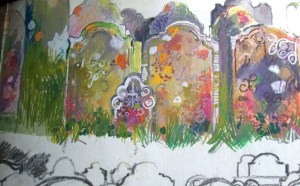
Canterbury graveyard, 1960s sketchbook

Lichens in a Canterbury graveyard: from my 1960s sketchbook

In my last post I started to write about orchil, and how I became fascinated by its story through my researches on an eighteenth / nineteenth century Wood & Bedford / Yorkshire Chemicals archive.

To start at the beginning, orchil (pronounced or-kil) comes from lichens. It has been used for millennia to dye wool and silk a purple colour. There is some confusion over ancient recipes for purple. It isn’t always possible to decipher which recipes refer to lichen and which to shellfish dyes. Both dyestuffs produce a remarkably similar colour, were to be found in the same areas (e.g. the Mediterranean coast) and descriptions of lichen are often a little vague. For instance, dyestuff might be referred to as a plant, or a moss, or a seaweed.

There is evidence (Pliny, Theophrastus, Dioscorides) that orchil was used in conjunction with shellfish purple and it’s a ready assumption that this was done  to defraud – which of course it may have been. The processing of orchil would have been significantly cheaper than for shellfish dye. But the combination was also undertaken to produce a legitimately cheaper alternative to pure shellfish-dyed cloth. Nevertheless, orchil and shellfish-dyed cloth seems regarded with disdain because of the great and unique reputation of shellfish purple, and orchil’s tendency to fade.

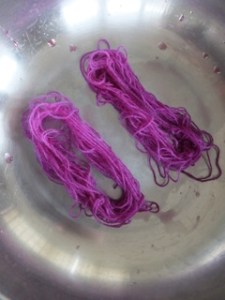
The beauty of fresh orchil on woollen yarn

The beauty of fresh orchil on woollen yarn

Orchil dye is extremely beautiful in its first, fresh bloom of colour but it normally proceeds to fade fast. It is therefore interesting to read a 2012 paper (link below) in which Casselman and Terada demonstrated that a combination of orchil and shellfish dye may in certain circumstances, stabilise the orchil. They also reported that the  use of orchil as a base dye would to some extent neutralise the intensely unpleasant odour of shellfish-dyed cloth. Those facts cast an entirely different light on the historic combination of orchil and shellfish dye.

It occurs to me that in more recent days, far from being ‘poor man’s purple’, orchil could have been considered a great luxury. If you could afford the rich glories of orchil-dyed silk, and these would be obvious to all by the colour, it might indicate one’s financial indifference to fading and the realities of a soon-spoiled garment.

Dye lichens

Not all lichens will dye, not all dye lichens will make orchil. Orchil-producing lichens (and there are innumerable species) contain precursors of the dye and to make this available the dyestuff must be crushed in ammonia or stale urine and water and then kept well-oxygenated. It undergoes a type of fermentation, and the purple colour develops over several weeks.

Orchil is very sensitive to changes in pH and by adjusting vat strength and acidity, a wide variety of colours can be achieved, ranging from browny reds to reds, pinks and purples.

Crotal / crottles

There are lichens that will dye rusty reds, browns and golds. They are often referred to as ‘crotal’, (a Gaelic word) or crottle, lichen. These require no fermentation and are normally boiled up together with fibre, yarn or cloth. They have been in traditional use in Scotland for centuries and the warm, earthy smell of crotal-dyed yarn is also a moth deterrent. But crotals are not orchils!

Mordants

Neither orchil nor crotal requires a mordant although some historical recipes recommend an alum mordant for orchil.


The Wood & Bedford Orchil Story

I found a vast number of items in the archive which related to the nineteenth and twentieth century trade in orchil. A couple of them can be seen in the previous post. The records defined several sources of orchil lichen. Around 1830 these included Scandinavia, Sardinia, the Azores, Madeira,  the Canary Islands and Cape Verde. Political changes and colonial interests affected trading in the later 1800s, as did the slave trade and, eventually, its abolition. A picture emerged of a voracious trade that reached an industrial and even global scale by the mid nineteenth century. There is a certain irony in the fact that stocks of what, in effect, is a non-renewable product were saved by the synthesis of mauveine by Perkin in 1856. The demand for lichen then dropped. Nevertheless, Wood & Bedford,  later the Yorkshire Dyeware and Chemical Company, continued to buy and process orchil lichen well into the twentieth century. I understand that the last unused lichen stocks went to Johnsons of Hendon who presumably used lichen to make their indicator papers.

Lichen ethics

You will see that I have learned to make orchil and to dye samples for research purposes but I don’t use it in my studio work. You can read some of my thoughts on lichen use here. I am extremely grateful to all those who taught me about making orchil and how to dye with it.

Pronunciation

How do you pronounce lichens? I say it to rhyme with kitchens. Most people and academics (ok, sorry, academics are also people)  say ‘likens’. The OED pronunciation makes it official: you can say it either way:
/ˈlʌɪk(ə)n, ˈlɪtʃ(ə)n/

References:

The Politics of Purple: Dyes from Shellfish and Lichens Karen Diadick Casselman and Takako Terada

Natural Dyes: Sources, Tradition, Technology and Science; Dominique Cardon, Archetype Publications

The Colourful Past: Origins, Chemistry and Identification of Natural Dyestuffs; Judith H. Hofenk de Graaff, Archetype Publications

Lichen Dyes: The New Sourcebook and Craft of the Dyer by Karen Diadick / Leigh Casselman


18 Comments

Dyes, history, and a chilly trip to Yorkshire

About five years ago life veered off in a new and unexpected direction.

My neighbours asked me to look at a dye-related company archive they were liberating from their attic. They were selling their house, thought they had a ‘firm offer’ and there wasn’t a lot of time.  There would be no space for the archive in their new home and I offered to rescue anything important from its potential new resting place – an unconverted stone barn. I imagined I’d see a small, disparate heap of documents and books descend the attic stairs with little supporting contextual information;  honestly, I did wonder how interesting that might be.  Because I knew a little about dyes I hoped to advise my neighbours if anyone would be interested in any of the collection before it made its acquaintance with the barn.

Six weeks later (the ‘firm offer’ wasn’t) I had opened and listed the contents of dozens of boxes and trunks containing documents, books, ledgers, patents, dye samples, photographs, letters, diaries, Minutes, catalogues, invoices, plans, maps, contracts, botanical samples, watercolours, chemicals, medals and awards….   and even a mousetrap, devoid of mouse.

Are you beginning to get the idea? Neither disparate, nor without context.

This is some of what I initially learned. The archive had been handed down through my neighbour’s family. He is a direct descendant (the great-great grandson) of a chemist called James Bedford who was born in  1795 and apprenticed to a chemist and druggist in Briggate, Leeds, in 1810.  James Bedford was the first in a descending series of three James’, all of whom worked in the family business, which started its life as Wood & Bedford. The same company, though it amalgamated with others and changed names, never underwent a takeover and occupied the same premises in Leeds, on Kirkstall Road, until it went into administration in 2004. It was by then the internationally-known Yorkshire Chemicals.

The Wood & Bedford / Yorkshire Chemicals archive was largely assembled in the early twentieth century by the third of the James’, although it included material from the early 1800s. There was little after 1945 as later material was largely retained by the company and not kept within the family. I published an article in the Journal for Weavers, Spinners and Dyers in 2008 (it can still be downloaded here) which gives a summary of the early days of my research. I was amazed to discover that, contrary to what I had read and often heard, the use of natural dyes persisted long after 1856 when mauveine was discovered by the young William Henry Perkin. Logwood, orchil lichen and various tannins featured in the archive well into the twentieth century, although the company also worked successfully on the development of synthetic dyes.

It’s hard to pin down why I became particularly intrigued by the orchil trade, but an early 1800s dyers’ notebook (there’s a page shown above) certainly helped. My orchil-dyed path, proceeding from the heap of rusty trunks, has since led me to Galicia in Spain, to Posnan in Poland, to Leeds, Lisbon and to Ecuador. In October it’s taking me to La Rochelle, and last week it took me back to Yorkshire. I will be giving a talk on the orchil trade to the ‘6 Guilds’ group of Weavers, Spinners and Dyers at the end of this month in Stratford; at DHA (Dyes in History and Archaeology) in La Rochelle in October I am delivering a joint research paper with Professor Zvi Koren on samples labelled ‘Tyrian Purple’. I can’t say any more about those until after the event – or I would have to leap through the screen and kill you. It’s Classified.

Yorkshire Grit

The Wood & Bedford / YC archive has been accepted by the West Yorkshire Archive Service (WYAS) through the generosity of my one-time neighbours; a ‘firm offer’ did eventually materialise. So the collection has gone back to Leeds where it belongs. WYAS were excited by the fact that the archive covered long periods of the same company’s history. It isn’t yet available for study as archiving is being undertaken by a dye chemist; through a coincidental set of circumstances I was put in touch with a large group of ex-employees of Yorkshire Chemicals (YC), of which he is one. This contact led to my giving ex YC employees several presentations as they knew nothing about Wood & Bedford’s beginnings. Most professed great affection for their time at YC, and one referred to it as ‘the best days of my working life’.

A (sadly) dwindling band of ageing YC folk meet up from time to time and I sometimes join them for the annual outdoor charity Band Concert given by the Elland Silver Youth Band. That’s why I have just been back to Yorkshire. The rest of the country sweltered in tropical heat, but Halifax wasn’t having that. It was practising Yorkshire Winter. The wind Heathcliffed down from the moors with such enthusiasm that tents and gazebos couldn’t be put up to protect the young Band members – who played valiantly in shirtsleeves. A knocky-kneed and freezing set of ex YC attendees cowered under woolly blankets and discussed cryogenic concerts. There’s nout like Yorkshire Grit.

I’ll be writing more about the archive in future blogs, once I thaw out.

Farfield Mill

Some years ago when Farfield Mill reopened as an arts centre, I used to sell work there but I have never visited until this week. The impressive Mill centre is set on four floors which include exhibition spaces, a retail area, the best second-hand textiles bookshop ever, a historical display about wool, weaving and knitting  and small workshop / display units. A large industrial working loom weaves blankets and throws next to the Weavers Café – a refuelling stop after the rigours of viewing everything at Farfield. I enjoyed seeing but particularly, handling, Laura Rosenzweig’s Howgill Range which I have only read about in the Journal  (issue 243).  As Laura’s Loom, Laura runs one of the work and display units. With my next Yorkshire concert in mind, I bought a Shetland wool hat from Angela Bradley‘s shop.

On the top floor we found a welcoming group of weavers, some of whom I know through the Online Guild. They had a variety of looms and equipment on show and in use, and were clearly a valuable asset offering explanations to visitors, many of whom, it seems, don’t know the difference between weaving and knitting.