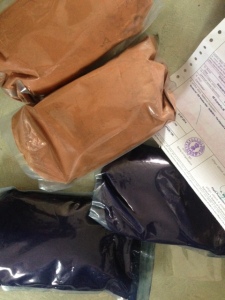
Packs of indigo and Rubia cordifolia, (Indian madder) shown with Phytosanitary Certificate
My latest excitement is today’s arrival of a parcel from India, containing indigo and Indian madder (Rubia cordifolia) from the excellent KMA Exports. I am sharing the consignment with a friend because the freight is expensive and costs more than the dyestuff, but it took just one day to arrive from Tamil Nadu. Sometimes a parcel takes longer from Okehampton. It would have been here earlier but import regulations into the UK now require fumigation which takes a bit longer; the Phytosanitary Certificate confirms that my consignment is free of Khapra beetle (Trogoderna granarium) and other quarantine pests.
Having tried Rubia cordifolia with Deb Bamford at Summer School last year I can’t wait to have another go. It produced the most astonishing colour on wool.
A highspot of recent weeks was a short trip to Finistère in Brittany, in the glorious weather also enjoyed in the UK that week. I enjoyed seeing fine examples of Breton embroidery, something about which I knew nothing, in the Musée Bigouden, Pont l’Abbé. There is an informative page about traditional Breton costume here from which I’ve learned a lot. You can see a photo of the embroiderers of Pont l’Abbé at the top of the page. Until I studied the caption I thought it was a very old photo, but it is dated to 1976, when I was about the age of some women in the picture. Perhaps that does make it a very old photo, come to think of it.
Several walks along the coast west of Douarnenez offered stunning views over the sea and as always, I was on the lookout for lichen. I don’t collect it, but I like to find it; my views on actually using lichen for dyeing are here. A knowledgeable colleague has told me that one of my images probably shows an orchil lichen, one of the Roccellae, which cheers me up now I’m back and the weather has changed.
The historic cork floats and netting tools, which I found rather beautiful, were in the window of shop selling fish in Audièrne. Without a given explanation, I must assume the carved names once indicated owners of nets. When I lived on the west coast of Scotland I remember several vitriolic exchanges over ownership of creels, buoys and nets. This appears to be a simple way of marking equipment.
Embroidery, Pont l’Abbé
Corks and netting tools, Audièrne
Orchil lichen?
I’m teaching three courses at Ardington School of Crafts from Wednesday. Natural dyes on Wednesday 9th and Thursday 10th, and shibori with synthetic dyes on Friday 11th. If you’re coming, I look forward to seeing you there.
Work laid out during dyeing with individual twists held in position
A recent picture posted on Twitter gained me more re-tweets, follows and favourites than I’ve ever had. I’d been excited to share a caterpillar-shaped tying-and-dyeing which emerged like a butterfly into unpicked daylight. I was using a new set of folds, twists and ties and had a feeling it was going to be successful. While working the piece (and others like it, as left) my studio dyeing area looked like an operating theatre, with clips and ties keeping twists weighted down, or held out of the way so that nothing bled together. Dyeing took me a long time, adding colours one-by-one with an eye-dropper. I then had to wait until it was completely dry before unpicking, which was like eyeing up an interesting-looking present under the Christmas Tree.
Unpicking was a forensic job where a seam-picker and total concentration was essential so I didn’t make an accidental hole in the fabric. I unpicked before steam-fixing, so I also had to keep the work bone dry.
Tied and dyed
Detail of ties
Forensic surgery
Caterpillar to Butterfly
After the work was unpicked, I had, with regret, to iron out the beautiful bumps and wrinkles. Work must go into the steamer rolled flat. Although steaming will help set wrinkles, it isn’t really an option for me. Strong wrinkles last only as long as the work remains dry and I plan to sell these pieces as wearable and washable scarves.
The silk was a georgette 8 (I tried using a 10, but the increased density left me with less interesting dye ‘migrations’). I use dental floss or tape for tying and the metal clips were from shopfitting suppliers Morplan. I think they are used for displaying pairs of socks…. but I use them for endless studio jobs. Morplan don’t still stock the ones I show at the top, above, but there is s similar design online. They are especially suited to work with dyes as the grips can be wiped clean.
I’ve been working on a set of scarves in which the first layer of dye is more than usually vital. In layered wax-resist one works by blocking out, or outlining, existing dyed areas. This effectively ‘leaves them out’. One then adds more dye for the next layer of the design. This sequence of dye – wax – dye – wax can go on more or less indefinitely until there is no room left on the fabric, or the silk is saturated with dye and will take no more.
In this way the first layer of dye, if applied in a lively and varied way, can still work its magic when the silk is covered with several more layers. If wax outlines are used in a design, these, or the areas they define, will appear as interesting as the layer of dye they cover or isolate. This new design, which I’m calling Fish and Fowl, relies on lines, outlines and areas of lighter and dark tone.
Two frames with first-layer dye plus finished scarf
First layer wax on first layer dye
Work in progress: second layer dye
Detail, finished work
I was teaching the principle last week at West Dean on my Brilliant with Pattern course: it’s hard to explain to students verbally and far easier by means of examples, demonstration and encouraging them to ‘have a go’ on experimental sample silk pieces.
Student’s work, showing colour shift of under-dye from pink to yellow.
Student’s work showing build up of dye and wax
My October course at West Dean is already full, but if you would like to learn the wax and dye technique along with some basic shibori, it’s worth adding your name to the waiting list. A further course is sometimes arranged if there are several people waiting.
Otherwise, I will be teaching Brilliant with Pattern at West Dean again at the end of March 2015.
If you want to book, look out for the Winter short courses programme which will be available from the West Dean website.
Brilliant with Pattern is the title of a course I teach at West Dean College, and I’m off again tomorrow. The course always runs under this title, but I never tutor it the same way. It’s partly because I’d get bored teaching an identical course and so I take different ideas along, but also because the creativity of individual students infuses the group, making each outcome entirely different.
Preparation for these intense weekends is extensive, in terms of assembling boxes and general ‘stuff’, but also in the thinking about how I will approach them. This week I completed two days’ teaching at Ardington School of Crafts (see some images on Facebook here) and finished up with a visit to a friend in Oxford. She took me to see the recently completed courtyard of the Mathematical Institute.
There I saw the work of someone truly ‘brilliant with pattern’. Professor Sir Roger Penrose, mathematician and physicist, works at the Mathematical Institute and his brilliance shines on fields beyond my understanding. But his work on non-periodic tiling (yes, I had to look it up too: try here for some assistance) is exhibited in the form of a pavement outside the entrance to the Mathematical Institute. It’s pattern: constructed, mathematical, non repeating, and compellingly beautiful. The steel, mirrored sections work especially well, reflecting sky, birds, or passers by.
Penrose tiling, Mathematical Institute, Oxford
Entrance to Mathematical Institute, Oxford
View of the Natural History Museum, Oxford
Resist-dyed egg, Pitt Rivers Museum. Galicia (Poland /Ukraine)
On the same day I was able to spend a short time in the Pitt Rivers Museum, perhaps my favourite museum in the world. The newly-cleaned and restored glass roof of the Natural History Museum lit a path to the Pitt Rivers, which has no external public entrance. I know I will always discover something new in the Pitt Rivers: going there is like Christmas. This time it was a collection of resist-dyed eggs, the kind I wrote about in my previous post. The Pitt Rivers collection of these eggs was made at the turn of the 20th century in Galicia – not Spanish Galicia, but the one that is now part of Poland and Ukraine.
On the recent Brilliant with Pattern course at West Dean one of my students had brought along something unusual. It was an Eastern European kystka. These small tools for applying hot wax are used, particularly in Ukraine, for the decoration of Easter eggs known as pysanky. I’d heard of a kystka but never seen one and until I started to research today’s post I knew nothing of the pysanky tradition. Wikipedia has a page on it here; it is a full and fascinating read which explains symbolism in the colours, the motifs and the actual giving of the eggs. It describes the ancient heritage of the craft, how patterns and methods were handed from mother to daughter, and the tools used. The list of pysanka recipients each Easter is especially interesting, revealing ‘life priorities’ of the givers. It includes a gift to the beehive, and eggs to the graves of deceased family members.
A list of natural dyes in traditional pysanky includes familiar names, such as alder buckthorn (Rhamnus frangula), Dyer’s Broom (Genista tinctoria) and green walnut husks from Juglans nigra. The Wiki article introduced me to two new words in the language of symbols: scevomorphic and cosmomorphic. To find out what they mean, follow those links to a website about pysanka tradition.
And in case you’re wondering how to pronounce pysanky, this is what the pysanky website says:
Despite what you may have heard on the Food Network or in a local class, ‘Pysanka’ is pronounced ‘PIH-sahn-kah’ (with the plural ‘pih-sahn-KIH’), with all short vowels. The term ‘pysanky’ is not, never was, nor will it ever be correctly pronounced ‘pie-SAN-kee’!!!!
Olga Kryway using a kystka. State Archives of Florida; photographer Robert L. Stone; 1994
Collection of decorated eggs from Bavaria
The kystka sent to me
My West Dean student (not the lady in the image above!) showed me how she uses her kystka on silk fabric. I was impressed because it was clear that the tool adapts well to applying fine lines to fabric and it doesn’t drip. I have never felt wholly at ease with a tjanting, although it produces beautiful fine lines in expert hands. The reservoir and spout of the kystka is made of brass but looks similar to the ‘rotring-style’ heads I used to use to apply spirit-based gutta resist in pre-wax days. The reservoir is small and the hot wax would soon run out, but one can adapt to this. I am wondering if I could improvise my old, now-unused gutta nibs into home-made kystkas. But brass may be a preferable metal with hot wax than steel ‘rotring’ nibs and I’ll have to try it out.
A greeting to Ukraine This post sends a special greeting to L, a reader in Ukraine, who has been a regular visitor to my blog until all the current distractions. I send warmest spring and Easter wishes at a time of continuing anxiety.
Update: a reply from Ukraine I had a reply from my reader L, recalling their grandmother using onion skin dyes to make krashanky, which are one-colour-dyed eggs. The skins were collected well in advance of Easter so that there were enough to make deeper colours. In Ukraine, the kystka is called a pysachok. My Ukrainian correspondent also recommended a great website here. Teresa Mihalko Harbert is The Real Thing when it comes to decorating eggs and the Trypillian culture, which provides some of her inspiration, a source of some superb patterns. Thank you L.
Acknowledgments: The image of Olga Kryway is by Robert L. Stone from the State Archives of Florida which allows reproduction for educational use. Florida Memory, http://floridamemory.com/items/show/108313
Thanks also to R for allowing me to reproduce an image of her family’s beautiful collection of decorated eggs and to A for the generous gift of a kystka.
Everything there is to be said about memory has been said before, and very much better than I’ll manage here. We build all kinds of structures with memories, but if we start serious archaeology these structures often teeter: fallen material is merely the start of a new construction.
I’m at an age when I have more past than future. So I am curious about probably unstable structures on which my memories (and assumptions) are built. I like revisiting once-familiar places, and finding out what happened to people I once knew well. It’s a kind of nosiness, but it’s mainly a need to clarify connections, identify patterns across time and events and reorganise a continuous construction programme.
Sometimes a more infinite past is tangibly and intriguingly revealed. In the last months, British coasts have been lashed by sequences of ferocious storms. At several coastal locations traces of ancient forests appeared when raging seas scoured out layers of sand and stones above them. Some of the 4,500-year-old stumps and roots are astonishing, such as those in Cardigan Bay – seehere. Ancient forests also appeared in the South West.
Trees at Daymer Bay
Trees at Daymer Bay
Trees at Daymer Bay
We found the the ones at Daymer Bay, emerging from slabs of dark compressed soil-like material threaded by a network of roots and embedded with land snail shells. The submerged trees only appear every hundred years or so and may by now have been re-covered by sand and rocks. They look ordinary, just like any old tree stumps, which of course, they are – and aren’t. My imagination was fired and I noticed other visitors were approaching the stumps with something like reverence. By my calculation (and construction), the unknown but important person buried in the Dartmoor White Horse Hill cist might have walked in the forest at Daymer Bay, although it’s a bit of a Bronze Age bus ride.
Last weekend I was teaching at West Dean and en route home diverted to the New Forest, a once familiar place. Starting with a clear picture of what I was looking for, and where, I soon found that memories weren’t particularly accurate. In ‘deconstructing’ I found that paths were longer, or shorter, or just somewhere else. Buildings that had clearly been in place forty years ago took me by surprise, as if I’d never seen them before. In ‘reconstructing’ a new visual memory, old versions were revised by new observations, both being perceptions which can, at least for the moment, be separately accessed. Most curious.
Detail of gold lace jacket
Detail of silk reversible jacket: I used to wear this in the 60s as an art student
Black, white and gold lamé coat
Detail of flapper-type dress
Detail of printed linen furnishing fabric
I was named after a great-aunt. Her grave is in a churchyard in the New Forest and my headstone would be the same as hers – were I to be buried, which I probably won’t. I don’t find it spooky or morbid visiting the grave with (almost) my full name on it; I like to go because there will be few people that now remember who she was. I have her to thank for my love of textiles because her house was full of beautiful fabrics. As a small child I loved to poke about in her mothballed chests of drawers where I plunged my hands into heaps of beautiful embroidered shawls and scarves. She made patchwork quilts, and beautifully executed decorative dolls from pipe-cleaners and precious fabric scraps. She tatted long scarves like nets for herself and her friends.
I still have some of her clothes. As an art student in the late 1960s I used to wear the reversible brown and cream silk jacket with the fleur-de-lys type motif (shown above) when I went in to college. It looked great over a black polo neck and jeans, which would have horrified my great-aunt. The jacket was much admired and if I wore it, I felt totally-far-out-cool.
All her clothes are in the style of the 1920s and 30s and are handmade: there are no designer labels.
Just before Christmas I wrote about my experiment making ink from oak galls. Read it here. I tried using the mixture as an ink fairly early on in the experiment, using recipes found on the internet, with disappointing results. It came out very pale and did not darken with exposure to light as I had read that it would. That could be for many reasons. I maybe didn’t use enough galls, or fresh ones, or I hadn’t left it all to soak enough; maybe the mixture was insufficiently concentrated; maybe I hadn’t added enough iron. I also learned that ink would flow better with the addition of gum arabic. I couldn’t find my stock of gum arabic, so I sent off for some (in powder form).
Galls still soaking
Ink, round one, without gum arabic
Gall ink with gum arabic
Ink, round two, concentrated, and with addition of gum arabic
When the gum arabic arrived I decanted some of the gall liquid, added an iron mixture (made from rusty nails and vinegar) and allowed it to reduce naturally by leaving the jar in a warm dry place. I hoped to concentrate the pigment. I then added a small quantity of powdered gum arabic and made some drawings and scribbles using sharpened twigs: a proper quill pen would have been great, but I was short of a goose. The second ink result was somewhat better than the first, but having looked at some manuscripts written in gall ink, I think it could be a more intense brown/black. I’m leaving the galls to continue soaking and will try again later in the year – as well as looking for more samples in late summer when they will be fresh.
Time will tell if I have used too much iron and my ink rots through the paper – definitely a problem with ‘over-ironed’ dyes of the past which ate their way through wools and silk.
I spent my childhood in the New Forest and have enjoyed following artist Stephen Turner’s blog about his year in the ‘Exbury Egg’. I know the area he is writing about intimately. Coincidentally, Stephen has undertaken a similar experiment with gall ink and you might like to look at two of his posts. He describes collecting galls here, and his ink results here. Stephen’s observations on the Turkey oak (Quercus cerris) were completely new to me: apparently this species was reintroduced into the British Isles in the eighteenth century and there were concerns that acorn production, vital for the local feeding of pigs, was affected by the arrival of the Turkey oak and its attendant galls. The Oak Marble Gall Wasp (Andricus kollari), for which a Turkey oak is vital, is responsible for the marble galls Stephen used.
The galls I collected in Devon are not the same thing as Stephen’s New Forest marble galls. They were found on a different type of oak and produced by a different wasp. But as far as I know all galls are tannin-rich and can be used to produce ink. So I’ll keep try-ink. Sorry, couldn’t resist that one.
Breaking news.. extra course at West Dean: Brilliant with Pattern
Because my West Dean course in March has a waiting list double the size of the course itself, the organisers have scheduled an extra course from 9th – 11th May. See the West Dean programme here. You can also download the full West Dean College Course programme here.
Back in 2011 photographer Steve Kenward started on a mission. It was to be an unfunded personal project, of more or less infinite scope, which he called Made Not Manufactured. His idea was to travel the British Isles to photograph ‘people that use traditional crafts to make something that still has relevance today.’ Steve’s paid work as a freelance photographer would fund the entire project which includes his travel, accommodation, and any other personal expenses.
He put the word out for craftspeople / participants through the Heritage Crafts Association (HCA) and soon found that makers of objects such as baskets, boats, rakes, bowls, knives and clocks began to contact him. You can see the results of this committed photographic portrait of British craftsmanship on Steve’s website here. I contacted him as a dyer, and feeling that natural rather than synthetic dyes were more relevant to his ‘traditional’ aims, I made an indigo vat from my crop of Persicaria tinctoria for his day in my dyeroom. Up in my studio I worked with a beeswax resist on the beginning stages of a silk scarf. With Steve’s permission I am including some of his images below.
Steve has photographed 43 craftspeople (plus 13 dogs, including mine) and travelled 5,300 miles – at the last count. Until yesterday, I believed his arrangement to exhibit the complete body of work at the Weald and Dowland Museum in Sussex in August was still going ahead. It seemed the ideal venue to celebrate the work of so many makers, some of whom were prepared to demonstrate their craft, and show Steve’s unique collection of photographs. But something has gone seriously amiss; it seems there is no funding to support the exhibition project and the arrangement has been cancelled.
I feel disappointed for Steve who has worked extremely hard to achieve his aims. He is an unobtrusive but enquiring observer as his photographs demonstrate but also a delightful guest: even the dog approved, although she took exception to having a tripod in the house.
Steve is now looking for another exhibition venue for this body of work. If you know of somewhere suitable, please contact Steve through his website and while you’re there view other images of his impressive project.
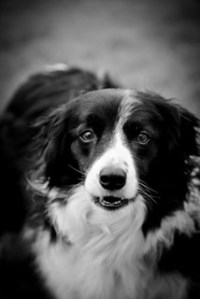
Footnote: I resolved that my dog would never appear on this blog, but here she is, as seen by Steve Kenward. As today is her 100th birthday in doggy years, I think there is something to celebrate.
I’ve found a link between art installations and our family’s Pasty Evaluation Test. We live in the South West, the traditional home of the pasty. Most local bakers produce pasties and whole businesses are devoted to their making, including one of our favourites, The Original Pasty House in Tavistock. What is the Pasty Evaluation Test? Taste and healthy ingredients are part of it, but the initial stage is to check how many bites it takes before you achieve something other than pastry-coated air.
It’s the same with installations. I’ve seen many that beckon appealingly but prove increasingly unrewarding and wearisome post-first-bite. I don’t want to pre-read screeds of explanation telling me what to think, so if an installation doesn’t communicate after a decent period of interaction, then for me it’s a non-starter.
I remember some good ones such as Jaume Plensa’s gongs at The Baltic in 2002. (Note: YouTube link shows them at the Yorkshire Sculpture Park where they seem arranged in a different way). They glowed in changing light and there was a timeless, temple-like quality to the space where silence and sound defined each other. People sounded the gongs with great intensity and contemplated powerful reverberations. Others seemed embarrassed to hit the gongs, as if they needed permission. A further cohort transformed into delighted children, shattering reverence with indiscriminate boing-ing and restaging the experience as wicked fun. It ended up as much about watching people as listening to gongs.
Not quite on the same scale, but I did enjoy two installations at the Devon Guild of Craftsmen this week. The first was Tina Hill’s Excavating Babel, a striking, tall spiral of over 2000 once-discarded books set in dust on a dark plinth. The books had been stripped of their covers, and thus identity, revealing a structure of sections and linen stitches, showing that books are, or can be, sewn together. Created with books set uniformly with spines outwards, the inner spiral could be entered. It enclosed, isolated and insulated the visitor with a dense paper barrier. One was aware of millions of pages of muffling, unknown stuff. What was this no-longer-needed information? There were interesting supporting notes to read, which afterwards I did. But Excavating Babel worked on several levels without explanation, and thus passed the equivalent of the Pasty Evaluation Test. You can see more about it on Tina’s own site here. Excavating Babel is part of the Devon Guild of Craftsmen exhibition Narrative Remains and you can see it until 23 March.
Outside spiral: spines, sections and stitches
Inside spiral
In the Riverside Gallery, also at the Devon Guild, is another exhibition called Love, Loss and Laundry. This can be seen until March 16th.Through stitch and fabric Jacqui Parkinson commemorates the lives of destitute women and girls who worked in Devon House, Bovey Tracey. Devon House was run by Anglican nuns of the Clew Sisterhood – the notes record that they were largely a kindly organisation. The refuge they offered allowed some girls, at least, to obtain respectable jobs in service and even to marry and have families of their own.
Women and girls were mostly occupied with laundry and sewing. Dirty sheets were washed, torn clothing darned, linen patched. But many inmates of Devon House lived or were buried unnamed. If it were not for the 1911 census records, their lives might have left no trace. Anne Liebermann’s embroidered linen squares record some of these lives in the delicate red cross-stitching of their names from the census. Jacqui has sewn these onto squares of an old bedspread where layers of old fabrics can be seen. The squares resemble the padded fabric the girls would have used to hold an iron and the names are haunting and moving.
Jannet Price
Squares and names
A sample of a Turkey red design?
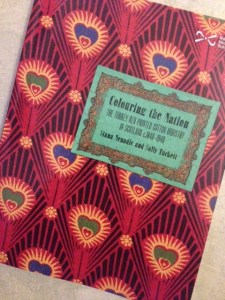
I have just enjoyed reading ‘Colouring the Nation’, a book about the Turkey red industry which set up along the Clyde and Vale of Leven in the nineteenth and twentieth centuries. One of the fabrics in the installation (the one on the right, above, with the fan) looked very like a Turkey red or Turkey red derived pattern, and the dates fit.
Thanks to theDevon Guild of Craftsmen and the artists involved in the two exhibitions for permitting photography of their work.
Colouring the Nation: The Turkey Red Printed Cotton Industry in Scotland c1840-1940
by Stana Nenadic and Sally Tuckett. Published by National Museums Scotland
There is an associated website which is well worth a visit for its text and searchable images. There are 501 available to see from the full 40,000 contained in the pattern books now held by National Museums Scotland.
I’ve recently been up to London to the first Journal meeting of 2014. Whatever time of the year, this long day trip involves a very early start to drive to the station and travel up to London. We start at 11 am and the whole day, even lunch, forms a meeting to discuss Journal matters and plan forthcoming issues. On the chime of 4 pm the meeting ends and the room empties so swiftly you’d think we were all going to turn into pumpkins. Members disappear to catch their trains – and occasionally, their planes. There is a great intensity to Journal meeting days, quite a few biscuits are eaten and sometimes it’s a bit frustrating. One has the day-long company of interesting textile-y people with whom one exchanges no more than a sentence or two of nothing-to-do-with-Journal conversation. But that’s the way it is. We are all volunteers giving time for a registered charity / organisation and we keep our expenses to a minimum: most of us are able to complete our round-trip to London within the day. If you don’t know the Journal, have a look at the website.
Australian Journey: Leaves at Katherine
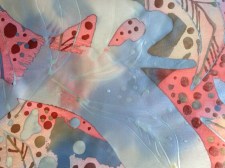
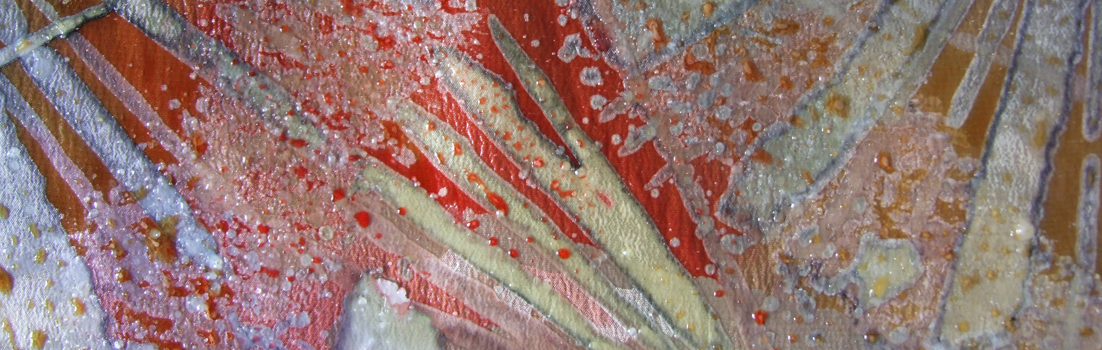
Back at home I have been working on a new piece of wax-resist work which started off with one idea in mind but was intruded on, in a most impolite and insistent way, by the shapes of eucalyptus leaves. The direction of the work (and my hand) changed totally. It’s weird when this happens and is, I assume, a luxury not open to certain types of craft work such as weaving, which require more advance planning.
I’m not sure whether the bossy leaves idea will work, but I have dewaxed the silk and it will go into the steamer this week, along with several shibori scarves of a – thankfully – more compliant nature. Then I will creep up on the leaf-piece and see if it’s any good.
This new work is part of the series I call Australian Journey because the designs are based on colours, shapes and ideas from our trip to Western Australia in 2012. There is a bit more about it here and you can find other posts and images by clicking the Australian Journey link in the tag cloud.