Isabella Whitworth

probably more than natural and synthetic dyes, wax, resists, and history


Leave a comment

BB1: Historical Dyeing at Leewood

June was my busiest month for a very long time. Work continued on the historical dye project at Leewood, I taught three courses including three sessions of 90 minute workshops plus demonstrating at West Dean over a weekend, sat on an exhibition selection committee and enjoyed a family visit. As a result I am so behind with blog posts that I need to tackle them in Blog-Bites (BBs) or I’ll give up before I start.

So. BB1 is about the final ‘public’ day of historical dyeing at Leewood which I have been working on with friend and colleague Jane Deane. If you want to see what it’s all been about, click here. After this exploratory phase we’ve concluded that we can focus on what we believe is affecting dyes and fleeces. There are certainly differences in dye take-up although they are so far unpredictable across the range of dyes and fleeces. We think we are onto something interesting, which came as a result of the intially frustrating and unpromising day using cochineal in May.

An effective and foolproof  method of collating, labelling and notekeeping has developed as the project has progressed so that we can remember precisely what we did from one session to another and compare results. Each fibre sample is individually labelled and kept in a (similarly labelled) transparent bag. This allows the contents to be viewed without always needing to remove and handle them.

We had intended to run our last day using indigo or woad, but as a result of the cochineal experience decided to repeat three dyes on the same day, but using different water sources. To create conditions as near identical as possible, we made a stock dye solution and divided it equally into jars containing an equal weight of dry fibre. By putting the jars into a bain-marie we kept dyeing conditions the same for all jars.

Our public dye-days have run since March and we have welcomed a number of visitors. The work will now continue privately at Leewood and we’ll no longer suffer the humiliation of ‘maths in public’, at which neither of us excels. Our final day in June was the most busy, with eight visitors (we can count ok provided we have sufficient fingers between us) crammed into the studio workshop. We are grateful to all who braved the creative weather to visit, ask questions and learn about natural dyes.


4 Comments

Shibori, sheep and the power of six

Last week I tutored a day-course in shibori techniques at Ardington School of Crafts. Ardington is a village on the edge of the Berkshire Downs. The venue is housed in a Victorian school, and its large windows ensure good light at all times. It has been imaginatively and calmly adapted for its current incarnation as a craft school and overlooks a traditional English landscape of farmland and trees. This week, with fine weather and leaves at the multiple-greens stage, everything looked at its best.

Students were introduced to the basic principles of shibori and how patterns will build in the fabric through what is a mathematical logic of repeating folds and layers. We worked principally with the equilateral triangular fold which creates hexagon-based patterns through its geometry of six equilateral triangles. I prepared a set of triangular card units showing how this repeat principle works. The positioning (and shape) of the clamped and identical wooden blocks either side of the folded fabric is represented by the white areas in my patterns. The clamping inhibits the flow of dye through the fabric. The wood blocks can be any shape – there is a pattern created by the green-painted triangular blocks below – and placed in any practical position. Block position will dictate the basics of the pattern. You can see from the image (below right) that the blocks do not necessarily prevent dye from entering the fabric beneath the clamped area. They just affect the character of the final pattern which is based on dye dilutions, deliberate drying of work, overdyeing etc.

Students ironed vertical folds in a scarf length and converted the strip to a stack of triangular folds. They checked the wood blocks and protected them with new clingfilm. This enables a clean start each time the blocks are used: wood absorbs dye readily and will mark  work that follows. I advise beginners to work with three colours only, plus dilutant, to avoid shades of mud. Some students admitted they had been sceptical that their seemingly random application of dye would create something so ordered and I think all were pleased with their results.

Below, you can see me opening up the steamer. This has to be done with considerable care, hence the somewhat stressed expression. You can see the roll of paper and scarves, which has been protected with foil at top and bottom to prevent drips entering the folds and spoiling the work. Note that the top piece of foil was dislodged as I lifted the chamber from the boiler.

Many thanks to the students for allowing me to post these pictures and to Faith at Ardington for taking the photos.

Other news: On Thursday 13th June, Jane Deane and I will be working on our dye research at Leewood for the final open-to-the-public time. We haven’t finished our research, but from Thursday on you can’t come to watch us. To check on details, see here.

With shearing time in Devon arriving, local flocks are looking cooler and in the summer-ish sun my nest of mason bees (Osmia) is hyperactive. The bees don’t make honeycombs (that’s another hexagon-based subject) but are laying eggs in the tubes and sealing them in various shades of Devon clay. We are lucky to have culm meadow locally which is filling with textured grasses in some summer sun. But tomorrow it is going to rain.


3 Comments

Surprised at Leewood: dyeing with cochineal

Dyeing at Leewood: If you have been following for a while, you’ll know that Jane Deane and I are researching natural dyes on five different fleeces, initially using four dyes. The  four dye-days were / are open to to the public. Visitors can watch, ask questions, and howl at our inability to do basic maths without recourse to endless bits of paper and the assistance of passing goats.

We are dyeing at Leewood, a smallholding on the edge of Dartmoor in Devon. So far we’ve worked with weld and madder; this week it was cochineal. We used raw dyestuff  and there is a post on preparing a stock solution of Lanzarote cochineal here. At Leewood we decided to use Mexican cochineal rather than Lanzarote. Why?

Mexican dyestuff  is reputed to be stronger but is more suited to the historical aspect of our interests. It also has a significant local connection.  Lanzarote cochineal arrived on the natural dye scene in about 1830, which is relatively late in terms of pre-synthetic dyes. Our dyestuff was a gift from a friend, who had obtained it while in Mexico from Rancho Tlapanochestli, Oaxaca. If you are reading, thank you, Ana.

A brief history lesson: When the Spanish arrived in Mexico, Hernán Cortés heard of the existence of nocheztli, or grana, which the Aztecs used for a rich, red dye. Recognising its efficiency compared to insect dyes available in Europe (eg: kermes, St John’s Blood, Armenian Red), specimens were sent to Spain in the 1520s. The Spanish monopolised the dye, so it rapidly became a great prize to pirates of all nations. A fabled English ‘pirate’ of the age was a Devon boy, Sir Francis Drake, sometimes known as ‘Queen Elizabeth’s chief pirate’. He was born in Tavistock, a few miles from Leewood. You can see Sir Francis, probably dressed in cochineal-dyed garments, in this portrait from the National Gallery.

What happened: Neither Jane nor I consider ourselves novices, but we were taken aback by our first batch of cochineal dyeing this week. Using our normal water source and mordant we failed to produce  colour on any one of five fleeces after around two hours’ dyeing in the jars. The dye ‘baths’ had turned from red to purple but the fleeces were virtually undyed.

Resourceful Jane suggested a different water source and we started a second batch.  That resulted in almost instant dyeing –  and the expected cochineal red. Why? We have absolutely no idea. We aren’t working in a laboratory so can’t analyse the water content of the original source which clearly had some vital part to play. But we take notes on pH, temperature, quantity etc and all the fleeces are dyed from the identical mordant and dye solution. It is the nearest we can get to comparing like with like.

The final surprise was that the initial batch, at first so reluctant to dye, did after four hours pick up very pale colour. This varied most from fleece to fleece of any of the three dyes we have tried. Why again? No idea.

Instead of working with indigo for our final ‘public’ day we are going to retest some of the dyes, comparing water sources.  To find out more about the final ‘open’ day or how to find Leewood, see this page.

Book: For a really interesting read on the history of cochineal I recommend A Perfect Red by Amy Butler Greenfield. My own copy is published by Black Swan (2006).


2 Comments

Blue routes – blue roots

As a schoolchild, my first and much-hated needlework project was to handsew a dirndl skirt. I was on the tubby side (not much has changed) and the skirt was red with white spots. My mother probably thought it would look charming but I knew I would look like a fat ladybird so, like Penelope and her shroud, I put off finishing it and learned to sew very slowly. Dirndl skirts and I have not crossed paths again for over 50 years.

We have just been to Bavaria to attend a family event. Many guests wore traditional clothes which, for the women, meant a dirndl costume. Now I have seen what it ought to look like, I must admit that the full dirndl costume can look good on old and young – and even the tubby. It isn’t just a skirt. There is a bodice, a blouse, a full skirt and an apron. Contemporary and expensive dirndl costumes are superbly tailored and very expensive.  They can be made from silks, cottons, linen, velvet or wool depending on the season, or the event at which they are worn.

A wedding dirndl. An apron knotted at the front means the wearer is unmarried

A dirndl worn at a wedding. An apron knotted at the front means the wearer is unmarried

A characteristic of the traditional dirndl is the printed cotton from which skirt and bodice are sometimes cut. The repeat patterns are small and delicate. At one time they would have been block-printed, and the blue and white fabrics would probably have been paste-resist-printed and indigo-dyed. This fabric is increasingly rare although there are still workshops in Hungary and Austria. Eastern Europe was a strong centre for these fabrics.

Last year the Devon Guild of Craftsmen held an exhibition called Tracing the Blueprint. The exhibition told the story of ‘Blauwdruk’ fabric from Eastern Europe which made its way to South Africa via trade,  European settlers and Manchester printers. Blue and white 100% cotton fabric is now printed in South Africa, although not using a traditional process. It is known as shweshwe and the Three Cats trademark of Da Gama Textiles is famous. Shweshwe used to be transported by sea and was heavily starched to help it survive the long journey. Although this is no longer necessary, heavy starching is still used to denote its status as true shweshwe. I have a pack of shweshwe by me as I write and the smell is strong and ‘inky’, but not unpleasant.

Last year I visited the studio of Martina Gistl near Gmünd in Bavaria. Martina screenprints traditional patterns onto cotton and linen at her studio. She has a beautiful workspace and you can look down on the printing process as she passes the ink-loaded squeegee across the fabric, forcing the ink down onto the stretched fabric. After the fabric dries it is heat-fixed (but I don’t think it’s a steam process).

There is such fascination in the journeys these strongly related patterns and designs have made, their natural dye origins and their contemporary uses and interpretations.


Leave a comment

Bees, baskets, beasts and the bull’s-eye rash

Because the wax I use for resist work contains a proportion of beeswax, my enthusiasm for a world of healthy bees extends to work materials. I don’t have beehives but I have several nests of bee-tubes and last year they were occupied for the first time. The bees that use the tubes are Osmia rufa, also known as the Red Mason Bee. They aren’t wax producers, but they are excellent pollinators and in the recent warmer weather we watched several of them hatching. You can see the red and yellow clay plugs that the bees make to seal the tubes. Both clay colours are local (obviously, unless bees use the bus) and typical of this area of West Devon. Some of the tubes in the image weren’t occupied last year but where you see a hole in the clay, the bees have emerged. There is an interesting download here if you want to know more about these bees.

Next weekend there is a festival of basketry at Dartington in south Devon. It’s called Basketry and Beyond and it focuses on the themes of fishing, farming and fashion. The festival features several workshops and demonstrations given by international makers, a parade, residencies, etc. A beautiful exhibition of baskets called From Bare Stems is currently showing at High Cross House, Dartington, as part of the festival. It has been curated by fellow Devon Guild of Craftsmen member Hilary Burns. We went to see it this week on a thoroughly wet day, the dripping woodland surrounding High Cross House smelling intensely of wild garlic. The two baskets shown above were loaned to the exhibition by Jenny Balfour Paul. Many thanks to her for supplying captions.

The little stone beast is not connected to anything on this page except that I like it and beast begins with B. Like the baskets, I went to visit it this week. It’s from a tiny, ancient church called Honeychurch; the building has hardly been touched since it was built in the 12th Century.

One final B. The bull’s-eye rash that sometimes develops with Lyme Disease can be seen in this link . If you walk your dog in the country (particularly where there are deer), work with sheep, or live where GP’s aren’t clued up on the disease, please read it. I noticed a bull’s-eye rash some years ago from an infected tickbite and had to go to considerable lengths to be prescribed the correct antibiotic. The incorrect antibiotic won’t clobber Lyme Disease. If I hadn’t once seen an image of this rash, I wouldn’t have known to persist and might have suffered long-term consequences.


11 Comments

Australian Journey: wax and dye on crêpe de Chine

We made a road trip from Darwin to Perth in late 2012. Ever since, I have been trying to respond to my observations and feelings about Australian colours and landscape through my work. I didn’t want to represent landscape, although one or two pieces have recognisable elements in them, such as trees. I don’t want to blog about my thoughts when I was planning the work except to say that each has to function as a flat or hung painting, and each piece must be wearable.

This, I began to realise, poses a problem. British light + clients don’t always respond well to the colours of Australia as wearable textiles. Australian colours are often vivid, highly contrasting and very, very bright. It’s to do with the intense heat, the light, the colour of the earth, sky and sea.  British wearers often choose muted and more subtle shades to wear.  These suit our pallid, sun-starved complexions and go very well with incessant rain.

So I have no idea if these vivid scarf-paintings will find a UK market.

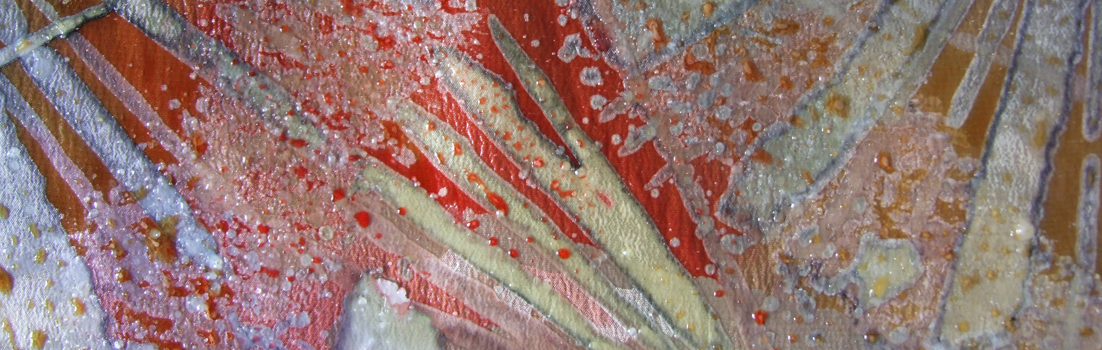
I have been working with steam-fixed dyes on silk crêpe de Chine, using wax-resist. I have layered up the wax and dyes until the fabric is as stiff as a board. Each wax layer is made from hundreds of waxed brush strokes which undulate over the surface. The layers have sometimes been 8 deep. Before I de-waxed the last piece I weighed it out of curiosity because it seemed really heavy. I found that it had lost 107 grams of wax after I had steamed and soaked out the last wax residue. The piece shown above (all the images are from the same piece) took me several days and was very time consuming, but I am pleased with the technique of multi-layered marks.

This particular piece is about the colours of Broome, Western Australia, where the desert meets the sea in an astonishing cymbal-crash of bright rusty red and turquoise blue. The landscape sketch shows patches of mangrove: crocodiles are often seen in the area.


3 Comments

Shibori through the megaphone

Last Friday I packed my passport and left the county to travel up to Gloucestershire. On  Saturday I led a shibori workshop, and gave a talk to the Gloucester Guild of Weavers, Spinners and Dyers. Not concurrently; not even foreigners from Devon can do that.  But all on the same day.

GGworkshop

Work from students of the Gloucester Guild of Weavers, Spinners and Dyers

The group of ten students successfully produced a wide variety of scarves during the morning using concertina folds on the vertical, and a triangular fold down the length. They clamped across the triangular block of fabric using oblong wooden blocks. I gave a demonstration of  folding before setting students loose on ironing boards – and then my steam-fixed Kniazeff dyes. The frequent use of  hairdryers, to create harder-edged patterns and lines on the outer folds, was an essential part of the technique. As a result the room became hairdresser-hot and infernally  noisy. Any general verbal instructions required a megaphone. I wondered if I’d have a voice left to give the afternoon talk.

One of the problems / pleasures of my teaching technique for shibori is that results obtained are unpredictable – and unrepeatable. I can only go so far with my instructions, and then students’ work will go its own way. Results are reliant on how wet they allow the work to become, how much they use the driers, how much they dilute the dyes and even which dyes they use. Separate colours can have different interactions.

It’s also a forgiving medium. Students are often dismayed at their first attempts to create a perfectly aligned  block of fabric, but astonished when the result appears pleasing and coherent. One student produced a stunning result by not exactly following my instructions: I am now going to experiment to see if I can reproduce her  ‘Gloucester Effect’.

My talk  was called Dyeing to Connect and described some of  the inspiring ways in which natural dyes are currently being used in social and educational projects.  It went well, as far as I can tell, although a gremlin crept in to my ‘remote’ clicker and it wouldn’t move my slides forward. Maddening. I had to dart in and out of the sidelines like a demented bird to click the computer trackpad. When I returned from foreign parts last night, the clicker worked perfectly and the gremlin had departed to plague a speaker in some other distant hall. Or maybe it didn’t have a passport and they’d apprehended it at the Devon border.


4 Comments

Madder and goats at Leewood

This week Jane Deane and I continued our research into natural dyes on fleece, working at Leewood in the Dartmoor National Park. On our last session we used weld: this time we dyed with madder.

We have chosen to use natural dye extracts to begin with as these have greater consistency in colour from batch to batch. At the moment our research isn’t so much about finding answers as knowing which questions to ask.  We realise we may need to retest the whole sequence of five dyes using raw dyestuff,  different water, altered mordant proportion etc.

Here are images from the day’s work showing how colour developed, the colour on fleece and the jars at the end of the session.

The sessions at Leewood are open to the public and yesterday we welcomed two visitors, one of whom was Robin Paris. Robin is a well-known and respected local batik artist whose concerns with sustainability have also led her to research the use of natural dyes with wax. You can read about this part of her work work here. Robin works mostly on cotton, a cellulose fibre, and because of this some of the problems she faces are different to mine using silk or wool, which are proteins. But there are also several common issues. I wrote here about some of them.

In May we will be working on cochineal at Leewood. We have had to change our published date of 16th May and this will be updated on my Leewood page as soon as it is confirmed.

The Leewood goats and  kids formed the cabaret as dye-day lengthened: goats are definitely madder than most animals.


4 Comments

The simple reappears once the dyer’s quite exhausted

Dyeing at Leewood on Dartmoor continues next week and on 11th April Jane Deane and I will be working on the same five fleeces as last month (see here), but this time using madder. Visitors are welcome and it’s free, but please phone Leewood before you make the journey.

I can now announce that our historical dye  project has been granted financial support from the Worshipful Company of Dyers, one of the historic London Livery Companies. I have been grateful for their assistance with research into the Wood & Bedford / Yorkshire Chemicals archive over the past years, but this is the first time I have requested support for a practical project. The Dyers Company has a long history of charitable giving which you can read about here.

Next weekend I’ll be in London for the AGM of the Association of Weavers, Spinners and Dyers followed, on the Sunday, by our quarterly Journal committee meeting. This whole weekend of meetings coincides with the major Huguenot of Spitalfields events and The Big Weave on the 13th, also in London. It’s most unlikely I will be able to bunk off meetings to inspect the Huguenots, however – it’s a shame there is so much on at once.

Despite a whole new bunch of lively committee members, there will be a sad  goodbye to Cally Booker (whose blog you can see here) and Belinda Rose , who have now completed their terms on the Journal committee. They have contributed hugely to a range of ever-changing Journal demands and I’ll really miss their intelligence, cheerfulness and good humour.

Plans for Fusion, West Dean’s summer event, proceed. This week I was asked for a ‘top tip’ by the organisers for a publicity campaign. I don’t have a practical one about dyeing dog hair or boiling sheep dung so I thought of a piece of Eastern philosophy I find revealing and useful. I first heard it when I read that Peter Collingwood had it fixed to his loom.

The simple only reappears once the complex is exhausted

It comes from Nigel Richmond’s Language of the Lines, written about the I Ching. The word I appreciate most is ‘reappears’. It’s because I recognise the simplicity of an idea in the inspiration stages, but endless, exhausting ‘stuff’ gets in the way and I struggle to pare everything down to try to find what I first saw. In so doing, I frequently take the wrong things out. It’s a process I often go through – in fact, I am doing it now, with work based on our trip to Australia last October.

Bookings for Fusion can be made through West Dean’s Fusion page here. I will be demonstrating wax resist on silk on Saturday 22 June and running three workshops on Sunday 23rd. These will be beginners’ workshops, but if you have done some work with wax before it should be equally enjoyable.


Leave a comment

Calculating cochineal: using Lanzarote dyestuff

The historical dye research Jane Deane and I are working on at Leewood (see previous post) involves comparing ‘like with like’. For the initial weld research we used a stock solution of weld extract and divided it equally into five separate jars to dye samples of five fleece types.

Last year I undertook a dye costing with a stock solution. It was for a Somerset-based company called The Woolly Shepherd which promotes the sustainable use of wool, particularly waste fleece that would normally be thrown away. It is producing  needle-felted insulation materials, horticultural products and acoustic panels and also sells a range of small items such as wine coolers and phone covers.

The Woolly Shepherd’s felt is a darkish grey overall, being a mixture of several fleece colours and thus far they had sold all their products undyed. The company asked me to find out if its felt could be natural-dyed to achieve a certain shade of dark pink. It had obtained a sample dyed pink with synthetic dyes and I offered to try to match it as nearly as possible using cochineal, and in such a way that a costing for natural dyes plus the dyeing process could be calculated.

Dye calculations are normally made on percentage of dyestuff to fibre, yarn or fabric, so I needed to work with a known weight of dry felt and a known weight of cochineal. By increasing the amount of measured dyestuff in a sequence of individual vats, I planned to dye a set of samples to calculate a percentage weight of dye to weight of felt. Cutting a precise weight of thick felt has ‘pound of flesh’ Merchant of Venice connotations. It isn’t as easy as it sounds. In the end I cut a piece that was slightly too heavy and then sliced pieces off the side so that I was working with a 200 g weight. I cut this into four so I could work with 50 g samples.

All the felt was mordanted in alum and cream of tartar. I used 12% alum and 8% cream of tartar – although I normally use less. The wool smelled so strongly of lanolin that I wasn’t sure if it had been sufficiently scoured for dyeing, so I erred on the side of a stronger mordant.

Because working with very small weights of ground cochineal is extremely fiddly I made a stock solution.

I used Lanzarote cochineal for The Woolly Shepherd project. Some time ago I undertook quality tests for the  Asociación Milana, found their cochineal to be excellent and I continue to use it.

I ground 50 g dried cochineal to fine powder and tied it firmly  into a silk gauze bag. This helped prevent cochineal fragments entering the dye and avoided the need to strain the dyestuff. The bag was put into a stainless steel vessel with about 500 ml water and heated to simmer point (80C) for about 10 minutes. The decocted liquor was decanted into a container. Repeats of this process followed until there was hardly any colour coming out of the bag. The series of decoctions made up a stock solution of 50 g cochineal in 4 litres of water.

I calculated that I could draw off the equivalent of 1 g cochineal in each 80 ml of water  – if I kept the solution swirling while decanting so that it would be well-mixed.

The dyeing was fairly straightforward although I had an initial panic with the first sample: it appeared that the dye was not ‘taking’. Was the wool too greasy? But after the first half hour I saw the felt begin to turn pink. I slowly raised the temperature to 80C and held it for an hour, then allowed it to cool and sit overnight before rinsing. The colour was nearly exhausted in the vat after the long soak. I prepared three samples starting with a 4% proportion of dye to fibre and then increasing the percentage. With the felt being grey, the dye was always having to work against the base colour and in the end the percentage of dyestuff required for the dark pink was higher than I anticipated.

In a spirit of pessimistic self-knowledge I noted precise quantities, weights, times and individual calculations in my dye notebook. If my actual calculations were later found to be faulty (not uncommon with my maths), I could still make sense of the dyed samples because the maths could be reworked.

When undertaking my research into orchil I’ve studied historical dye notebooks, invoices, orders and the occasional sniffy nineteenth century letter of complaint. A high standard of colour accuracy was expected of past dyemakers by their clients. My exercise with cochineal gave me a small insight into how consistent results, competitive purchase and selling prices were achieved, using natural materials which can vary in quality.

Then as now, good results would depend on careful note-taking, accurate calculations, rigorously consistent dyeing and efficient retention of standard dyed samples.

The Woolly Shepherd: http://www.woollyshepherd.co.uk/

Asociación Milana http://www.tinamala.com

A version of this article was first published in the Journal for Weavers, Spinners and Dyers, Issue 242, Summer 2012, pp 24 – 25