Isabella Whitworth

probably more than natural and synthetic dyes, wax, resists, and history


7 Comments

Pysanky and a kystka

On the recent Brilliant with Pattern course at West Dean one of my students had brought along something unusual. It was an Eastern European kystka. These small tools for applying hot wax are used, particularly in Ukraine, for the decoration of Easter eggs known as pysanky. I’d heard of a kystka but never seen one and until I started to research today’s post I knew nothing of the pysanky tradition. Wikipedia has a page on it here; it is a full and fascinating read which explains symbolism in the colours, the motifs and the actual giving of the eggs. It describes the ancient heritage of the craft, how patterns and methods were handed from mother to daughter, and the tools used. The list of pysanka recipients each Easter is especially interesting, revealing ‘life priorities’ of the givers. It includes a gift to the beehive, and eggs to the graves of deceased family members.

A list of natural dyes in traditional pysanky includes familiar names, such as alder buckthorn (Rhamnus frangula), Dyer’s Broom (Genista tinctoria) and green walnut husks from Juglans nigra. The Wiki article introduced me to two new words in the language of symbols: scevomorphic and cosmomorphic. To find out what they mean, follow those links to a website about pysanka tradition.

And in case you’re wondering how to pronounce pysanky, this is what the pysanky website says:

Despite what you may have heard on the Food Network or in a local class, ‘Pysanka’ is pronounced ‘PIH-sahn-kah’  (with the plural ‘pih-sahn-KIH’),  with all short vowels.  The term ‘pysanky’ is not, never was, nor will it ever be correctly pronounced ‘pie-SAN-kee’!!!!


My West Dean student (not the lady in the image above!) showed me how she uses her kystka on silk fabric. I was impressed because it was clear that the tool adapts well to applying fine lines to fabric and it doesn’t drip. I have never felt wholly at ease with a tjanting, although it produces beautiful fine lines in expert hands. The reservoir and spout of the kystka is made of brass but looks similar to the ‘rotring-style’ heads I used to use to apply spirit-based gutta resist in pre-wax days. The reservoir is small and the hot wax would soon run out, but one can adapt to this. I am wondering if I could improvise my old, now-unused gutta nibs into home-made kystkas. But brass may be a preferable metal with hot wax than steel ‘rotring’ nibs and I’ll have to try it out.


A greeting to Ukraine  This post sends a special greeting to L, a reader in Ukraine, who has been a regular visitor to my blog until all the current distractions. I send warmest spring and Easter wishes at a time of continuing anxiety.

Update: a reply from Ukraine I had a reply from my reader L, recalling their grandmother using onion skin dyes to make krashanky, which are one-colour-dyed eggs. The skins were collected well in advance of Easter so that there were enough to make deeper colours. In Ukraine, the kystka is called a pysachok.  My Ukrainian correspondent also recommended a great website here. Teresa Mihalko Harbert is The Real Thing when it comes to decorating eggs and the Trypillian culture, which provides some of her inspiration, a source of some superb patterns. Thank you L.


Acknowledgments: The image of Olga Kryway is by Robert L. Stone from the State Archives of Florida which allows reproduction for educational use. Florida Memory, http://floridamemory.com/items/show/108313

Thanks also to R for allowing me to reproduce an image of her family’s beautiful collection of decorated eggs and to A for the generous gift of a kystka.

Leave a comment

The Journal and a few bossy leaves

I’ve recently been up to London to the first Journal meeting of 2014. Whatever time of the year, this long day trip involves a very early start to drive to the station and travel up to London. We start at 11 am and the whole day, even lunch, forms a meeting to discuss Journal matters and plan forthcoming issues. On the chime of 4 pm the meeting ends and the room empties so swiftly you’d think we were all going to turn into pumpkins.  Members disappear to catch their trains – and occasionally, their planes. There is a great intensity to Journal meeting days, quite a few biscuits are eaten and sometimes it’s a bit frustrating. One has the day-long company of interesting textile-y people with whom one exchanges no more than a sentence or two of nothing-to-do-with-Journal conversation. But that’s the way it is. We are all volunteers giving time for a registered charity / organisation and we keep our expenses to a minimum: most of us are able to complete our round-trip to London within the day. If  you don’t know the Journal, have a look at the website.

Australian Journey: Leaves at Katherine

Australian Journey: Leaves at Katherine

Back at home I have been working on a new piece of wax-resist work which started off with one idea in mind but was intruded on, in a most impolite and insistent way, by the shapes of eucalyptus leaves. The direction of the work (and my hand) changed totally. It’s weird when this happens and is, I assume, a luxury not open to certain types of craft work such as weaving, which require more advance planning.

I’m not sure whether the bossy leaves idea will work, but I have dewaxed the silk and it will go into the steamer this week, along with several shibori scarves of a – thankfully – more compliant nature. Then I will creep up on the leaf-piece and see if it’s any good.

This new work is part of the series I call Australian Journey because the designs are based on colours, shapes and ideas from our trip to Western Australia in 2012. There is a bit more about it here and you can find other posts and images by clicking the Australian Journey link in the tag cloud.


8 Comments

It’s all gone a bit Rumsfeld..

“… there are known knowns; there are things we know that we know.
There are known unknowns; that is to say, there are things that we now know we don’t know. But there are also unknown unknowns – there are things we do not know we don’t know.” 

United States Secretary of Defence, Donald Rumsfeld, 2002 


With the Christmas break just round the corner I know that if I don’t hit certain things right now it will be endlessly harder to pick them up in the New Year. So I have stopped making new work (see above) and am  organising the references for my co-authored DHA paper.

I am into Harvard References. I don’t have an academic background but occasionally I stray into Dark Territory and have to abide by the mighty rules, one of which is correct referencing. Writing up the DHA paper has meant revisiting texts read and absorbed maybe five years back. I have been favoured with a good memory and this means I sometimes remember very well that I know something, but don’t remember how or why. If I recognised the need to know at time of reading I will have taken a note of a source.  But as is the way with research, sometimes I don’t always know the relevance of a fact or a comment until a few years down the line. Then it can become vital – and that’s when it all goes a bit Rumsfeld.

So to his much lampooned statement (which I have always felt is more sane than many suppose) I’d add the following:

“… there are known knowns; there are things we know that we know. We just don’t know where we read them…”

And I recommend the University of Exeter’s helpful online resource here.


Leave a comment

Poly-heading: and that’s not funny

Poly-heading

No, that’s not something that nasty pirates do*. It’s me, head-switching again. There’s a copy deadline coming up for the Journal for Weavers, Spinners and Dyers so I have had temporarily to drop the write-up of the DHA paper.  I also need to continue making scarves. One is a commission (yes, RD, there will be a choice for you!) but also a batch for the Burton Gallery and Museum, Bideford, where I am demonstrating working with wax all day on 14th December as part of their Meet the Burton Makers family programme.

The Burton Gallery and Museum, Bideford, Devon

I am a devoted fan of the Burton Gallery and Museum. I urge anyone visiting Bideford to go. I happen to love the ceramics of North Devon; they have an excellent permanent display from the RJ Lloyd Collection and I never tire of looking at it. Related to the collection is a brick-built bottle-kiln adjacent to the Gallery in Victoria Park and wood firings regularly take place there. In the images above you can see a sherd of pottery I found in our vegetable patch. There is an entire plate with almost the same pattern in the RJ Lloyd collection, dated to the 16th century, so my find is rather special and I keep looking for more of it under the carrots and chard. The historic Devon pottery tradition carries on today with the work of many local potters, including that of Clive Bowen. We have several pieces of his work at home.

The Burton has a permanent collection of watercolours and drawings containing evocative marine and local scenes but also shows touring art exhibitions of international standard. It also has rather a good and child-friendly French café…

Wax resist work

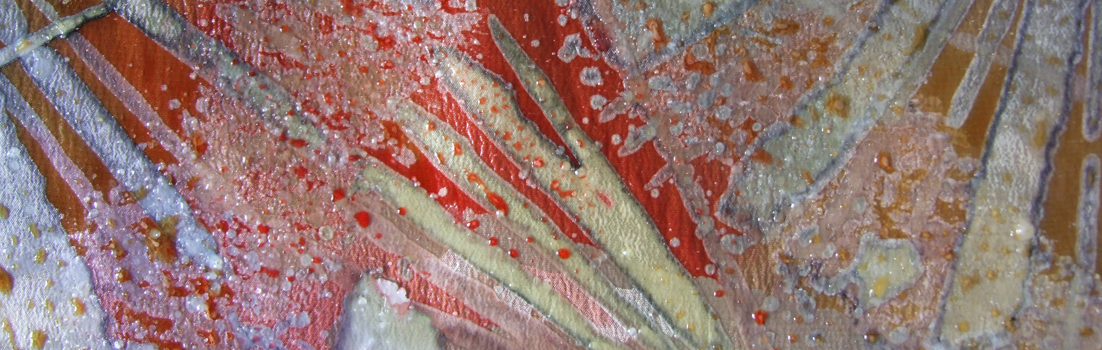
The images of the scarf in progress show the final layer of dye applied over about five layers of wax and dye. You will see that in two images there are beads of dye on the wax surface. On other images they have been removed. This is because if they dry on the wax surface, they will eventually deposit themselves on the silk when the wax melts out and I don’t like the often fuzzy, mottled effect this produces. So I wipe it off, carefully. Minute quantities of residual dye attach themselves to the textured surface of waxed shapes which produces unpredictable but often subtle textures. These I do like. The wiping-up process is rather like cleaning an etching plate before printing: I do it in a whizzy, upwards, circular motion. Thank you Mr Sellars, who taught me how to do this fifty years ago.

* Apologies to those reading this whose mother tongue isn’t English. Poly-heading is meant to be a joke – a pun – because ‘Polly’ is the name people often give to pet parrots, and as we all know parrots always sit on old-fashioned Long John Silver-type pirates’ shoulders saying ‘Pieces of Eight’. A pirate might want to knock its head off if it went on and on…

The other thing we all know is that when one attempts to explain a joke, it ceases to be in any way amusing…


5 Comments

Some bits I like: shibori and wax

Extreme Ironing takes place at the start of making folded and clamped shibori and if I’m not in the mood, it can be tedious and exhausting. The next bit is great as it’s working with dyes, but the best is the Christmas Stocking moment of opening up each dyed scarf. That comes after the ironing, but before the steaming.

With wax it’s the other way round. You do the evil stuff after the creative work with wax and dyes is complete. There’s a lengthy sequence of de-waxing, steaming, cleaning and washing out residual wax, etc before the scarves are ready.

despatch

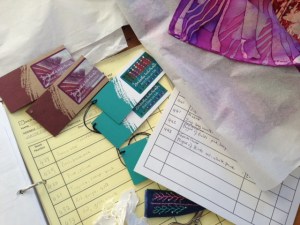
Labels, lists, tissue paper and scarves for despatch this morning

But however they are made, all scarves need a sewn-in label, a personal label / swing tag and a price tag with a stock number. My personal tags were designed for me by Chameleon Studio, a local Devon company. We chose recycled card and vegetable-based inks for the two types of label. I have one for natural-dyed and another for synthetic-dyed work; they look different but the design is related. On the left, you can see the two types of label. The buff label with plummy-coloured ink is the one I use for natural-dyed work. The full-colour image on an individual label is actually a sticker which I attach one by one. It was a brilliant idea of the designer’s to reduce costs on printing because sheets of sticky labels are much cheaper than full-colour printing on card. Once everything is labelled and listed for despatch to a shop or gallery there is always a list to fill out and a package to make up, followed by a trek down the hill to the local post office. Post-dog usually helps with this part of the process.

The latest batch of work has gone down to the Devon Guild of Craftsmen whose Christmas Show ‘Make 2013’ begins at the end of this week. It’s open daily from 10 am – 5.30 pm.


8 Comments

Head-switching

I’m crunching a lot of words these days. As a voluntary editor for the Journal of Weavers, Spinners and Dyers I normally spend at least part of my day reading and commenting on articles, corresponding with authors, checking facts and figures, proofreading or generally nitpicking. I happen to care about commas, colons and how to spell practise. (If it’s a verb, use an ‘s’. That’s if you’re British).

Writing up part of the co-authored DHA paper from La Rochelle (see previous post) is also a priority and it’s a lengthy task which may stretch to several thousand words.

My main computer is in the studio and it’s here that Journal, editorial and some research work happens. The studio is also where I keep dyes, brushes, wax pots, frames and silks. Theoretically it’s the place I make things too – but studio work has suffered heavily over the past months from the quantity of research and editorial commitments.  I consider everything I do absorbing, but there is only one of me.  And there’s the question of changing heads.

From art college training I realised, and perhaps learned, the intense concentration needed to draw or paint. If I have to interrupt work on a drawing or experimental textile, creative thought-trains chuff-chuff deep into irretrievable tunnels by the time I get back, and I lose the metaphorical plot, as has this sentence. Essentially, I find it intensely frustrating to be interrupted when I’m working on something new.

With an established design, it isn’t so difficult as it’s only half new. Sometimes I can change heads from the particular analytical demands of editing, and work on a  textile. I know what I’m aiming at, and although each textile is unique it’s like being guided by written music. Instructions have been established; technique and interpretation are what matter.

This week I’ve been constantly switching heads. I’ve been editing articles on shipwreck dye cargoes, medieval woad vats, or working on the history of a Leeds dye manufacturer: then I migrate two metres to wax pot, silk, frames, dyes and an established design theme. In three paces I unscrew Nitpick Ed-Head and replace it with Agent Zig-Zag. Zig-Zag, because that’s the design I’m working on this week.

I can’t always do this head-switching lark. I can’t always manage to ban the activity I’m not doing from my thoughts, and then nothing works at all. But this week it’s going OK.


7 Comments

BB3: Teaching rewards: wax, dye and shibori

Blog-Bite 3 – and almost up to date

It’s great when a student lets me know if something from my course has helped them in their work or studies. Last week I heard from someone on my West Dean course last March . The ‘Brilliant with Pattern’ course introduces several techniques with an emphasis on scarf making, although the skills are useful for general fabric design as well as learning about dyes, wax and silk. The young student who contacted me had just completed a Foundation Course in Sussex. She has been awarded a distinction. She told me she had made her final major project based on what she learned at West Dean and sent me some images, which I have her permission to publish here. Thanks, PJ, and congratulations on your success.

She wrote, about the silk vest in the images: For my final major project I made from georgette silk , the middle panel is actually a print from a photograph I took, using this direct imagery I printed onto transfer paper, then heat pressed onto cotton with an overlay of white chiffon. Then made into a basic top to focus the attention on the print.

More recently I taught two students (J and R) at home. I normally enjoy this: everything is to hand and I don’t have to load the car, drive 200 miles, unload it, sleep in a strange bed with scary pillows and eat too much breakfast every day. There is but one but – and I know it’s something of a cliché.  When students come to me I have to tidy the studio. By the time cleaning operations are complete I don’t recognise the place. Acres of floor emerge, bin bags are filled with things I didn’t know I didn’t need, I am emotionally drained by the stress and I then can’t find a thing for weeks.

J and R had a professional interest in learning silk and steam-fixed dye technique. They were already ‘creatives’ which made technical input the most important part of their visit. To realise the designs and garments they planned through the use of wax, resist and dye, they need to experiment with equipment, materials, various dye techniques and resists and work on various weights of silk. Because they live abroad, heat and humidity will play a part in how they work, how dyes need to be stored etc. There was a lot to pack in, from dye basics to some studio safety, steaming, where to buy to buy silk and wax, even how best to label and market work. We discussed various technical issues, such as painting long lengths and supporting the fabric. We had  to improvise this to some extent using workbenches: I don’t have a set of shinshi sticks and these days do not paint fabric lengths.

We worked in the garage for the longer length as the studio isn’t big enough. The garage too had required a moderate tidy but the Maintenance Department (also Catering Department for two days) had already taken care of it.

I am hoping J and R keep in touch – I’d love to see how the two days with me translates and how they solve some of the technical difficulties we discussed.

And I now have a squeaky-tidy studio and am scared to go in.


2 Comments

BB2 Teaching dyes, Fusion and Sewing a Boat

Blog-Bite 2: Ardington update

The shibori course I ran at Ardington School of Crafts at the beginning of last month will be repeated on Thursday May 1st and Friday 11th July 2014. There will also be an introductory ‘taster’ day on natural dyes on 10th July 2014 plus a day on shibori using indigo on May 2nd. Look out for the courses in Ardington’s forthcoming programme.

Fusion at West Dean

On June 22nd and 23rd I took part in a new outdoor event at West Dean called Fusion. On the first day I was demonstrating and selling my work, and on the second I led three 90-minute workshops designed to introduce students to working with wax and dyes. The evening before Fusion, I arrived at West Dean to set up and the weather was fine and sunny. It was only a day off midsummer night and I took a walk up onto the hills above West Dean to look down on the tented site. The moon was up and great fields of oxeye daisies caught the evening light. It was like walking on paths through moonlight. Marvellous stuff, but no time to go all romantic because we live in England and it was the last fine weather we saw until Sunday afternoon.

Hot waxpots, dyes and fourteen students confined in a tent taking off for Chichester, anyone?  Not a mix I would normally recommend. But  with a few precautions all seemed to go ok. I was pleased with what students achieved. The sessions were carefully pre-planned and timed, with a basic traced design already on the silk so no-one had to panic because they were expected to draw anything. With the assistance of heavy-drinking Devon friends, I had made a set of simple tools using wine corks and wire which could be dipped into wax to make textures and lines. I offered students small, cheap, bristle brushes which wouldn’t drip wax onto the silk. For sessions two and three we pre-stretched the silk to save time, but students could choose colours and some tools and textures. Without friend and helper Fiona it wouldn’t have worked half so well, and here is a huge and grateful cheer for her.

HOORAY FOR FIONA!!

Sewing a Boat

In my last post I mentioned a family visit. My brother, who is well known for his epic perambulations in rather a small boat (see here)  has been visiting from Australia. In mid June we made a trip down to Falmouth, where several of his voyages have ended and begun and went to the National Maritime Museum. We saw the replica of the Bronze Age boat Morgawr which was built by a team of volunteers led by master boat-builder Brian Curnby. Paul Harry has made a brilliant time-lapse film of the building: see here.

Section of the boat showing sections sewn with yew withies

Section of the boat showing sections sewn with yew withies

One of the things that  fascinated me about the oak boat was that it was sewn together using yew withies. These appear to have been twisted into a kind of rope and pulled up very tight, probably assisted by shrinkage. From the Bronze Age onwards, English longbows were made using one stave of yew (Taxus baccata). The wood is very springy, and the sapwood and heartwood together combine to resist tension and compression. I don’t know all the techie stuff, but I ‘did’ Shakespeare’s Henry V for O Level.  I remember being not in the least interested in his tedious French wife, but far more intrigued by the English longbows used at Agincourt. There is more here about the history and the wood relating to bow making. Wikipedia has a page on yew trees with images of ancient examples from Northern Europe.

Possibly, the same qualities that made yew effective for longbows also worked well for sewing boats together, but I don’t know how the structure of the withies would differ from larger staves of yew used in bowmaking.  The most ancient trees in the British Isles are yew, with the oldest surviving wooden artifact from these shores being a spearhead an astonishing 400,000 years old – see link below.

White, T.S.; Boreham, S.; Bridgland, D. R.; Gdaniec, K.; White, M. J. (2008). “The Lower and Middle Palaeolithic of Cambridgeshire”. English Heritage Project. 


Leave a comment

Bees, baskets, beasts and the bull’s-eye rash

Because the wax I use for resist work contains a proportion of beeswax, my enthusiasm for a world of healthy bees extends to work materials. I don’t have beehives but I have several nests of bee-tubes and last year they were occupied for the first time. The bees that use the tubes are Osmia rufa, also known as the Red Mason Bee. They aren’t wax producers, but they are excellent pollinators and in the recent warmer weather we watched several of them hatching. You can see the red and yellow clay plugs that the bees make to seal the tubes. Both clay colours are local (obviously, unless bees use the bus) and typical of this area of West Devon. Some of the tubes in the image weren’t occupied last year but where you see a hole in the clay, the bees have emerged. There is an interesting download here if you want to know more about these bees.

Next weekend there is a festival of basketry at Dartington in south Devon. It’s called Basketry and Beyond and it focuses on the themes of fishing, farming and fashion. The festival features several workshops and demonstrations given by international makers, a parade, residencies, etc. A beautiful exhibition of baskets called From Bare Stems is currently showing at High Cross House, Dartington, as part of the festival. It has been curated by fellow Devon Guild of Craftsmen member Hilary Burns. We went to see it this week on a thoroughly wet day, the dripping woodland surrounding High Cross House smelling intensely of wild garlic. The two baskets shown above were loaned to the exhibition by Jenny Balfour Paul. Many thanks to her for supplying captions.

The little stone beast is not connected to anything on this page except that I like it and beast begins with B. Like the baskets, I went to visit it this week. It’s from a tiny, ancient church called Honeychurch; the building has hardly been touched since it was built in the 12th Century.

One final B. The bull’s-eye rash that sometimes develops with Lyme Disease can be seen in this link . If you walk your dog in the country (particularly where there are deer), work with sheep, or live where GP’s aren’t clued up on the disease, please read it. I noticed a bull’s-eye rash some years ago from an infected tickbite and had to go to considerable lengths to be prescribed the correct antibiotic. The incorrect antibiotic won’t clobber Lyme Disease. If I hadn’t once seen an image of this rash, I wouldn’t have known to persist and might have suffered long-term consequences.


11 Comments

Australian Journey: wax and dye on crêpe de Chine

We made a road trip from Darwin to Perth in late 2012. Ever since, I have been trying to respond to my observations and feelings about Australian colours and landscape through my work. I didn’t want to represent landscape, although one or two pieces have recognisable elements in them, such as trees. I don’t want to blog about my thoughts when I was planning the work except to say that each has to function as a flat or hung painting, and each piece must be wearable.

This, I began to realise, poses a problem. British light + clients don’t always respond well to the colours of Australia as wearable textiles. Australian colours are often vivid, highly contrasting and very, very bright. It’s to do with the intense heat, the light, the colour of the earth, sky and sea.  British wearers often choose muted and more subtle shades to wear.  These suit our pallid, sun-starved complexions and go very well with incessant rain.

So I have no idea if these vivid scarf-paintings will find a UK market.

I have been working with steam-fixed dyes on silk crêpe de Chine, using wax-resist. I have layered up the wax and dyes until the fabric is as stiff as a board. Each wax layer is made from hundreds of waxed brush strokes which undulate over the surface. The layers have sometimes been 8 deep. Before I de-waxed the last piece I weighed it out of curiosity because it seemed really heavy. I found that it had lost 107 grams of wax after I had steamed and soaked out the last wax residue. The piece shown above (all the images are from the same piece) took me several days and was very time consuming, but I am pleased with the technique of multi-layered marks.

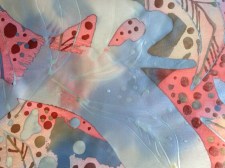
This particular piece is about the colours of Broome, Western Australia, where the desert meets the sea in an astonishing cymbal-crash of bright rusty red and turquoise blue. The landscape sketch shows patches of mangrove: crocodiles are often seen in the area.