Isabella Whitworth

probably more than natural and synthetic dyes, wax, resists, and history


Leave a comment

Talking Orchil

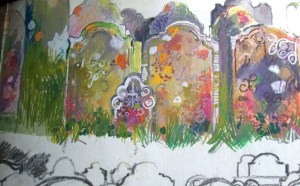
Canterbury graveyard, 1960s sketchbook

Lichens in a Canterbury graveyard: from my 1960s sketchbook

In my last post I started to write about orchil, and how I became fascinated by its story through my researches on an eighteenth / nineteenth century Wood & Bedford / Yorkshire Chemicals archive.

To start at the beginning, orchil (pronounced or-kil) comes from lichens. It has been used for millennia to dye wool and silk a purple colour. There is some confusion over ancient recipes for purple. It isn’t always possible to decipher which recipes refer to lichen and which to shellfish dyes. Both dyestuffs produce a remarkably similar colour, were to be found in the same areas (e.g. the Mediterranean coast) and descriptions of lichen are often a little vague. For instance, dyestuff might be referred to as a plant, or a moss, or a seaweed.

There is evidence (Pliny, Theophrastus, Dioscorides) that orchil was used in conjunction with shellfish purple and it’s a ready assumption that this was done  to defraud – which of course it may have been. The processing of orchil would have been significantly cheaper than for shellfish dye. But the combination was also undertaken to produce a legitimately cheaper alternative to pure shellfish-dyed cloth. Nevertheless, orchil and shellfish-dyed cloth seems regarded with disdain because of the great and unique reputation of shellfish purple, and orchil’s tendency to fade.
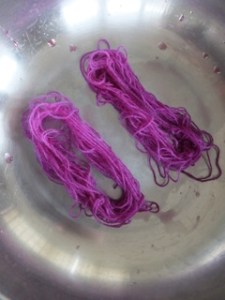
The beauty of fresh orchil on woollen yarn

The beauty of fresh orchil on woollen yarn

Orchil dye is extremely beautiful in its first, fresh bloom of colour but it normally proceeds to fade fast. It is therefore interesting to read a 2012 paper (link below) in which Casselman and Terada demonstrated that a combination of orchil and shellfish dye may in certain circumstances, stabilise the orchil. They also reported that the  use of orchil as a base dye would to some extent neutralise the intensely unpleasant odour of shellfish-dyed cloth. Those facts cast an entirely different light on the historic combination of orchil and shellfish dye.

It occurs to me that in more recent days, far from being ‘poor man’s purple’, orchil could have been considered a great luxury. If you could afford the rich glories of orchil-dyed silk, and these would be obvious to all by the colour, it might indicate one’s financial indifference to fading and the realities of a soon-spoiled garment.

Dye lichens

Not all lichens will dye, not all dye lichens will make orchil. Orchil-producing lichens (and there are innumerable species) contain precursors of the dye and to make this available the dyestuff must be crushed in ammonia or stale urine and water and then kept well-oxygenated. It undergoes a type of fermentation, and the purple colour develops over several weeks.

Orchil is very sensitive to changes in pH and by adjusting vat strength and acidity, a wide variety of colours can be achieved, ranging from browny reds to reds, pinks and purples.

Crotal / crottles

There are lichens that will dye rusty reds, browns and golds. They are often referred to as ‘crotal’, (a Gaelic word) or crottle, lichen. These require no fermentation and are normally boiled up together with fibre, yarn or cloth. They have been in traditional use in Scotland for centuries and the warm, earthy smell of crotal-dyed yarn is also a moth deterrent. But crotals are not orchils!

Mordants

Neither orchil nor crotal requires a mordant although some historical recipes recommend an alum mordant for orchil.


The Wood & Bedford Orchil Story

I found a vast number of items in the archive which related to the nineteenth and twentieth century trade in orchil. A couple of them can be seen in the previous post. The records defined several sources of orchil lichen. Around 1830 these included Scandinavia, Sardinia, the Azores, Madeira,  the Canary Islands and Cape Verde. Political changes and colonial interests affected trading in the later 1800s, as did the slave trade and, eventually, its abolition. A picture emerged of a voracious trade that reached an industrial and even global scale by the mid nineteenth century. There is a certain irony in the fact that stocks of what, in effect, is a non-renewable product were saved by the synthesis of mauveine by Perkin in 1856. The demand for lichen then dropped. Nevertheless, Wood & Bedford,  later the Yorkshire Dyeware and Chemical Company, continued to buy and process orchil lichen well into the twentieth century. I understand that the last unused lichen stocks went to Johnsons of Hendon who presumably used lichen to make their indicator papers.

Lichen ethics

You will see that I have learned to make orchil and to dye samples for research purposes but I don’t use it in my studio work. You can read some of my thoughts on lichen use here. I am extremely grateful to all those who taught me about making orchil and how to dye with it.

Pronunciation

How do you pronounce lichens? I say it to rhyme with kitchens. Most people and academics (ok, sorry, academics are also people)  say ‘likens’. The OED pronunciation makes it official: you can say it either way:
/ˈlʌɪk(ə)n, ˈlɪtʃ(ə)n/

References:

The Politics of Purple: Dyes from Shellfish and Lichens Karen Diadick Casselman and Takako Terada

Natural Dyes: Sources, Tradition, Technology and Science; Dominique Cardon, Archetype Publications

The Colourful Past: Origins, Chemistry and Identification of Natural Dyestuffs; Judith H. Hofenk de Graaff, Archetype Publications

Lichen Dyes: The New Sourcebook and Craft of the Dyer by Karen Diadick / Leigh Casselman


18 Comments

Dyes, history, and a chilly trip to Yorkshire

About five years ago life veered off in a new and unexpected direction.

My neighbours asked me to look at a dye-related company archive they were liberating from their attic. They were selling their house, thought they had a ‘firm offer’ and there wasn’t a lot of time.  There would be no space for the archive in their new home and I offered to rescue anything important from its potential new resting place – an unconverted stone barn. I imagined I’d see a small, disparate heap of documents and books descend the attic stairs with little supporting contextual information;  honestly, I did wonder how interesting that might be.  Because I knew a little about dyes I hoped to advise my neighbours if anyone would be interested in any of the collection before it made its acquaintance with the barn.

Six weeks later (the ‘firm offer’ wasn’t) I had opened and listed the contents of dozens of boxes and trunks containing documents, books, ledgers, patents, dye samples, photographs, letters, diaries, Minutes, catalogues, invoices, plans, maps, contracts, botanical samples, watercolours, chemicals, medals and awards….   and even a mousetrap, devoid of mouse.

Are you beginning to get the idea? Neither disparate, nor without context.

This is some of what I initially learned. The archive had been handed down through my neighbour’s family. He is a direct descendant (the great-great grandson) of a chemist called James Bedford who was born in  1795 and apprenticed to a chemist and druggist in Briggate, Leeds, in 1810.  James Bedford was the first in a descending series of three James’, all of whom worked in the family business, which started its life as Wood & Bedford. The same company, though it amalgamated with others and changed names, never underwent a takeover and occupied the same premises in Leeds, on Kirkstall Road, until it went into administration in 2004. It was by then the internationally-known Yorkshire Chemicals.

The Wood & Bedford / Yorkshire Chemicals archive was largely assembled in the early twentieth century by the third of the James’, although it included material from the early 1800s. There was little after 1945 as later material was largely retained by the company and not kept within the family. I published an article in the Journal for Weavers, Spinners and Dyers in 2008 (it can still be downloaded here) which gives a summary of the early days of my research. I was amazed to discover that, contrary to what I had read and often heard, the use of natural dyes persisted long after 1856 when mauveine was discovered by the young William Henry Perkin. Logwood, orchil lichen and various tannins featured in the archive well into the twentieth century, although the company also worked successfully on the development of synthetic dyes.

It’s hard to pin down why I became particularly intrigued by the orchil trade, but an early 1800s dyers’ notebook (there’s a page shown above) certainly helped. My orchil-dyed path, proceeding from the heap of rusty trunks, has since led me to Galicia in Spain, to Posnan in Poland, to Leeds, Lisbon and to Ecuador. In October it’s taking me to La Rochelle, and last week it took me back to Yorkshire. I will be giving a talk on the orchil trade to the ‘6 Guilds’ group of Weavers, Spinners and Dyers at the end of this month in Stratford; at DHA (Dyes in History and Archaeology) in La Rochelle in October I am delivering a joint research paper with Professor Zvi Koren on samples labelled ‘Tyrian Purple’. I can’t say any more about those until after the event – or I would have to leap through the screen and kill you. It’s Classified.

Yorkshire Grit

The Wood & Bedford / YC archive has been accepted by the West Yorkshire Archive Service (WYAS) through the generosity of my one-time neighbours; a ‘firm offer’ did eventually materialise. So the collection has gone back to Leeds where it belongs. WYAS were excited by the fact that the archive covered long periods of the same company’s history. It isn’t yet available for study as archiving is being undertaken by a dye chemist; through a coincidental set of circumstances I was put in touch with a large group of ex-employees of Yorkshire Chemicals (YC), of which he is one. This contact led to my giving ex YC employees several presentations as they knew nothing about Wood & Bedford’s beginnings. Most professed great affection for their time at YC, and one referred to it as ‘the best days of my working life’.

A (sadly) dwindling band of ageing YC folk meet up from time to time and I sometimes join them for the annual outdoor charity Band Concert given by the Elland Silver Youth Band. That’s why I have just been back to Yorkshire. The rest of the country sweltered in tropical heat, but Halifax wasn’t having that. It was practising Yorkshire Winter. The wind Heathcliffed down from the moors with such enthusiasm that tents and gazebos couldn’t be put up to protect the young Band members – who played valiantly in shirtsleeves. A knocky-kneed and freezing set of ex YC attendees cowered under woolly blankets and discussed cryogenic concerts. There’s nout like Yorkshire Grit.

I’ll be writing more about the archive in future blogs, once I thaw out.

Farfield Mill

Some years ago when Farfield Mill reopened as an arts centre, I used to sell work there but I have never visited until this week. The impressive Mill centre is set on four floors which include exhibition spaces, a retail area, the best second-hand textiles bookshop ever, a historical display about wool, weaving and knitting  and small workshop / display units. A large industrial working loom weaves blankets and throws next to the Weavers Café – a refuelling stop after the rigours of viewing everything at Farfield. I enjoyed seeing but particularly, handling, Laura Rosenzweig’s Howgill Range which I have only read about in the Journal  (issue 243).  As Laura’s Loom, Laura runs one of the work and display units. With my next Yorkshire concert in mind, I bought a Shetland wool hat from Angela Bradley‘s shop.

On the top floor we found a welcoming group of weavers, some of whom I know through the Online Guild. They had a variety of looms and equipment on show and in use, and were clearly a valuable asset offering explanations to visitors, many of whom, it seems, don’t know the difference between weaving and knitting.


4 Comments

More-or-less-Ethel and the Mairet madder method

Several years ago I was fortunate to buy a small out-of-print hardback book in the collection of an Oxfordshire dyer. It was Ethel Mairet’s Vegetable Dyes. Originally published in 1916, the book is something of a classic and my 1952 edition represents its eleventh reprinting. I normally don’t like finding handwritten marks and notes in books but this one has been well-used, and I enjoy thinking of (at least) two dyers before me making use of it.

Ethel Mairet, née Partridge, was born in 1872  in Barnstaple, North Devon, which isn’t far from where I live. Her life was extraordinary on many levels as an influential figure in arts, crafts and education. She was married for a time to a Ceylonese called Ananda Coomaraswamy and travelled to Ceylon with him, studying and documenting weaving, spinning and dyeing techniques. She divorced in 1912 and married Philippe Mairet in 1913. At ‘Gospels’, her house at Ditchling, she set up a workshop and taught students who themselves became influential in the textile world. These include Marianne Straub and Elizabeth Peacock. Elizabeth Peacock has an association with Dartington, also here in Devon, for whom she wove a set of banners in 1938. There is an image of one of them here.

In 1931 Elizabeth Peacock co-founded the Association of Guilds of Weavers, Spinners and Dyers (AGWSD). With others, she organised the first AGWSD Summer Schools and if you have been reading previous blogs about madder and Turkey Red, you’ll know that Summer Schools are still held biennially by the Association.  Ethel Mairet taught on these first Schools, so I’m glad her madder recipe emerged with such success at Carmarthen. Opinions change over the years, however, and nowadays dyers tend to use much less alum mordant than the 25% her 1916 recipe recommends. It’s certainly a large percentage for me.

Blessed with some summer sun, I have been drying out the wet madder chips I brought back from Wales. I was surprised at how much the heap shrank as the chips contracted. With the liquid madder exhaust I have used a More-or-Less-Ethel (call it MOLE?) method to dye scarves. It’s ‘more-or-less’ because the exhaust is an amalgam of numerous dyebaths from Summer School and isn’t consistent with Mairet’s recipe. I have also dyed silk with it, and her recipe specifies it’s for wool. But I worked the Mairet long mordant (resting it damp for several days) and the 25% alum and also brought the dyebath to the boil for the recommended ten minutes. Boiling madder is very controversial as many recipes (such as Jill Goodwin’s) advise that raising the heat of the dye bath above a certain point will make the madder go nasty and brown. This is clearly not necessarily the case because our experiments included recipes where we boiled, and those where we didn’t, and Deliberately Boiled Brown became something of a Holy Grail.

If you read my blog regularly you will also know I am a voluntary editor on the Journal for Weavers, Spinners and Dyers which is the magazine of the AGWSD.  A new issue (247) will shortly be plopping onto doormats for the attention of international sets of dog-teeth; we are also approaching the copydate for a future issue. So it has been a frantically busy week. All the reports from the recent Summer School are included in 247, as well as regular articles and features.

The Journal is also announcing the appointment of the new AGWSD President, Dr Jenny Balfour-Paul, but this will be in Journal 248. Jenny is best known for her research work into indigo but is passionate about education and the passing on of our skills.  I owe my own passion for natural dyes to her: I attended a series of lectures on Japanese crafts at the Crafts Council in the early 1990s (Marianne Straub was another attendee!) and was infected by Jenny’s enthusiasm for natural dyes. She taught me to dye with indigo, and the rest is history.

Links

Ethel Mairet:

University of Brighton biography of Ethel Mairet here

vads online resource here. There are also images of her woven cloth

You can read Ethel Mairet’s book, which is out of copyright, online here 

An image of Ethel (then) Coomaraswamy weaving at Broad Campden here

Elizabeth Peacock:

vads online resource here

Dr Jenny Balfour-Paul

Jenny’s website (under construction) here

Institute of Arab and Islamic Studies, University of Exeter, here

Jenny’s work with Yo-Yo Ma’s Silk Road Connect here

Books here


6 Comments

Post-madder, madder post and a blue gorilla

I’m back home after Summer School. As one of few students on my course who took a car to Carmarthen, I brought back gallons of exhaust madder in containers, as well as a heap of bulgy muslin bags containing chopped and ground root we had used on various projects. I’m glad I wasn’t apprehended by South Wales Police trailing my gory drips: the gooey, oozing bags would have looked at home at an Aztec sacrifice. Maybe police were too busy chasing the rotter who stole tutor Jason Collingwood’s laptop and irreplaceable woven samples, some his late father’s, from his train home from Summer School.  The samples have, thankfully, been recovered: they had been chucked over a garden hedge in Neath. Through the kindness of strangers, they will be returned to Jason. The computer is still missing.

Deb Bamford suggested that if I were to empty the bags of chopped madder and dry out the dyestuff I could regrind and re-use it. It will have lost some of its colour in previous dye sessions, but I like the yellow / orange / peach  tones that exhaust madder produces on silk and wool.  As to the liquid exhausts, I shall be blending them and using them on silk and wool for scarves. I need to get on with this as the liquid is beginning to ferment and there is a noticeable implosion when I open the containers.

I looked at the vast array of madder-dyed samples we had done on the course and arranged them to photograph, then wondered how many people-hours they represented. I calculated it would have taken one person 66 days to complete the equivalent work over an eight hour day. That’s without the labour put into the Turkey Red preparation by Deb, our tutor.

Why the gorilla? I’ve been going on about red rather a lot, he is a blue gorilla and he is loose in Exeter.

Other blogs on Summer School: please let me know if you know of more

Cally Booker: A Week at the Coleg

Pat Foster here and onward posts


Leave a comment

We have Turkey Red

Not the final day of the course, but the final day of dyeing.  We have been through all the processes used in dyeing Turkey Red through a long sequence of carefully managed samples prepared by tutor Deb Bamford. Today we dyed the final stage. The temperature of the dyepot was raised and maintained and the prepared fabric was immersed, with one of the group stirring it continuously.

Turkey Red

Turkey Red

At the end of the dye period, we lifted the cotton from the pot. We had achieved a good, characteristic, Turkey Red. 

Various experiments and variations continued in the room and explanations and notes added to ‘the wall’.

Tomorrow is the last day and for tutors and students, it finishes at noon. For our course, the morning will be spent sorting and sharing samples and  clarifying processes.

Deb Bamford is highly organised; if she hadn’t been, this intensely complex course could have descended to chaos and dyeing mightn’t have been completed accurately, safely, or at all. Deb explained everything clearly and directly; she really knows her stuff. The student group has been pleasant, co-operative and multi-skilled, which has added to an enjoyable (and valuable) week.

The Trade Fair opened at the Summer School this afternoon with stands selling spinning and weaving equipment, yarns, books, fabrics and trimmings. I helped set up the stand for the Journal for Weavers, Spinners and Dyers for which I work as a volunteer editor.

Tomorrow classrooms and the Trade Fair are open to the public. In the evening there is a Gala Dinner with a speaker, and then it will be time to pack up and go home.

Two unrelated observations: it has been a great luxury to be on a course as a student and not a tutor, but it’s peculiar that I am more tired this way round.

The other is that they have some mighty fierce mosquitoes in Wales. I had hoped there was an interesting word for mosquito in Welsh, but it seems it’s mosgito. Oh.


Leave a comment

Day 4 and madder: sorry about the quilts

I have been writing Summer School blogs late at night and I am forgetting to include things. Here’s what I forgot yesterday: images of the textiles from the Welsh Quilt Centre at Lampeter. They should have been attached to yesterday’s post.

Today, Turkey Red preparations continued and we started to plan the ordering, labelling and displaying of the various samples dyed on the course. We are working in the art college (Coleg Sir Gar) in a Life Room; it’s part of a larger suite divided by folding screens. The screens are also whiteboards and we can write on them with markers, which makes displaying and explaining samples a bit easier. An exchange visit with students on Helen Melvin’s eco-dyeing course took place this afternoon and they could see the first samples together with their recipes and comments from the groups that had dyed them.

‘If you would dye wool into a perfect red colour..’ begins Gervaise Markham’s 1615 recipe from his book The English Huswife. I am in a group-within-a-group on the course; we excel at producing dispiriting pinks from recipes which boast all manner of ‘perfect reds’ as their outcome.  I think we have even astonished tutor Debbie by our unerring skill in this regard.

From the selection above, guess which yarn is ours after trying Markham’s recipe. No prizes.


Leave a comment

Madder, wool and Welsh quilts

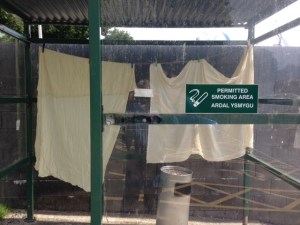
In the dye room this morning we reground the fourth and final exhaust dyestuff for the Turkey Red samples and heated it to temperature so that it could cool before dyeing tomorrow. Debbie has hung the Turkey Red-prepared cloth in the college smoking shelter – which might well discourage smokers from entering and be very good for overall Welsh health.

smoking

Smelly smoking shelter

Many madder recipes state that one should not raise the temperature of the dyepot above a certain point or the colours will turn brown.  On the other hand, many recipes have silk or wool boiling for as much as an hour. So what’s going on?

Jill Goodwin advises a maximum of 158 F (70 C). We were careful to follow her recipe yesterday, but today someone suggested we should boil one of the Goodwin skeins to see if  it would affect the colour.

So we did, and it didn’t…. and it set us thinking where such advice originates and under what, if any, circumstances it might be true.

If you read yesterday’s blog you’ll know I wasn’t sure where we were going on our outing: it turned out to be the National Wool Museum at Dre-fach Felindre and the Welsh Quilt Centre at Lampeter.

Our visit to the museum was interesting but short and there were far too many of us for a comfortable visit. Nevertheless, I enjoyed watching the spinning mule in action, and touring the finishing and weaving sheds. Across in the field was a tenterframe for stretching and finishing cloth, and a windhouse for drying more delicate fabric. The tenterframe looked squeaky-new and unhistoric (do Ikea offer a selection?)  but gave some idea of how the field might once have looked.

I came across a set of natural-dyed yarns produced by David and Margaret Redpath who, until 2002, ran Wallis Mill in Pembrokeshire. It was the last commercial mill in Wales to dye with plant materials. The dye garden behind the wool museum was sadly neglected and overgrown with weeds, although some madder was struggling plantfully on.

The Quilt Centre at Lampeter is in the old Town Hall. Currently, and until November, a collection of antique Welsh quilts is on display with work by Kaffe Fassett and other contemporary quiltmakers. There was a time when this modern work would have held all my attention, but now I am old and grey it was the monochrome historic textiles I found the most beautiful. The collection has been put together by Jen Jones, who realised several years ago that these lovely bedcovers were being discarded as having no value. In a short address to the group, Jen said that she had once seen a farmer using an old quilt to keep a sick cow warm. The Quilt Centre exhibition was superbly done, with work suspended at different angles and heights from an immensely high ceiling. Complexities of lighting were skilfully handled so that nothing appeared overshadowed.

crossover

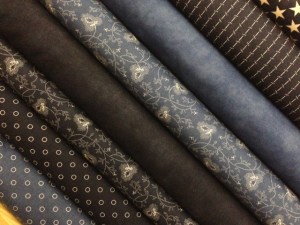
This collection is by Moda Fabrics and is called Indigo Crossing

In Calico Kate,  a shop for quilting enthusiasts almost next door, I found a set of printed cottons in the blue and white derived from the traditional patterns of resist-dyed indigo. These fabrics seem to be following me around: see this post from earlier this year.

A reminder to anyone following in real time that you can follow AGWSD Summer School at Carmarthen through the posts of several students here on Twitter, using the hashtag #wsdsschool


3 Comments

Even madder dyeing: Summer School, Carmarthen

The first task of the day was to devise a test sequence of Turkey Red dyeing in which a full solution of soaked and ground madder would be used to dye with, then the dyestuff re-ground and re-used to test the exhaust of each previous phase. It is expected that each phase will produce lighter tones than the last, but dyed cotton may also shift in colour as various chemicals are taken up in the dyeing at each stage. The four groups in the course undertook a stage of grinding and re-grinding, and then the cloth dyeing. At the end of the second day we are half way through this exercise. Each stage takes a while to complete.

The sheep-dunged cotton from yesterday was first worked in the oily emulsion prepared from olive oil and potassium carbonate. It was then divided up for the four dye stages.

While this exercise continued through the day, each group worked on recipes selected from Debbie’s suggested choices. My group completed dyeing silk according to a historic recipe (Haarlem Manuscript 281/1/1)  republished in Judith Hofenk de Graaf’s book The Colourful Past. The results were pale and salmony, not the ‘beautiful red’ we had hoped for. We must re-check calculations and compare results with another group using the same recipe.

The Jill Goodwin recipe we are using has turned out more successful. Madder had been soaked overnight with two tsps powdered chalk (calcium carbonate). This morning it was placed on the stove and over the period of an hour (and before the yarn was put in it) the temperature raised to a definitive ‘no more than 158F’.  Goodwin’s instructions are somewhat stern on temperature and I guarded it with a thermometer and my life. The dyebath developed  a very marked purple foam but in the wool yarn dyeing there was no shift from the expected madder shade. The yarn is resting in the cooled dyepot so I have no picture yet.

During the day a small group studied the water analyses brought in by students to accompany their 5 litre water samples. This revealed that the softest water comes from the water in my area, West Devon.

Tomorrow is a half day at Summer School and we off on a trip to the National Wool Museum at Dre-fach Felindre. At least, I think it’s there we’re going: my piece of paper doesn’t confirm the destination. No doubt we will find out when we get there. If it isn’t Dre-fach Felindre, it will be somewhere else.


1 Comment

Carmarthen, Summer School and Turkey Red

I’m currently staying at Trinity St David’s College, Carmarthen, Wales, attending the Summer School of the Association of Weavers, Spinners and Dyers. The course I am on is called Turkey Red and all that Madder and it’s being taught by Debbie Bamford.

There are 14 of us on Debbie’s course  (about 16 textile courses are running concurrently) and she has selected a number of madder recipes for us to try during the week. Because we can divide into small groups, we can prepare several recipes, adjust elements of the instructions, compare results and dye using water from different areas of the country. This ties in neatly with work I’ve been doing with Jane Deane at Leewood. 

We are using several historic madder recipes for wool and silk, including one from the 1548 Plictho of Gioanventura Rosetti and another from the late Jill Goodwin’s A Dyer’s Manual. What’s even more exciting is that we are going to dye Turkey Red. This method of dyeing cotton is very lengthy, requiring a number of separate processes which may involve many days’ airing between each.  I have always wanted to know more about it. Natural dyes are often reluctant to bond to cellulose fibres and the success of the complex and lengthy Turkey Red recipe is legendary.  As the course only lasts a week,  Debbie has prepared cotton in stages, ready for us to participate in all the preparations for dyeing Turkey Red.

Today, as the first stage, she presented us with a metre of cloth scoured and ready for the first process which involved fresh sheep dung.  Debbie has not brought us the sheep intestines which would have made it truly authentic. Shame on her.

The dung was squeezed and dissolved in water, then filtered through a cloth.  The cotton was then agitated in the fluid and allowed to soak.

More about madder and Carmarthen as the week goes on. You can follow other Summer School participants on Twitter using the hashtag #wsdsschool


Leave a comment

BB1: Historical Dyeing at Leewood

June was my busiest month for a very long time. Work continued on the historical dye project at Leewood, I taught three courses including three sessions of 90 minute workshops plus demonstrating at West Dean over a weekend, sat on an exhibition selection committee and enjoyed a family visit. As a result I am so behind with blog posts that I need to tackle them in Blog-Bites (BBs) or I’ll give up before I start.

So. BB1 is about the final ‘public’ day of historical dyeing at Leewood which I have been working on with friend and colleague Jane Deane. If you want to see what it’s all been about, click here. After this exploratory phase we’ve concluded that we can focus on what we believe is affecting dyes and fleeces. There are certainly differences in dye take-up although they are so far unpredictable across the range of dyes and fleeces. We think we are onto something interesting, which came as a result of the intially frustrating and unpromising day using cochineal in May.

An effective and foolproof  method of collating, labelling and notekeeping has developed as the project has progressed so that we can remember precisely what we did from one session to another and compare results. Each fibre sample is individually labelled and kept in a (similarly labelled) transparent bag. This allows the contents to be viewed without always needing to remove and handle them.

We had intended to run our last day using indigo or woad, but as a result of the cochineal experience decided to repeat three dyes on the same day, but using different water sources. To create conditions as near identical as possible, we made a stock dye solution and divided it equally into jars containing an equal weight of dry fibre. By putting the jars into a bain-marie we kept dyeing conditions the same for all jars.

Our public dye-days have run since March and we have welcomed a number of visitors. The work will now continue privately at Leewood and we’ll no longer suffer the humiliation of ‘maths in public’, at which neither of us excels. Our final day in June was the most busy, with eight visitors (we can count ok provided we have sufficient fingers between us) crammed into the studio workshop. We are grateful to all who braved the creative weather to visit, ask questions and learn about natural dyes.