Everything there is to be said about memory has been said before, and very much better than I’ll manage here. We build all kinds of structures with memories, but if we start serious archaeology these structures often teeter: fallen material is merely the start of a new construction.
I’m at an age when I have more past than future. So I am curious about probably unstable structures on which my memories (and assumptions) are built. I like revisiting once-familiar places, and finding out what happened to people I once knew well. It’s a kind of nosiness, but it’s mainly a need to clarify connections, identify patterns across time and events and reorganise a continuous construction programme.
Sometimes a more infinite past is tangibly and intriguingly revealed. In the last months, British coasts have been lashed by sequences of ferocious storms. At several coastal locations traces of ancient forests appeared when raging seas scoured out layers of sand and stones above them. Some of the 4,500-year-old stumps and roots are astonishing, such as those in Cardigan Bay – seehere. Ancient forests also appeared in the South West.
Trees at Daymer Bay
Trees at Daymer Bay
Trees at Daymer Bay
We found the the ones at Daymer Bay, emerging from slabs of dark compressed soil-like material threaded by a network of roots and embedded with land snail shells. The submerged trees only appear every hundred years or so and may by now have been re-covered by sand and rocks. They look ordinary, just like any old tree stumps, which of course, they are – and aren’t. My imagination was fired and I noticed other visitors were approaching the stumps with something like reverence. By my calculation (and construction), the unknown but important person buried in the Dartmoor White Horse Hill cist might have walked in the forest at Daymer Bay, although it’s a bit of a Bronze Age bus ride.
Last weekend I was teaching at West Dean and en route home diverted to the New Forest, a once familiar place. Starting with a clear picture of what I was looking for, and where, I soon found that memories weren’t particularly accurate. In ‘deconstructing’ I found that paths were longer, or shorter, or just somewhere else. Buildings that had clearly been in place forty years ago took me by surprise, as if I’d never seen them before. In ‘reconstructing’ a new visual memory, old versions were revised by new observations, both being perceptions which can, at least for the moment, be separately accessed. Most curious.
Detail of gold lace jacket
Detail of silk reversible jacket: I used to wear this in the 60s as an art student
Black, white and gold lamé coat
Black, white and gold lamé coat
Detail of flapper-type dress
Detail of printed linen furnishing fabric
I was named after a great-aunt. Her grave is in a churchyard in the New Forest and my headstone would be the same as hers – were I to be buried, which I probably won’t. I don’t find it spooky or morbid visiting the grave with (almost) my full name on it; I like to go because there will be few people that now remember who she was. I have her to thank for my love of textiles because her house was full of beautiful fabrics. As a small child I loved to poke about in her mothballed chests of drawers where I plunged my hands into heaps of beautiful embroidered shawls and scarves. She made patchwork quilts, and beautifully executed decorative dolls from pipe-cleaners and precious fabric scraps. She tatted long scarves like nets for herself and her friends.
I still have some of her clothes. As an art student in the late 1960s I used to wear the reversible brown and cream silk jacket with the fleur-de-lys type motif (shown above) when I went in to college. It looked great over a black polo neck and jeans, which would have horrified my great-aunt. The jacket was much admired and if I wore it, I felt totally-far-out-cool.
All her clothes are in the style of the 1920s and 30s and are handmade: there are no designer labels.
Just before Christmas I wrote about my experiment making ink from oak galls. Read it here. I tried using the mixture as an ink fairly early on in the experiment, using recipes found on the internet, with disappointing results. It came out very pale and did not darken with exposure to light as I had read that it would. That could be for many reasons. I maybe didn’t use enough galls, or fresh ones, or I hadn’t left it all to soak enough; maybe the mixture was insufficiently concentrated; maybe I hadn’t added enough iron. I also learned that ink would flow better with the addition of gum arabic. I couldn’t find my stock of gum arabic, so I sent off for some (in powder form).
Galls still soaking
Ink, round one, without gum arabic
Gall ink with gum arabic
Ink, round two, concentrated, and with addition of gum arabic
When the gum arabic arrived I decanted some of the gall liquid, added an iron mixture (made from rusty nails and vinegar) and allowed it to reduce naturally by leaving the jar in a warm dry place. I hoped to concentrate the pigment. I then added a small quantity of powdered gum arabic and made some drawings and scribbles using sharpened twigs: a proper quill pen would have been great, but I was short of a goose. The second ink result was somewhat better than the first, but having looked at some manuscripts written in gall ink, I think it could be a more intense brown/black. I’m leaving the galls to continue soaking and will try again later in the year – as well as looking for more samples in late summer when they will be fresh.
Time will tell if I have used too much iron and my ink rots through the paper – definitely a problem with ‘over-ironed’ dyes of the past which ate their way through wools and silk.
I spent my childhood in the New Forest and have enjoyed following artist Stephen Turner’s blog about his year in the ‘Exbury Egg’. I know the area he is writing about intimately. Coincidentally, Stephen has undertaken a similar experiment with gall ink and you might like to look at two of his posts. He describes collecting galls here, and his ink results here. Stephen’s observations on the Turkey oak (Quercus cerris) were completely new to me: apparently this species was reintroduced into the British Isles in the eighteenth century and there were concerns that acorn production, vital for the local feeding of pigs, was affected by the arrival of the Turkey oak and its attendant galls. The Oak Marble Gall Wasp (Andricus kollari), for which a Turkey oak is vital, is responsible for the marble galls Stephen used.
The galls I collected in Devon are not the same thing as Stephen’s New Forest marble galls. They were found on a different type of oak and produced by a different wasp. But as far as I know all galls are tannin-rich and can be used to produce ink. So I’ll keep try-ink. Sorry, couldn’t resist that one.
Breaking news.. extra course at West Dean: Brilliant with Pattern
Because my West Dean course in March has a waiting list double the size of the course itself, the organisers have scheduled an extra course from 9th – 11th May. See the West Dean programme here. You can also download the full West Dean College Course programme here.
Back in 2011 photographer Steve Kenward started on a mission. It was to be an unfunded personal project, of more or less infinite scope, which he called Made Not Manufactured. His idea was to travel the British Isles to photograph ‘people that use traditional crafts to make something that still has relevance today.’ Steve’s paid work as a freelance photographer would fund the entire project which includes his travel, accommodation, and any other personal expenses.
He put the word out for craftspeople / participants through the Heritage Crafts Association (HCA) and soon found that makers of objects such as baskets, boats, rakes, bowls, knives and clocks began to contact him. You can see the results of this committed photographic portrait of British craftsmanship on Steve’s website here. I contacted him as a dyer, and feeling that natural rather than synthetic dyes were more relevant to his ‘traditional’ aims, I made an indigo vat from my crop of Persicaria tinctoria for his day in my dyeroom. Up in my studio I worked with a beeswax resist on the beginning stages of a silk scarf. With Steve’s permission I am including some of his images below.
Steve has photographed 43 craftspeople (plus 13 dogs, including mine) and travelled 5,300 miles – at the last count. Until yesterday, I believed his arrangement to exhibit the complete body of work at the Weald and Dowland Museum in Sussex in August was still going ahead. It seemed the ideal venue to celebrate the work of so many makers, some of whom were prepared to demonstrate their craft, and show Steve’s unique collection of photographs. But something has gone seriously amiss; it seems there is no funding to support the exhibition project and the arrangement has been cancelled.
I feel disappointed for Steve who has worked extremely hard to achieve his aims. He is an unobtrusive but enquiring observer as his photographs demonstrate but also a delightful guest: even the dog approved, although she took exception to having a tripod in the house.
Steve is now looking for another exhibition venue for this body of work. If you know of somewhere suitable, please contact Steve through his website and while you’re there view other images of his impressive project.
Footnote: I resolved that my dog would never appear on this blog, but here she is, as seen by Steve Kenward. As today is her 100th birthday in doggy years, I think there is something to celebrate.
I’ve found a link between art installations and our family’s Pasty Evaluation Test. We live in the South West, the traditional home of the pasty. Most local bakers produce pasties and whole businesses are devoted to their making, including one of our favourites, The Original Pasty House in Tavistock. What is the Pasty Evaluation Test? Taste and healthy ingredients are part of it, but the initial stage is to check how many bites it takes before you achieve something other than pastry-coated air.
It’s the same with installations. I’ve seen many that beckon appealingly but prove increasingly unrewarding and wearisome post-first-bite. I don’t want to pre-read screeds of explanation telling me what to think, so if an installation doesn’t communicate after a decent period of interaction, then for me it’s a non-starter.
I remember some good ones such as Jaume Plensa’s gongs at The Baltic in 2002. (Note: YouTube link shows them at the Yorkshire Sculpture Park where they seem arranged in a different way). They glowed in changing light and there was a timeless, temple-like quality to the space where silence and sound defined each other. People sounded the gongs with great intensity and contemplated powerful reverberations. Others seemed embarrassed to hit the gongs, as if they needed permission. A further cohort transformed into delighted children, shattering reverence with indiscriminate boing-ing and restaging the experience as wicked fun. It ended up as much about watching people as listening to gongs.
Not quite on the same scale, but I did enjoy two installations at the Devon Guild of Craftsmen this week. The first was Tina Hill’s Excavating Babel, a striking, tall spiral of over 2000 once-discarded books set in dust on a dark plinth. The books had been stripped of their covers, and thus identity, revealing a structure of sections and linen stitches, showing that books are, or can be, sewn together. Created with books set uniformly with spines outwards, the inner spiral could be entered. It enclosed, isolated and insulated the visitor with a dense paper barrier. One was aware of millions of pages of muffling, unknown stuff. What was this no-longer-needed information? There were interesting supporting notes to read, which afterwards I did. But Excavating Babel worked on several levels without explanation, and thus passed the equivalent of the Pasty Evaluation Test. You can see more about it on Tina’s own site here. Excavating Babel is part of the Devon Guild of Craftsmen exhibition Narrative Remains and you can see it until 23 March.
Outside spiral: spines, sections and stitches
Outside spiral: spines, sections and stitches
Inside spiral
In the Riverside Gallery, also at the Devon Guild, is another exhibition called Love, Loss and Laundry. This can be seen until March 16th.Through stitch and fabric Jacqui Parkinson commemorates the lives of destitute women and girls who worked in Devon House, Bovey Tracey. Devon House was run by Anglican nuns of the Clew Sisterhood – the notes record that they were largely a kindly organisation. The refuge they offered allowed some girls, at least, to obtain respectable jobs in service and even to marry and have families of their own.
Women and girls were mostly occupied with laundry and sewing. Dirty sheets were washed, torn clothing darned, linen patched. But many inmates of Devon House lived or were buried unnamed. If it were not for the 1911 census records, their lives might have left no trace. Anne Liebermann’s embroidered linen squares record some of these lives in the delicate red cross-stitching of their names from the census. Jacqui has sewn these onto squares of an old bedspread where layers of old fabrics can be seen. The squares resemble the padded fabric the girls would have used to hold an iron and the names are haunting and moving.
Jannet Price
Squares and names
A sample of a Turkey red design?
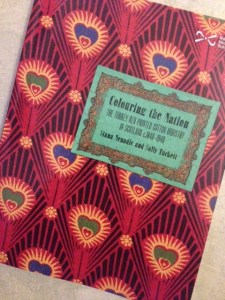
I have just enjoyed reading ‘Colouring the Nation’, a book about the Turkey red industry which set up along the Clyde and Vale of Leven in the nineteenth and twentieth centuries. One of the fabrics in the installation (the one on the right, above, with the fan) looked very like a Turkey red or Turkey red derived pattern, and the dates fit.
Thanks to theDevon Guild of Craftsmen and the artists involved in the two exhibitions for permitting photography of their work.
Colouring the Nation: The Turkey Red Printed Cotton Industry in Scotland c1840-1940
by Stana Nenadic and Sally Tuckett. Published by National Museums Scotland
There is an associated website which is well worth a visit for its text and searchable images. There are 501 available to see from the full 40,000 contained in the pattern books now held by National Museums Scotland.
In the previous post I mentioned gum arabic. I vaguely thought it came from a tree but I don’t actually know much about it. Wikipedia’s entry here explains that it is known by many names, including acacia gum, which starts to give the game away. The trees concerned are Senegalia senegal and Vachellia seyal and Wikipedia continues, ‘The gum is harvested commercially from wild trees throughout the Sahel from Senegal to Somalia, although it has been historically cultivated in Arabia and West Asia.’
Gold, frankincense and myrrh (the dark grains)
Frankincense
Thanks to a generous travelling friend I have a small amount of two valuable resins which also come from trees: frankincense and myrrh. As precious gifts from kings at Bethlehem, frankincense and myrrh obviously predate Christianity. Frankincense (and myrrh) were consecrated incenses described in the Hebrew Bible and Talmud. It is worth reading Wikipedia’s explanation of the value and reverence in which frankincense was held.
The substance is tapped from varieties of tree, the Boswellia sacra being one. Over-exploitation of the tree is contributing to a decline in population, as is the fact that seeds from tapped trees demonstrate lower germination rates.
Myrrh
The trees which are the primary source of myrrh are Commiphora myrrha. In ancient Egypt and along with natron it was used for embalming mummies. Is this why the Christmas carol contains this rather glum verse?
Myrrh is mine, its bitter perfume Breathes a life of gathering gloom Sorrowing, sighing, bleeding, dying Sealed in the stone-cold tomb
Perhaps not, according to Sister Sarah’s Bible Bytes. Her explanation has a surprising take on myrrh – to those of us unfamiliar with Old Testament texts. Read versions of Esther 2:12 here.
Apart from playing its part in the narrative of the Christmas story, myrrh is still used is Eastern and Western Christian rites, including the sacraments of chrismation and unction.
“… there are known knowns; there are things we know that we know. There are known unknowns; that is to say, there are things that we now know we don’t know. But there are also unknown unknowns – there are things we do not know we don’t know.”
United States Secretary of Defence, Donald Rumsfeld, 2002
Australian Journey: bush Night
Australian Journey: Judbarra
With the Christmas break just round the corner I know that if I don’t hit certain things right now it will be endlessly harder to pick them up in the New Year. So I have stopped making new work (see above) and am organising the references for my co-authored DHA paper.
I am into Harvard References. I don’t have an academic background but occasionally I stray into Dark Territory and have to abide by the mighty rules, one of which is correct referencing. Writing up the DHA paper has meant revisiting texts read and absorbed maybe five years back. I have been favoured with a good memory and this means I sometimes remember very well that I know something, but don’t remember how or why. If I recognised the need to know at time of reading I will have taken a note of a source. But as is the way with research, sometimes I don’t always know the relevance of a fact or a comment until a few years down the line. Then it can become vital – and that’s when it all goes a bit Rumsfeld.
So to his much lampooned statement (which I have always felt is more sane than many suppose) I’d add the following:
“… there are known knowns; there are things we know that we know. We just don’t know where we read them…”
And I recommend the University of Exeter’s helpful online resource here.
No, that’s not something that nasty pirates do*. It’s me, head-switching again. There’s a copy deadline coming up for the Journal for Weavers, Spinners and Dyers so I have had temporarily to drop the write-up of the DHA paper. I also need to continue making scarves. One is a commission (yes, RD, there will be a choice for you!) but also a batch for the Burton Gallery and Museum, Bideford, where I am demonstrating working with wax all day on 14th December as part of their Meet the Burton Makers family programme.
Sgraffito sherd found in garden
Glaze on Clive Bowen bowl
Sgraffito detail from Clive Bowen teapot
The Burton Gallery and Museum, Bideford, Devon
I am a devoted fan of the Burton Gallery and Museum. I urge anyone visiting Bideford to go. I happen to love the ceramics of North Devon; they have an excellent permanent display from the RJ Lloyd Collection and I never tire of looking at it. Related to the collection is a brick-built bottle-kiln adjacent to the Gallery in Victoria Park and wood firings regularly take place there. In the images above you can see a sherd of pottery I found in our vegetable patch. There is an entire plate with almost the same pattern in the RJ Lloyd collection, dated to the 16th century, so my find is rather special and I keep looking for more of it under the carrots and chard. The historic Devon pottery tradition carries on today with the work of many local potters, including that of Clive Bowen. We have several pieces of his work at home.
The Burton has a permanent collection of watercolours and drawings containing evocative marine and local scenes but also shows touring art exhibitions of international standard. It also has rather a good and child-friendly French café…
Australian Journey series: Night: detail
Australian Journey series: Night: detail
Australian Journey series: Night: detail
Australian Journey series: Night: detail
Australian Journey series: Night: detail
Wax resist work
The images of the scarf in progress show the final layer of dye applied over about five layers of wax and dye. You will see that in two images there are beads of dye on the wax surface. On other images they have been removed. This is because if they dry on the wax surface, they will eventually deposit themselves on the silk when the wax melts out and I don’t like the often fuzzy, mottled effect this produces. So I wipe it off, carefully. Minute quantities of residual dye attach themselves to the textured surface of waxed shapes which produces unpredictable but often subtle textures. These I do like. The wiping-up process is rather like cleaning an etching plate before printing: I do it in a whizzy, upwards, circular motion. Thank you Mr Sellars, who taught me how to do this fifty years ago.
* Apologies to those reading this whose mother tongue isn’t English. Poly-heading is meant to be a joke – a pun – because ‘Polly’ is the name people often give to pet parrots, and as we all know parrots always sit on old-fashioned Long John Silver-type pirates’ shoulders saying ‘Pieces of Eight’. A pirate might want to knock its head off if it went on and on…
The other thing we all know is that when one attempts to explain a joke, it ceases to be in any way amusing…
I’m crunching a lot of words these days. As a voluntary editor for the Journal of Weavers, Spinners and Dyers I normally spend at least part of my day reading and commenting on articles, corresponding with authors, checking facts and figures, proofreading or generally nitpicking. I happen to care about commas, colons and how to spell practise. (If it’s a verb, use an ‘s’. That’s if you’re British).
Writing up part of the co-authored DHA paper from La Rochelle (see previous post) is also a priority and it’s a lengthy task which may stretch to several thousand words.
My main computer is in the studio and it’s here that Journal, editorial and some research work happens. The studio is also where I keep dyes, brushes, wax pots, frames and silks. Theoretically it’s the place I make things too – but studio work has suffered heavily over the past months from the quantity of research and editorial commitments. I consider everything I do absorbing, but there is only one of me. And there’s the question of changing heads.
From art college training I realised, and perhaps learned, the intense concentration needed to draw or paint. If I have to interrupt work on a drawing or experimental textile, creative thought-trains chuff-chuff deep into irretrievable tunnels by the time I get back, and I lose the metaphorical plot, as has this sentence. Essentially, I find it intensely frustrating to be interrupted when I’m working on something new.
With an established design, it isn’t so difficult as it’s only half new. Sometimes I can change heads from the particular analytical demands of editing, and work on a textile. I know what I’m aiming at, and although each textile is unique it’s like being guided by written music. Instructions have been established; technique and interpretation are what matter.
This week I’ve been constantly switching heads. I’ve been editing articles on shipwreck dye cargoes, medieval woad vats, or working on the history of a Leeds dye manufacturer: then I migrate two metres to wax pot, silk, frames, dyes and an established design theme. In three paces I unscrew Nitpick Ed-Head and replace it with Agent Zig-Zag. Zig-Zag, because that’s the design I’m working on this week.
I can’t always do this head-switching lark. I can’t always manage to ban the activity I’m not doing from my thoughts, and then nothing works at all. But this week it’s going OK.
A variety of wax application tools. The wax granules are still melting out
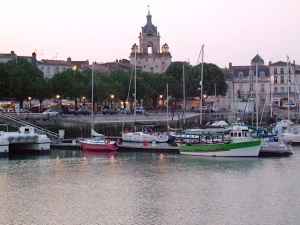
I’m back from a trip to the DHA (Dyes in History and Archaeology) Conference in La Rochelle. La Rochelle hosted the ISEND Conference in 2011 and so I was already familiar with the conference venue – a former fishmarket, now the exhibition and conference centre L’espace Encan.
This is a text-heavy post, so here’s a picture of La Rochelle to keep you going.
La Rochelle
A DHA conference annually attracts a wide variety of delegates from various disciplines. This year there were about 90 of us. Our number included chemists, conservators, artists, historians, researchers working with natural dyes, and students at various academic levels. At a DHA conference you can find yourself sitting next to someone from the British Museum, the Louvre or the Rijksmuseum, or an independent scholar who is simply passionate about parchment. It is a friendly assembly and all are welcome. Even if, as a non-chemist, you sometimes sit boggle-eyed through muscular technical papers full of graphs, analysis and molecular data, there is always something to be learned. I’m told that in early DHA days (this was the 32nd meeting!) there was a heavy bias towards these more scientific analytical papers but that nowadays the balance is more even, with a good mix of historic /scientific presentations. The selection committee who choose proposed papers must have an intensely hard job. Of the 24 or so papers accepted, several intrigued me but as none have yet been published this handful of comments remains general.
Purple Parchments
One paper involved the analysis of purple-dyed parchments. Very little work has been done to analyse the source of the purple colour in such codices and as far as I understand, there is currently no scientific evidence that shellfish dyes were used on the parchments. Non-invasive methods are normally used in their analysis, essential if precious manuscripts are to be studied without damage, and these methods can make it more difficult to identify dyestuffs. (With a parchment it isn’t so easy to remove a physical sample as it can be from a textile, where a loose fibre may be available).
There was a mention of dyeing parchment with orchil, and my ears twitched. Last year I was asked to dye some parchment samples with orchil – and dye they certainly did. But it was apparent that the temperatures and immersion involved in dyeing with orchil stiffened and damaged the parchment quality. I felt that this method wasn’t viable. Cold-dyeing seemed to yield a more sympathetic result but I have no idea to what extent the parchment quality was affected as I was only sent miniscule pieces of parchment to dye.
In the post-presentation question session it emerged that the term ‘dyeing’ means different things to different people. Some delegates considered ‘dyeing’ could be the layered painting on of dye and not dyeing by immersion, as working dyers think of it. Now, I should say that I tried painting orchil on too, but soon lost the will to live. It would be immensely protracted to paint on sufficient orchil to build up a good colour. That’s not to say it would be impossible, I just didn’t have the time or the resources to continue.
It will be interesting to learn more about this research. Maybe at Glasgow and DHA 33 next year? The dates are October 30th – 31st 2014.
Shearings and Clippings
Magnified images had been studied by the presenters which showed lumpy-looking particles in the red lake used in several medieval paintings. These indicated that they were reclaimed dyes from red-dyed wool, made into lakes for painting. The reclaiming of red lake pigment dyestuffs from clippings of dyed wool revealed that it made good economic sense to extract the dyes and to reuse them as painting materials. The dyeing of red, from whichever dye source, was expensive and thus waste material might be reprocessed. Again, I encountered problems with a mutual understanding. Initially I was confused by the words ‘shearings and clippings’ which were used by the presenters. I associate these words primarily with sheep-shearing! In the paper the words referred to waste dyed cloth after cutting woven material – or yarn.
The finding of these ‘reclaimed reds’ isn’t in itself new. A 1996 paper by Jo Kirby and Raymond White goes into great detail (find it here) and also lists a number of paintings in which red lake pigment dyestuffs have been found. Have a look. You may be amazed.
Networking
A couple of years ago, at DHA in Lisbon, I presented a paper about the trade in dye lichens from Angola through Lisbon. I have yet to publish this, for several complicated reasons. But I had an interesting conversation with another delegate which led me to sending a very small quantity of dye lichen and a recipe to the University of Évora. I heard no more, and forgot all about it. At La Rochelle my Portuguese colleague and her team presented a paper in which they had measured and tracked the breakdown of the depsides and depsidones (the dye precursors) in the orchil preparation process until purple chromophores formed. Chromophores are the part of the molecule responsible for colour. The chemistry was patiently explained to me in a coffee break and I now understand rather more about the process that before – although I wouldn’t like to take an exam just yet. DHA is great for this kind of contact and co-operation.
DHA=GFZ: A Gremlin Free Zone
If you read the previous post you will now that I was co-presenting a paper at DHA 32 and I wrote about the snaggly-toothed IT gremlins that lurk for unprepared presenters. I am pleased to report that my eminent co-author, Zvi Koren, had done an admirable job on gremlin-bashing (he’s ace at puns too) and everything loaded and presented totally as expected. So did everyone else’s, and we all benefited from calm, unobtrusive technical expertise delivered by Florent Glatard of ARRDH- CRITT Horticole. Our presentation was really well-received but I will not be writing about it until formal publication.
Thanks to DHA 32 organisers Anne de la Sayette and Dominique Cardon
Anne de la Sayette is the Directrice of ARRDHOR – CRITT Horticole, a ‘centre of research, innovation and technology transfer in horticulture’. Dominique Cardon is well known to most natural dyers as author of Natural Dyes: Sources, Tradition, Technology andScience. She is also Emerita Senior Researcher at CNRS, the French national centre of scientific research. CIHAM UMR 5648 CNRS (an institution, not a mathematical equation..) is one of the most important research centres in France for history, literature and archaeology of the Middle Ages. A new book by Dominique is about to be published but I don’t have the details: as soon as I do I will add them to a post.
Carnac
If you have got this far you deserve a pictorial prize. Using photos from DHA is tricky as I feel I should ask people’s permission before posting their images on a blog, so here is something rather special from the trip home.
Orchil lichen on stone at Carnac
One of the Carnac alignments
Viewpoint over Kerlescan alignments
I had never been to Carnac in Brittany until last week and I had no idea of the scale and breadth of the entire site. But it seemed most serendipitous to discover, on some stones of the alignments, a quantity of orchil lichen. Naturally, I did not touch it. But here are some images to reward stalwart readers. The orchil lichen is in the left hand image only.
I’m halfway between two presentations. The first was for the 6 Guilds of Weavers, Spinners and Dyers at Stratford where I spoke about orchil and how the trade in lichen dyestuff reached global proportions in the late nineteenth century. I thoroughly enjoyed my day at Stratford which included a talk by co-speaker Joan Baxter on the way the East Sutherland landscape influences her tapestries. Her recent collaborative work with dancers Between the Web and the Loom was interesting and she showed some video clips. But I can’t find any images on the internet to provide a link beyond this one (about the dance) and this one (about the tapestry she wove).
The second presentation is for the Dyes in History and Archaeology Conference (DHA) in La Rochelle, France. That’s later this week, is about something else entirely, and it’s going to be rather sensational.
Friday 4th October
11:45 Treasures from a Leeds Dye Chemist: A Century-Old “Tyrian Purple”?
Isabella Whitworth, Zvi C. Koren
If you want to know more about the sensational, come to La Rochelle. Otherwise, I’m sorry, you may have to wait a little. To download the whole DHA La Rochelle programme, visit this page and follow the links at the bottom.
For the moment, here is a taster in the form of some images. You will see two men, both chemists. There is a brother and a sister, and the son of a famous father.
Charles Samuel Bedford
Annie Perkin, née Bedford
Arthur G Perkin, second son of Sir William Henry Perkin
Lectures and technology
Those who are of ‘a certain age’ will remember that one of the worst things that could happen when giving a lecture was that you dropped all the slides just prior to going on stage then reloaded them upside down, in the wrong order and back to front.
Technology wasn’t satisfied with such piffling levels of stress. So it created Macs and PCs and system updates; memory sticks and SD cards and PowerPoint and embedding. It now arranges that hosts provide an ancient laptop unable to read anything post 1910; it organises missing leads, the wrong leads, deflating batteries, clickers that die, videos that won’t load and projectors which will have nothing to do with your laptop.
I have watched entirely respectable speakers show a presentation devoid of images because they haven’t checked their Mac presentation on a PC – or haven’t embedded their photos.
As a result I am obsessive about options. At the 6 Guilds event I took my own Mac laptop, own projector, requisite leads plus a boggling array of memory sticks and SD cards correctly formatted and checked out on a neighbour’s PC. In fact, the options proved unnecessary as the 6 Guilds laptop was up-to-date, the memory stick loaded, and two super-calm techies were in control.
For DHA, all presentations have to be sent in advance of the Conference which is good sense – in theory. You will be informed that something has arrived, but you still don’t know if the presentation shows exactly the way you designed it. So, when you get there, you need to check – and have some options up your sleeve. I didn’t do the DHA PowerPoint: my co-author did, for which I am deeply grateful. It can all be his fault.









 Isabella Whitworth