Isabella Whitworth

probably more than natural and synthetic dyes, wax, resists, and history


2 Comments

Historical Dyeing at Leewood

Over the next few months I am working on a set of historical dye experiments at Leewood in the Dartmoor National Park with friend and colleague Jane Deane. Leewood is a beautiful 30 acre smallholding in the Dartmoor National Park owned by artist Nick Viney. It is set on the bank of the river Walkham with water-meadows and ancient woodland, and offers a versatile environment for events, creative study and sustainable (but definitely comfortable!) camping. You can see Leewood’s website here.

Jane and I are conducting a set of detailed dye experiments at Leewood using traditional dye recipes and several varieties of fleece. Using the dyes of woad, indigo, cochineal, madder and weld we are comparing amounts of dye absorbed by individual fleeces. This information will be of interest to contemporary makers and textile conservators. It will be a long project which could run into a second year so any conclusions will be arrived at slowly.

We did a starter session with weld earlier this month.

Our weld session left us with rather more questions than it answered, but we are on our way. The sessions at Leewood are open to visitors – although we may politely ask them to stop asking questions from time to time while we struggle with the maths, at which neither of us excels.

The next session is on April 11th, and we will be using madder.


Leave a comment

Natural dye extracts with wax

There’s a lot going on. A deadline for the Journal for Weavers, Spinners and Dyers meant last-minute articles had to be reviewed and proof-read. This coming weekend I am teaching at West Dean in West Sussex, the course is full,  and there is a lot to do in advance. Immediately after getting back from West Dean I start a series of structured historical dyeing experiments at Leewood with colleague Jane Deane – more about the project on this page. The house smells of hot sheep at the moment as I have been scouring fleece. Next week I deliver new work for the spring exhibition at Redearth Gallery… and so it goes on.

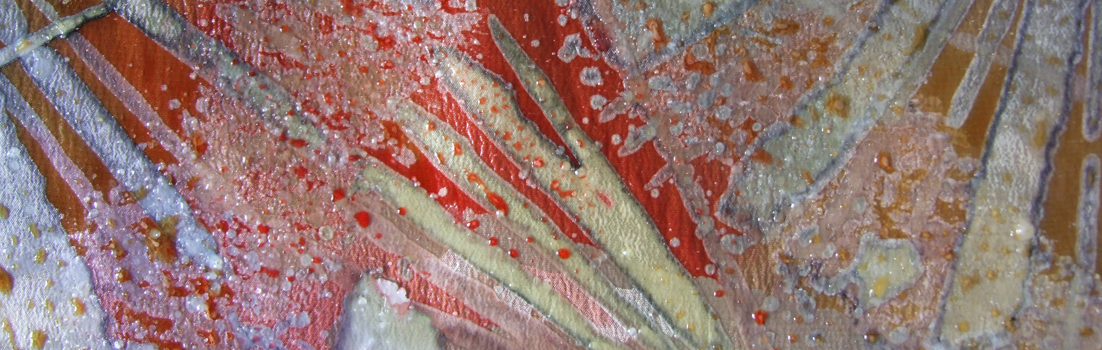
Reading that lot, I am not quite sure how I found time to do a little work with Aquarelle liquid extract natural dyes (see my blog post on them here). But I used spare hours to paint the extracts directly onto mordanted silk, using wax as a resist between the layers of dye. The instructions for Aquarelle give details on heated dye baths for fixation but this is not an option with wax resist, because the heat of the dye bath would melt the wax. My plan has been to place dye-painted and partially dewaxed work in the fabric steamer to replicate the heat and damp of a dye-bath. To start with I just used two of the dyes: the liquid indigo ‘Saxon Blue’ and the Himalayan Rhubarb.

NOTE: My comments on the outcome must be read as they stand: they are emphatically not a comment on the effectiveness of the dyes themselves but on the dyes used in this unconventional way.  There is a lot more work I need to do having seen the results.

My working method was as follows:

  • Silk scarf blanks mordanted in 8% alum 2% cream of tartar
  • Dried scarves stretched on a frame
  • Wax applied – in this case and in each layer simple stripes and lines across the scarf
  • Different dilutions of Himalayan Rhubarb (HR) and Liquid Indigo Saxon Blue (SB)  applied to create variations of blue – green
  • After several layers using a similar technique, wax partially removed by ironing cloth between newspapers
  • Work rolled in paper and steamed for one hour (note: I don’t have a thermometer in the steamer. It is brought to the boil every two minutes and turns off for about two minutes)
  • Work dipped in White Spirit to remove residual wax, and rinsed several times

Observations:

The good news is that the dyes have set in the steaming process. Repeated rinses after the White Spirit dip run entirely clear. I lost some of the SB in the first rinses, but this was almost certainly because I notched up the SB concentration to extremely high levels in some areas and probably overdid it. I always think of dyes and dye-sites like a game of Musical Chairs. When the chairs run out, the dye has nowhere to sit, molecularly speaking. It’s more to do with the fibre than the dye.

This experiment shows that it is possible to build quite dark tones by increasing the concentration of dye in selected areas. There are some deep greens. I had wondered if this would be possible, and it looks as though it is.

However, the HR has lost its lovely golden hue (see the original colour centre top) and has dulled to ochre. If you look at the images you can see some in which the steaming paper has picked up a lots of pink from the HR painted areas. The dyed steaming paper is lovely in itself: the red component of the dye has leached into the paper and didn’t fix to the silk. I have no idea why. It could be the mordanting. It could be the paper. It could be that I steamed too long, or steamed too hot. It could be that it would always happen, whatever the steam-time and heat. I now need to  dye silk with all the Aquarelle colours, using their recommended dye bath, to evaluate their ‘true’ colours.

The centre image shows small blotches on a brownish area. These are created by small spots of dye on a wax surface which I failed to wipe off. These are travelling through to the silk surface as remaining wax melts in the steamer, and they then fix. In this case it is not too big a blemish, but it can look smudgy and ruin a design.

On the centre right image there are ugly blue splashes. These weren’t present when the fabric went into the steamer. I think loose dye may have travelled all the way through the steaming paper and I shall use two layers next time.

More puzzling is the bleeding of the SB into areas that had been waxed onto white. You can see these top right and centre left in the images. This can happen with synthetic dyes if the work has been placed too close to the outside of the paper roll. If you imagine the rolled paper in the steamer (see here for an idea of how it looks) there is more moisture reaching the roll on the outer surface when it is in the steamer. If the steamer isn’t up to heat, work on the outer part of the roll receives a lot of moisture, doesn’t begin to fix and starts to wander around – playing Musical Chairs. The solution is to wrap additional paper around the outside of a steaming roll. I didn’t do it this time. I am not sure whether the bleeding is a result of the steaming process or an issue to do with the dyes themselves. This didn’t seem to happen with dyes on the inner part of the roll, so I tend to blame my lack of foresight.

Conclusion

There is a lot to do but I am enthusiastic about the potential for working with Aquarelle with wax. The colours I achieved aren’t particularly exciting because of the dullness of the HR after steaming, and I need to research this aspect. But they have fixed efficiently via the steamer, it does seem possible to use wax as a resist, and to achieve some strong, dark tones. So I am optimistic; I just need a 36 hour day.


6 Comments

Changing knowledge, changing attitudes: lichen dyeing

Because it looks like the inside tissue of human lungs, the lichen  Lobaria pulmonaria  (also known as Lungwort) was once commonly used in the treatment of chest infections. The historic rationale of using herbs that resemble parts of the body to treat illnesses of those parts of the body is called ‘the doctrine of signatures’. According to Wikipedia,  a theological justification was made for this philosophy in Christian European metaphysics: It was reasoned that the Almighty must have set his sign upon the various means of curing disease which he provided. The ‘signature’ on the plant was that of God, as a means of guiding the healer’s hand.

The substances in lichens used for both medicines and dye are normally acids; each lichen species can contain several types. The Wikipedia article (linked above) contains contemporary references to possible medicinal uses for  L. pulmonaria, which has indeed been found to have anti-inflammatory and ulcer-preventing properties. So, perhaps it did assist in the treatment of chest infections. When I was in Ecuador I saw usnea lichens sold  for the treatment of sore throats.

I took a serious interest in lichens when I began to study the orchil trade five years ago. You can read how it all came about here. Back then I joined a one-off lichen study walk, arranged by the local branch of the British Lichen Society (BLS). On the walk we were shown L. pulmonaria growing on just one ancient oak; the presence and abundance (or not) of this particular lichen is considered an indicator of forest age as it is normally found only in ancient woodland. It has been badly affected by habitat loss and pollution and according to Dominique Cardon, in many European countries it is a Red Data Book lichen.*  Those of us on the lichen walk were asked not to broadcast the precise location of this rare specimen, but as the BLS  Lobarion Interactive Map reveals L. pulmonaria  at Rosemoor, I can confirm that’s where I saw it – without incurring enduring wrath from the BLS.

In 1960, Eileen M. Bolton published a little handbook for handweavers called Lichens for Vegetable Dyeing.** The book is no less than a classic. It is scholarly from botanic and chemical perspective and it’s also beautiful. It is illustrated with Eileen Bolton’s carefully observed drawings and paintings with several lichens appearing on the same page along with snails, butterflies and curling fronds of ferns or flowers. Through these she shows a thorough knowledge, love and and respect for lichens, and her text includes comments relevant to the US as well as Europe. She makes no general statement on the wisdom and ethics of gathering lichen although she does advocate taking only a little of the L. pulmonaria ‘as it takes years to grow, and forestry operations are likely to make the plant even more scarce.’ She also refers to some species as being ‘less plentiful’.

In 1991 the book*** was reissued in the US due to the efforts of Karen Diadick Casselman. The fascinating story of Eileen Bolton, her family, and tracking down the copyright to her 1960 book, is told in the preface. I strongly recommend reading the preface but the whole book is available to read online here where you can also see Eileen Bolton’s illustrations. The re-issued book was updated to included the status of rare and potentially endangered lichens; L pulmonaria is noted to be endangered in Britain by 1991.

Ten years later, Karen Diadick Casselman’s 2001 book**** on lichen dyes is prefaced by two pages on the ethical approach to dyeing, a useful chapter  on ethics and identification, and an epilogue which briefly exposes some conflicting attitudes and raises questions that potential lichen dyers might consider. I would just add this: I have learned a little through  my contact with mycologists while researching orchil and one of these is the utter complexity of lichen reproduction. It still isn’t properly understood. It isn’t known that a ‘windfall’  lichen can no longer reproduce, or for how long it might reproduce once fallen.  Gathering windfall lichen seems less of a wise move than once it did unless you are actually rescuing it from the bonfire. I now place windfalls back into the crevices of trees.

Last but not least: the pronunciation issue

Is it lichens (to rhyme with kitchens) or lichens (sounds like likens)? I have always said lichens to rhyme with kitchens. Maybe it’s a generation thing in the UK. I am not sure about pronunciation in the US (I’d like to hear from you!) but I think the likens pronunciation is more common. At the Royal Botanic Gardens, Kew, where I have worked with mycologists, they also say ‘likens’. But they also say I am not wrong, and as I have no intention of changing at my age, that’s just as well.

Books referred to in this post

*Natural Dyes: Sources, Tradition, Technology and Science; Dominique Cardon; Archetype Publications; 2007; p 518-9

** Lichens for Vegetable Dyeing; Eileen M. Bolton; Studio Books 1960

*** Lichens for Vegetable Dyeing; Eileen M. Bolton; second edition edited by Karen Leigh Casselman and Julia Bolton Holloway; Robin and Russ Handweavers 1991

**** Lichen Dyes: The New Source Book; Karen Diadick Casselman; Dover Publications 2001

5 Comments

A purple tent and Mr Ibsen’s haplotype

A journalist friend once told me that when bored in the newsroom, colleagues would set each other random words or phrases to insert as logically as possible into the day’s articles. The game was to sneak them past the wily editor, and everyone bought the winner a beer. With no colleagues to deal me a rum hand, I idly set myself a trio. A purple tent; sheep’s dung and Ibsen’s haplotype.  

As only the wily and super-smart read this blog, they will instantly smell a rat and I will not win the beer tonight.

Yesterday I received a draft paper on a set of sixteenth century tapestries at the Historic Royal Palaces – in this case, Hampton Court. During conservation work last year, dye analysis was carried out on a tapestry and orchil was found. Because tapestries were such lavish purchases, (a series might cost the equivalent of a super-yacht in today’s money), the use of such a light fugitive dye is surprising. But it’s not the first instance I know of. In the book accompanying the V&A’s 2010 exhibition of the Sistine Chapel Tapestries,* the (pitifully small) commentary on the dyes included the finding of orchil.

In the case of the Hampton Court set, further analysis was to be carried out which involved dyeing and testing wool samples. I assisted  by teaching the making of an orchil vat and demonstrating how to dye with orchil. It was fascinating to be involved in such a project and when the paper is published I will say more about it. Alexander and Hephaestion were the key figures in the tapestry, standing in front of a purple tent. The tapestry is one of a series called the Battles of Alexander. 

And onwards to the sheep’s dung. My initial contact with Hampton Court was through a recommendation. The natural dye / natural dye history world is very small and everyone knows each other’s particular dye obsessions. Deb Bamford is an expert natural dyer, member of the Online Guild of Weavers, Spinners and Dyers and always seen at the DHA (Dyes in History and Archaeology) conferences. She has worked and advised at Hampton Court before and was able to recommend me for my involvement with orchil. Deb will be a tutor at the Summer School of the Association of Weavers, Spinners and Dyers in August this year. I have a place on her course Turkey Red and all that Madder. One of the challenges in natural dye is in obtaining good shades on cellulose and I hope to learn a lot about the various methods and recipes for Turkey Red for which one ingredient used to be sheep’s dung.

My involvement with dyes, history and chemical analysis has increased over the past five years and it is astonishing what modern analysis can reveal about  dyes, colour, and even the variety of a species used to dye a textile. I have been similarly intrigued by the strands of research and archaeological evidence that included the DNA analysis of Michael Ibsen and the identification of Richard III’s bones.  One of the first novels I ever read was The Daughter of Time by Josephine Tey, which questions the ‘Shakespearian’ version of Richard III and considers how history is constructed very much in the interests of its authors.

Its title is based on a quotation from Sir Francis Bacon: Truth is the daughter of time, not of authority.

* Raphael: Cartoons and Tapestries for the Sistine Chapel; Evans, Browne and Nesselrath; V&A Publishing 2010; pp 36-37


4 Comments

New toys, no time to play

Last week I took one of my regular looks at Jenny Dean’s website Wild Colour. Jenny is an authority on natural dyes and author of several practical books on the subject.  I respect her work and long experience and her website invariably includes something new and interesting.  Her book Wild Colour was reprinted by Mitchell Beazley in 2010 with updates and revisions – and I wouldn’t be without it.

Jenny’s entry for January 8th 2013 was about a set of natural dye extracts in liquid form. They are called Aquarelle, they are from Botanical Colors and certified compliant with the Global Organic Textile Standard (GOTS). Jenny’s images show colours on wool yarn and silk fabric; some are mordanted and some are not. The colours look very good, especially on the wool, although the silk looks paler.

Twitter was then tweeted to see if any dyehards had experience of Aquarelle. Positive input arrived from several people including  Jane Deane  (no relation to Jenny and note the different spelling!) who tested the dyes last year. Jane probably told me all about them then, but I’m afraid I had forgotten.

I have used raw dyestuffs or powder extracts, but never a liquid extract which might suit my work better so I ordered a set of dyes which arrived yesterday. There is only one stockist in the UK, as far as I know, and that is D.T Crafts who import the dyes from the States. Unfortunately I just don’t have the time to try them out at the moment, so I took a photo instead.

A satisfying way of combining natural dyes with wax resist continues to be a challenge for me.  I am at my most confident when designs originate in a drawing or sketchbook study and gradually evolve into an image, a texture or an arrangement of shapes, defined by wax as a resist. The original drawing drives me onwards through several incarnations of an idea, although I occasionally fizzle out, exhausted or bored when something doesn’t merit further exploration.  Synthetic dyes are my medium for this type of work; they are painted on in layers alternating with the wax, and then steamed. They go where they are put, they stay there, the overdyes are predictable and they don’t change colour. It’s not at all like that with natural dyes, which, of course, is part of their allure.

Natural dyes normally require heat, and heat melts the wax, so there is an instant difficulty with the natural dye / wax technique. Each separate dye requires individual handling and the colour may not turn out the same as the last time you used it. One dye can affect another, unexpectedly altering a colour or tone and overdyes aren’t always predictable. The timing of the indigo layer is crucial, as is mordanting. I have achieved a few pieces that I am happy with and these can be seen in the gallery section, and above. The central piece suffered from too much alkali in the indigo vat and the silk went harsh. That’s yet another problem with the technique.

I will certainly be posting on the results of work with Aquarelle when I  have time to try them out.