Isabella Whitworth

probably more than natural and synthetic dyes, wax, resists, and history


3 Comments

Installations, pasties and Turkey red

I’ve found a link between art installations and our family’s Pasty Evaluation Test. We live in the South West, the traditional home of the pasty. Most local bakers produce pasties and whole businesses are devoted to their making, including one of our favourites, The Original Pasty House in Tavistock. What is the Pasty Evaluation Test? Taste and healthy ingredients are part of it, but the initial stage is to check how many bites it takes before you achieve something other than pastry-coated air.

It’s the same with installations. I’ve seen many that beckon appealingly but prove increasingly unrewarding and wearisome post-first-bite. I don’t want to pre-read screeds of explanation telling me what to think, so if an installation doesn’t communicate after a decent period of interaction, then for me it’s a non-starter. 

I remember some good ones such as Jaume Plensa’s gongs at The Baltic in 2002. (Note: YouTube link shows them at the Yorkshire Sculpture Park where they seem arranged in a different way). They glowed in changing light and there was a timeless, temple-like quality to the space where silence and sound defined each other. People sounded the gongs with great intensity and contemplated powerful reverberations. Others seemed embarrassed to hit the gongs, as if they needed permission. A further cohort transformed into delighted children, shattering reverence with indiscriminate boing-ing and restaging the experience as wicked fun. It ended up as much about watching people as listening to gongs.

Not quite on the same scale, but I did enjoy two installations at the Devon Guild of Craftsmen this week. The first was Tina Hill’s Excavating Babel, a striking, tall spiral of over 2000 once-discarded books set in dust on a dark plinth. The books had been stripped of their covers, and thus identity, revealing a structure of sections and linen stitches, showing that books are, or can be, sewn together.  Created with books set uniformly with spines outwards, the inner spiral could be entered. It enclosed, isolated and insulated the visitor with a dense paper barrier. One was aware of millions of pages of muffling, unknown stuff.  What was this no-longer-needed information? There were interesting supporting notes to read, which afterwards I did. But Excavating Babel worked on several  levels without explanation, and thus passed the equivalent of the Pasty Evaluation Test.  You can see more about it on Tina’s own site here. Excavating Babel is part of the Devon Guild of Craftsmen exhibition Narrative Remains and you can see it until 23 March.

In the Riverside Gallery, also at the Devon Guild, is another exhibition called Love, Loss and Laundry.  This can be seen until March 16th. Through stitch and fabric Jacqui Parkinson commemorates the lives of destitute women and girls who worked in Devon House, Bovey Tracey. Devon House was run by Anglican nuns of the Clew Sisterhood – the notes record that they were largely a kindly organisation.  The refuge they offered allowed some girls, at least, to obtain respectable jobs in service and even to marry and have families of their own.

Women and girls were mostly occupied with laundry and sewing. Dirty sheets were washed, torn clothing darned, linen patched. But many inmates of Devon House lived or were buried unnamed. If it were not for the 1911 census records, their lives might have left no trace.  Anne Liebermann’s embroidered linen squares record some of these lives in the delicate red cross-stitching of their names from the census. Jacqui has sewn these onto squares of an old bedspread where layers of old fabrics can be seen. The squares resemble the padded fabric the girls would have used to hold an iron and the names are haunting and moving.

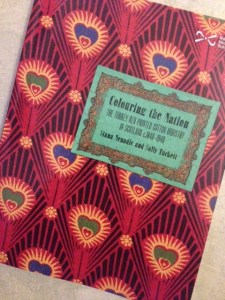
I have just enjoyed reading ‘Colouring the Nation’, a book about the Turkey red industry which set up along the Clyde and Vale of Leven in the nineteenth and twentieth centuries. One of the fabrics in the installation (the one on the right, above, with the fan) looked very like a Turkey red or Turkey red derived pattern, and the dates fit.

Thanks to the Devon Guild of Craftsmen and the artists involved in the two exhibitions for permitting photography of their work.
book

Colouring the Nation: The Turkey Red Printed Cotton Industry in Scotland c1840-1940

by Stana Nenadic and Sally Tuckett. Published by National Museums Scotland

From Amazon here

There is an associated website which is well worth a visit for its text and searchable images. There are 501 available to see from the full 40,000 contained in the pattern books now held by National Museums Scotland.

http://www.nms.ac.uk/turkey_red/colouring_the_nation.aspx


4 Comments

More-or-less-Ethel and the Mairet madder method

Several years ago I was fortunate to buy a small out-of-print hardback book in the collection of an Oxfordshire dyer. It was Ethel Mairet’s Vegetable Dyes. Originally published in 1916, the book is something of a classic and my 1952 edition represents its eleventh reprinting. I normally don’t like finding handwritten marks and notes in books but this one has been well-used, and I enjoy thinking of (at least) two dyers before me making use of it.

Ethel Mairet, née Partridge, was born in 1872  in Barnstaple, North Devon, which isn’t far from where I live. Her life was extraordinary on many levels as an influential figure in arts, crafts and education. She was married for a time to a Ceylonese called Ananda Coomaraswamy and travelled to Ceylon with him, studying and documenting weaving, spinning and dyeing techniques. She divorced in 1912 and married Philippe Mairet in 1913. At ‘Gospels’, her house at Ditchling, she set up a workshop and taught students who themselves became influential in the textile world. These include Marianne Straub and Elizabeth Peacock. Elizabeth Peacock has an association with Dartington, also here in Devon, for whom she wove a set of banners in 1938. There is an image of one of them here.

In 1931 Elizabeth Peacock co-founded the Association of Guilds of Weavers, Spinners and Dyers (AGWSD). With others, she organised the first AGWSD Summer Schools and if you have been reading previous blogs about madder and Turkey Red, you’ll know that Summer Schools are still held biennially by the Association.  Ethel Mairet taught on these first Schools, so I’m glad her madder recipe emerged with such success at Carmarthen. Opinions change over the years, however, and nowadays dyers tend to use much less alum mordant than the 25% her 1916 recipe recommends. It’s certainly a large percentage for me.

Blessed with some summer sun, I have been drying out the wet madder chips I brought back from Wales. I was surprised at how much the heap shrank as the chips contracted. With the liquid madder exhaust I have used a More-or-Less-Ethel (call it MOLE?) method to dye scarves. It’s ‘more-or-less’ because the exhaust is an amalgam of numerous dyebaths from Summer School and isn’t consistent with Mairet’s recipe. I have also dyed silk with it, and her recipe specifies it’s for wool. But I worked the Mairet long mordant (resting it damp for several days) and the 25% alum and also brought the dyebath to the boil for the recommended ten minutes. Boiling madder is very controversial as many recipes (such as Jill Goodwin’s) advise that raising the heat of the dye bath above a certain point will make the madder go nasty and brown. This is clearly not necessarily the case because our experiments included recipes where we boiled, and those where we didn’t, and Deliberately Boiled Brown became something of a Holy Grail.

If you read my blog regularly you will also know I am a voluntary editor on the Journal for Weavers, Spinners and Dyers which is the magazine of the AGWSD.  A new issue (247) will shortly be plopping onto doormats for the attention of international sets of dog-teeth; we are also approaching the copydate for a future issue. So it has been a frantically busy week. All the reports from the recent Summer School are included in 247, as well as regular articles and features.

The Journal is also announcing the appointment of the new AGWSD President, Dr Jenny Balfour-Paul, but this will be in Journal 248. Jenny is best known for her research work into indigo but is passionate about education and the passing on of our skills.  I owe my own passion for natural dyes to her: I attended a series of lectures on Japanese crafts at the Crafts Council in the early 1990s (Marianne Straub was another attendee!) and was infected by Jenny’s enthusiasm for natural dyes. She taught me to dye with indigo, and the rest is history.

Links

Ethel Mairet:

University of Brighton biography of Ethel Mairet here

vads online resource here. There are also images of her woven cloth

You can read Ethel Mairet’s book, which is out of copyright, online here 

An image of Ethel (then) Coomaraswamy weaving at Broad Campden here

Elizabeth Peacock:

vads online resource here

Dr Jenny Balfour-Paul

Jenny’s website (under construction) here

Institute of Arab and Islamic Studies, University of Exeter, here

Jenny’s work with Yo-Yo Ma’s Silk Road Connect here

Books here


6 Comments

Post-madder, madder post and a blue gorilla

I’m back home after Summer School. As one of few students on my course who took a car to Carmarthen, I brought back gallons of exhaust madder in containers, as well as a heap of bulgy muslin bags containing chopped and ground root we had used on various projects. I’m glad I wasn’t apprehended by South Wales Police trailing my gory drips: the gooey, oozing bags would have looked at home at an Aztec sacrifice. Maybe police were too busy chasing the rotter who stole tutor Jason Collingwood’s laptop and irreplaceable woven samples, some his late father’s, from his train home from Summer School.  The samples have, thankfully, been recovered: they had been chucked over a garden hedge in Neath. Through the kindness of strangers, they will be returned to Jason. The computer is still missing.

Deb Bamford suggested that if I were to empty the bags of chopped madder and dry out the dyestuff I could regrind and re-use it. It will have lost some of its colour in previous dye sessions, but I like the yellow / orange / peach  tones that exhaust madder produces on silk and wool.  As to the liquid exhausts, I shall be blending them and using them on silk and wool for scarves. I need to get on with this as the liquid is beginning to ferment and there is a noticeable implosion when I open the containers.

I looked at the vast array of madder-dyed samples we had done on the course and arranged them to photograph, then wondered how many people-hours they represented. I calculated it would have taken one person 66 days to complete the equivalent work over an eight hour day. That’s without the labour put into the Turkey Red preparation by Deb, our tutor.

Why the gorilla? I’ve been going on about red rather a lot, he is a blue gorilla and he is loose in Exeter.

Other blogs on Summer School: please let me know if you know of more

Cally Booker: A Week at the Coleg

Pat Foster here and onward posts


Leave a comment

We have Turkey Red

Not the final day of the course, but the final day of dyeing.  We have been through all the processes used in dyeing Turkey Red through a long sequence of carefully managed samples prepared by tutor Deb Bamford. Today we dyed the final stage. The temperature of the dyepot was raised and maintained and the prepared fabric was immersed, with one of the group stirring it continuously.

Turkey Red

Turkey Red

At the end of the dye period, we lifted the cotton from the pot. We had achieved a good, characteristic, Turkey Red. 

Various experiments and variations continued in the room and explanations and notes added to ‘the wall’.

Tomorrow is the last day and for tutors and students, it finishes at noon. For our course, the morning will be spent sorting and sharing samples and  clarifying processes.

Deb Bamford is highly organised; if she hadn’t been, this intensely complex course could have descended to chaos and dyeing mightn’t have been completed accurately, safely, or at all. Deb explained everything clearly and directly; she really knows her stuff. The student group has been pleasant, co-operative and multi-skilled, which has added to an enjoyable (and valuable) week.

The Trade Fair opened at the Summer School this afternoon with stands selling spinning and weaving equipment, yarns, books, fabrics and trimmings. I helped set up the stand for the Journal for Weavers, Spinners and Dyers for which I work as a volunteer editor.

Tomorrow classrooms and the Trade Fair are open to the public. In the evening there is a Gala Dinner with a speaker, and then it will be time to pack up and go home.

Two unrelated observations: it has been a great luxury to be on a course as a student and not a tutor, but it’s peculiar that I am more tired this way round.

The other is that they have some mighty fierce mosquitoes in Wales. I had hoped there was an interesting word for mosquito in Welsh, but it seems it’s mosgito. Oh.


Leave a comment

Day 4 and madder: sorry about the quilts

I have been writing Summer School blogs late at night and I am forgetting to include things. Here’s what I forgot yesterday: images of the textiles from the Welsh Quilt Centre at Lampeter. They should have been attached to yesterday’s post.

Today, Turkey Red preparations continued and we started to plan the ordering, labelling and displaying of the various samples dyed on the course. We are working in the art college (Coleg Sir Gar) in a Life Room; it’s part of a larger suite divided by folding screens. The screens are also whiteboards and we can write on them with markers, which makes displaying and explaining samples a bit easier. An exchange visit with students on Helen Melvin’s eco-dyeing course took place this afternoon and they could see the first samples together with their recipes and comments from the groups that had dyed them.

‘If you would dye wool into a perfect red colour..’ begins Gervaise Markham’s 1615 recipe from his book The English Huswife. I am in a group-within-a-group on the course; we excel at producing dispiriting pinks from recipes which boast all manner of ‘perfect reds’ as their outcome.  I think we have even astonished tutor Debbie by our unerring skill in this regard.

From the selection above, guess which yarn is ours after trying Markham’s recipe. No prizes.


Leave a comment

Madder, wool and Welsh quilts

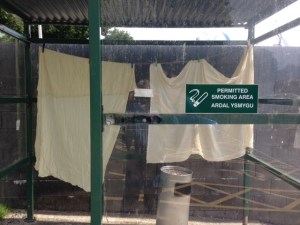
In the dye room this morning we reground the fourth and final exhaust dyestuff for the Turkey Red samples and heated it to temperature so that it could cool before dyeing tomorrow. Debbie has hung the Turkey Red-prepared cloth in the college smoking shelter – which might well discourage smokers from entering and be very good for overall Welsh health.

smoking

Smelly smoking shelter

Many madder recipes state that one should not raise the temperature of the dyepot above a certain point or the colours will turn brown.  On the other hand, many recipes have silk or wool boiling for as much as an hour. So what’s going on?

Jill Goodwin advises a maximum of 158 F (70 C). We were careful to follow her recipe yesterday, but today someone suggested we should boil one of the Goodwin skeins to see if  it would affect the colour.

So we did, and it didn’t…. and it set us thinking where such advice originates and under what, if any, circumstances it might be true.

If you read yesterday’s blog you’ll know I wasn’t sure where we were going on our outing: it turned out to be the National Wool Museum at Dre-fach Felindre and the Welsh Quilt Centre at Lampeter.

Our visit to the museum was interesting but short and there were far too many of us for a comfortable visit. Nevertheless, I enjoyed watching the spinning mule in action, and touring the finishing and weaving sheds. Across in the field was a tenterframe for stretching and finishing cloth, and a windhouse for drying more delicate fabric. The tenterframe looked squeaky-new and unhistoric (do Ikea offer a selection?)  but gave some idea of how the field might once have looked.

I came across a set of natural-dyed yarns produced by David and Margaret Redpath who, until 2002, ran Wallis Mill in Pembrokeshire. It was the last commercial mill in Wales to dye with plant materials. The dye garden behind the wool museum was sadly neglected and overgrown with weeds, although some madder was struggling plantfully on.

The Quilt Centre at Lampeter is in the old Town Hall. Currently, and until November, a collection of antique Welsh quilts is on display with work by Kaffe Fassett and other contemporary quiltmakers. There was a time when this modern work would have held all my attention, but now I am old and grey it was the monochrome historic textiles I found the most beautiful. The collection has been put together by Jen Jones, who realised several years ago that these lovely bedcovers were being discarded as having no value. In a short address to the group, Jen said that she had once seen a farmer using an old quilt to keep a sick cow warm. The Quilt Centre exhibition was superbly done, with work suspended at different angles and heights from an immensely high ceiling. Complexities of lighting were skilfully handled so that nothing appeared overshadowed.

crossover

This collection is by Moda Fabrics and is called Indigo Crossing

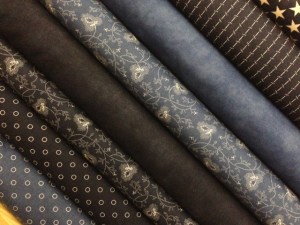
In Calico Kate,  a shop for quilting enthusiasts almost next door, I found a set of printed cottons in the blue and white derived from the traditional patterns of resist-dyed indigo. These fabrics seem to be following me around: see this post from earlier this year.

A reminder to anyone following in real time that you can follow AGWSD Summer School at Carmarthen through the posts of several students here on Twitter, using the hashtag #wsdsschool


3 Comments

Even madder dyeing: Summer School, Carmarthen

The first task of the day was to devise a test sequence of Turkey Red dyeing in which a full solution of soaked and ground madder would be used to dye with, then the dyestuff re-ground and re-used to test the exhaust of each previous phase. It is expected that each phase will produce lighter tones than the last, but dyed cotton may also shift in colour as various chemicals are taken up in the dyeing at each stage. The four groups in the course undertook a stage of grinding and re-grinding, and then the cloth dyeing. At the end of the second day we are half way through this exercise. Each stage takes a while to complete.

The sheep-dunged cotton from yesterday was first worked in the oily emulsion prepared from olive oil and potassium carbonate. It was then divided up for the four dye stages.

While this exercise continued through the day, each group worked on recipes selected from Debbie’s suggested choices. My group completed dyeing silk according to a historic recipe (Haarlem Manuscript 281/1/1)  republished in Judith Hofenk de Graaf’s book The Colourful Past. The results were pale and salmony, not the ‘beautiful red’ we had hoped for. We must re-check calculations and compare results with another group using the same recipe.

The Jill Goodwin recipe we are using has turned out more successful. Madder had been soaked overnight with two tsps powdered chalk (calcium carbonate). This morning it was placed on the stove and over the period of an hour (and before the yarn was put in it) the temperature raised to a definitive ‘no more than 158F’.  Goodwin’s instructions are somewhat stern on temperature and I guarded it with a thermometer and my life. The dyebath developed  a very marked purple foam but in the wool yarn dyeing there was no shift from the expected madder shade. The yarn is resting in the cooled dyepot so I have no picture yet.

During the day a small group studied the water analyses brought in by students to accompany their 5 litre water samples. This revealed that the softest water comes from the water in my area, West Devon.

Tomorrow is a half day at Summer School and we off on a trip to the National Wool Museum at Dre-fach Felindre. At least, I think it’s there we’re going: my piece of paper doesn’t confirm the destination. No doubt we will find out when we get there. If it isn’t Dre-fach Felindre, it will be somewhere else.


1 Comment

Carmarthen, Summer School and Turkey Red

I’m currently staying at Trinity St David’s College, Carmarthen, Wales, attending the Summer School of the Association of Weavers, Spinners and Dyers. The course I am on is called Turkey Red and all that Madder and it’s being taught by Debbie Bamford.

There are 14 of us on Debbie’s course  (about 16 textile courses are running concurrently) and she has selected a number of madder recipes for us to try during the week. Because we can divide into small groups, we can prepare several recipes, adjust elements of the instructions, compare results and dye using water from different areas of the country. This ties in neatly with work I’ve been doing with Jane Deane at Leewood. 

We are using several historic madder recipes for wool and silk, including one from the 1548 Plictho of Gioanventura Rosetti and another from the late Jill Goodwin’s A Dyer’s Manual. What’s even more exciting is that we are going to dye Turkey Red. This method of dyeing cotton is very lengthy, requiring a number of separate processes which may involve many days’ airing between each.  I have always wanted to know more about it. Natural dyes are often reluctant to bond to cellulose fibres and the success of the complex and lengthy Turkey Red recipe is legendary.  As the course only lasts a week,  Debbie has prepared cotton in stages, ready for us to participate in all the preparations for dyeing Turkey Red.

Today, as the first stage, she presented us with a metre of cloth scoured and ready for the first process which involved fresh sheep dung.  Debbie has not brought us the sheep intestines which would have made it truly authentic. Shame on her.

The dung was squeezed and dissolved in water, then filtered through a cloth.  The cotton was then agitated in the fluid and allowed to soak.

More about madder and Carmarthen as the week goes on. You can follow other Summer School participants on Twitter using the hashtag #wsdsschool


3 Comments

Learning the ropes: learning methods

One of my first posts on this blog included a reference to bellringing.  If you live outside the UK you may know nothing of the ancient tradition of church ringing which seems to have started in England at an uncertain date, but was well established by the 1600s. It spread to the English-speaking world, but not to continental Europe. Bells are rung in sequences of ‘changes’. They start in rounds (ringing down from the highest bell to the lowest). Then, bells swap places in the sequence. This can be done any number of ways, but always ends up in rounds. It requires control, co-ordination and concentration. The changes are normally called out for ringers to follow, so they are not feats of memory.

These ‘changes’ are what I have learned for about four years but recently we started to learn a different system, called ‘method ringing’. Bells are rung in a sequence but the patterns or order of ringing must be memorised and executed by the ringers – once they are experienced.

If you have followed some of my Leewood posts you’ll have read that I have problems with numbers and maths. I recognise the mathematics of patterns, but experience a debilitating sense of panic when urgently or publicly required to do a sum, follow a numerical sequence or hold a set of numbers in my head. Method ringing is therefore a real challenge. An entire community of over 1,000 people can hear my every mistake.  I have tried to take in the information I need in several ways and this involves learning a sequence of numbers (not so hard for me, but apparently not a good way to learn methods) or writing them out on paper. Then I found a method-teaching explanation describing the pattern changes as a kind of ‘plaiting’. Plaiting or braiding comes from a world I understand, so I thought I’d apply textile tech to bell tech and see where it got me.

It was very interesting. I used dyed string (prepared for braiding workshops I taught in Wales 13 years ago). There was a different colour for each of the six bells rung in learning a beginners’ sequence called ‘Plain Hunt.’ Here the bells move along one place in the sequence but more than one bell may be doing it concurrently. So it isn’t just a case of swapping to the next number in logical sequence because it too may have swapped…. Bring on the debilitating panic.

The image shows what I did with my string. In the right hand sample if you follow a particular colour it travels along one step at a time and remains on the outer edge for two rows, before travelling back the opposite way and returning to its starting position. On the left hand sample, ignore the thick yellow string on the outside right and just look at the sequence to its left.

I certainly find it easier to ‘see’ the ringing patterns by visualising it this way. Removing the scary numbers helps. But I take issue with the description of its being ‘plaiting’ or ‘braiding’ in the method-teaching instructions. To me, a plait or a braid has every change or sequence held in position by the previous one. In the samples above it is impossible to hold the sequence changes in place without the addition of a ‘weft thread’ in the form of a cocktail stick.

Merry postscript: I learned while checking bell facts that that when Mary, Queen of Scots was beheaded in1587 the parish of St Margaret’s, Westminster, paid ringers 1 shilling per head to ring out in rejoicing. That is a mighty sum.

Following on from a Welsh mention, I am off to the Association of Guilds of Weavers, Spinners and Dyers Summer School at Carmarthen next week. I am thoroughly looking forward to attending as a student rather than as a tutor for a change and to meeting  Journal colleagues, old friends and students from past years. I will be on Deb Bamford’s course (Deb is The Mulberry Dyer) called Turkey Red and all that Madder. Deb has asked us to take 5 litres of tap water, and to obtain a water analysis from our water supplier. I didn’t know, until she told us, that the water supplier is legally obliged to supply this without charge. Mine finally arrived last week.

I am hoping to blog from the Summer School and will now need to reacquaint myself with the Blogsy app I have on my iPad. It worked very well in Australia last year when we created our travelling blog.


Leave a comment

BB1: Historical Dyeing at Leewood

June was my busiest month for a very long time. Work continued on the historical dye project at Leewood, I taught three courses including three sessions of 90 minute workshops plus demonstrating at West Dean over a weekend, sat on an exhibition selection committee and enjoyed a family visit. As a result I am so behind with blog posts that I need to tackle them in Blog-Bites (BBs) or I’ll give up before I start.

So. BB1 is about the final ‘public’ day of historical dyeing at Leewood which I have been working on with friend and colleague Jane Deane. If you want to see what it’s all been about, click here. After this exploratory phase we’ve concluded that we can focus on what we believe is affecting dyes and fleeces. There are certainly differences in dye take-up although they are so far unpredictable across the range of dyes and fleeces. We think we are onto something interesting, which came as a result of the intially frustrating and unpromising day using cochineal in May.

An effective and foolproof  method of collating, labelling and notekeeping has developed as the project has progressed so that we can remember precisely what we did from one session to another and compare results. Each fibre sample is individually labelled and kept in a (similarly labelled) transparent bag. This allows the contents to be viewed without always needing to remove and handle them.

We had intended to run our last day using indigo or woad, but as a result of the cochineal experience decided to repeat three dyes on the same day, but using different water sources. To create conditions as near identical as possible, we made a stock dye solution and divided it equally into jars containing an equal weight of dry fibre. By putting the jars into a bain-marie we kept dyeing conditions the same for all jars.

Our public dye-days have run since March and we have welcomed a number of visitors. The work will now continue privately at Leewood and we’ll no longer suffer the humiliation of ‘maths in public’, at which neither of us excels. Our final day in June was the most busy, with eight visitors (we can count ok provided we have sufficient fingers between us) crammed into the studio workshop. We are grateful to all who braved the creative weather to visit, ask questions and learn about natural dyes.