Isabella Whitworth

probably more than natural and synthetic dyes, wax, resists, and history


6 Comments

Orchil, Leeds and Yorkshire Chemicals

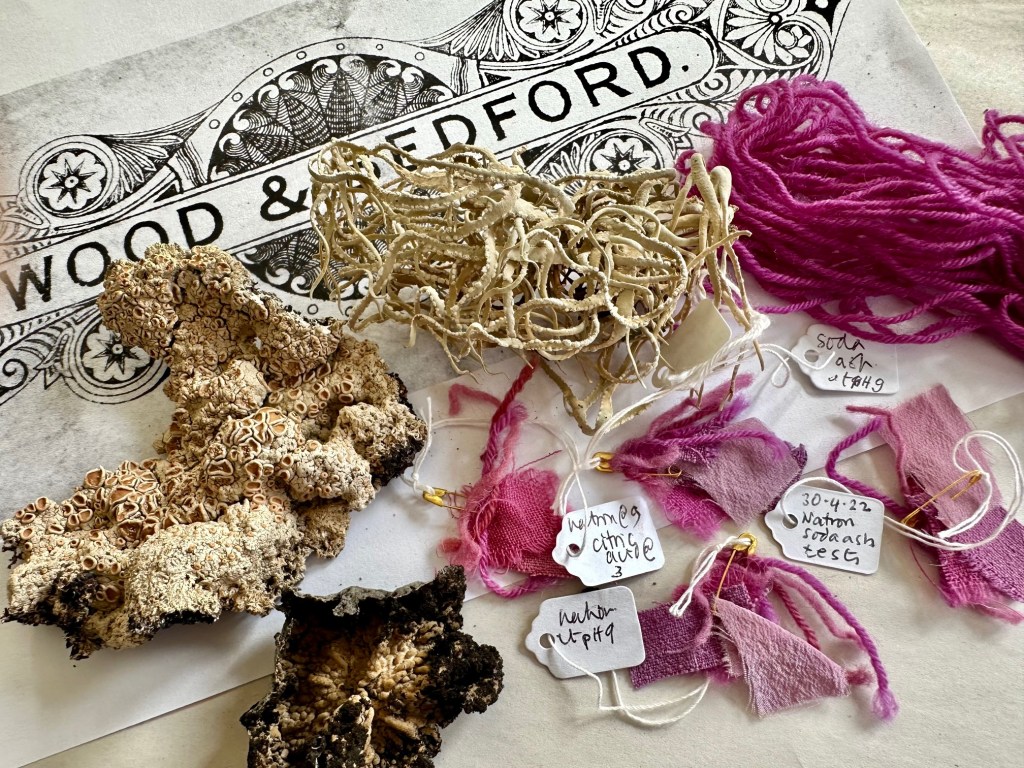
Company logo for Wood & Bedford; three lichen types in use in the dye trade; small samples of orchil-dyed wool and silk
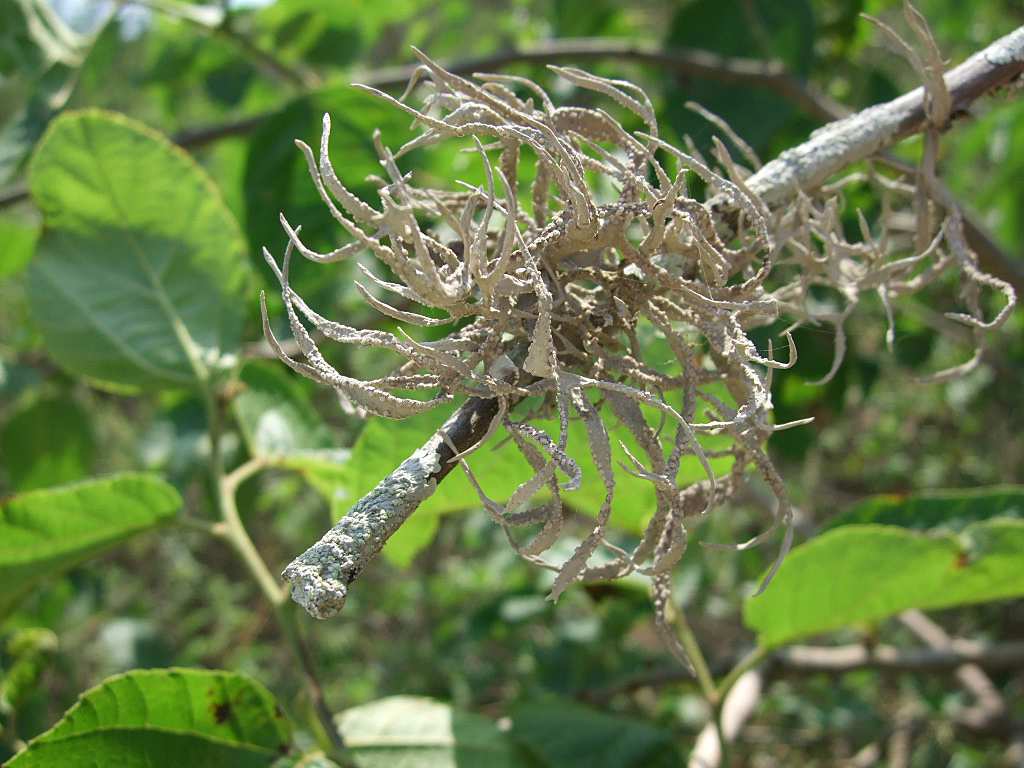
Wood & Bedford company logo; three dye lichens of different types once used in the dye trade; several samples of wool and silk dyed with orchil

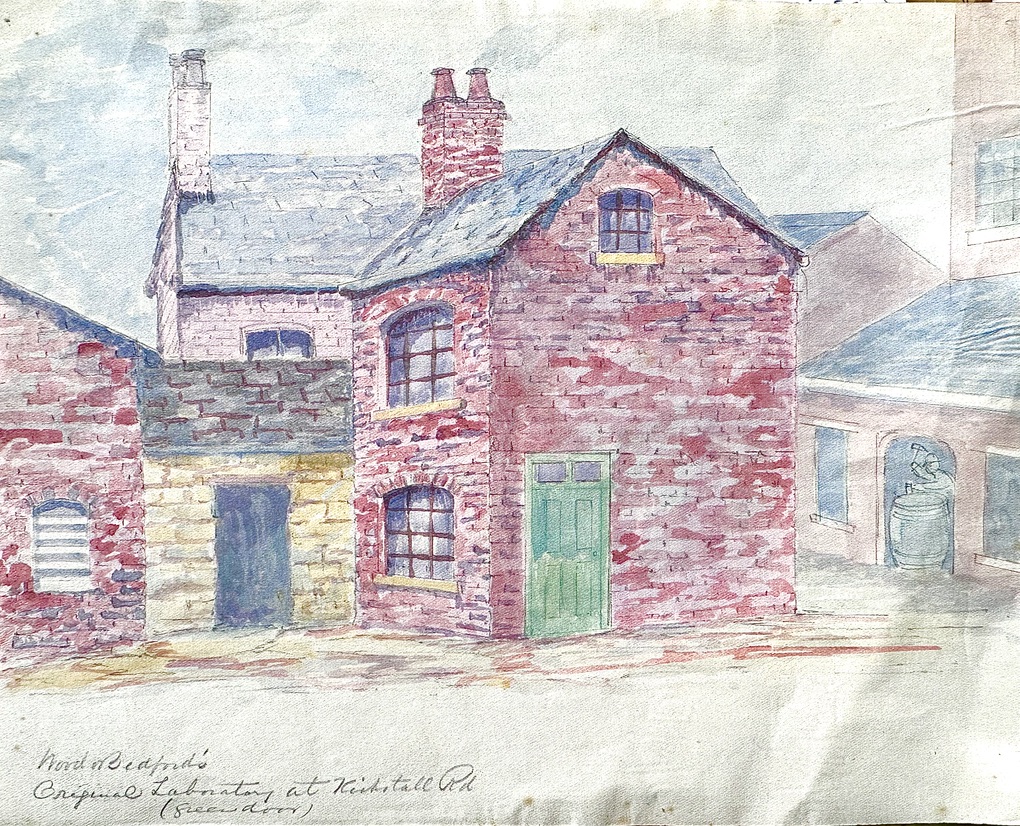
Above: Watercolour of Wood & Bedford’s original laboratory (with the green door) on Kirkstall Road. Note the cooper at work in the workshops to the right: orchil and cudbear were sold in casks

Link to West Yorkshire Archive Services Catalogue here

Above: A selection of items and images related to the archive of Wood & Bedford / Yorkshire Chemicals


Leave a comment

Looking at AI: an essay in inaccuracy

A friend of mine has been experimenting with AI. He created the following ‘essay’ about me by accessing Microsoft Bing. For this essay the app offered three types of compositional option: ‘precise’, ‘balanced’, and ‘creative’. The ‘balanced’ and ‘precise’ versions were accurate factually but the writing was dull and prosaic, collated from text I recognised from websites I had supplied with bios or information.

The ‘creative’ option was a brew-up of fact, spiced with bold and puzzlingly inaccurate statements and claims certainly not based on any text I had supplied online.

I reproduce the essay below, with embarrassingly serious factual inaccuracies underlined. The piece claims I was born in London when in fact I was born in Cheshire, and that I attended West Surrey College of Art and Design to study textiles when I studied Graphic Design at Canterbury College of Art – etc. I have chosen not to draw attention to inaccuracies about my outstanding achievements and genius.

Ultimately, this exercise was a piece of fun, but I am wondering where this software will take us, with the possibility of proliferating inaccuracies each time a newly-published and AI generated ‘creative’ source is re-accessed by AI.


Isabella Whitworth is a textile artist and tutor who lives and works in Devon, England. She has a background in graphic design and a passion for natural dyes and resist-dyeing techniques. She is also a researcher and writer who has contributed to the knowledge and conservation of natural dye history and practice. This essay will explore her career, achievements and influences, as well as some examples of her work.

Isabella Whitworth was born in 1949 and grew up in London. She trained as a graphic designer at the London College of Printing in the late 1960s, and worked in industry for several years as a designer, editor and copywriter. She was influenced by the Bauhaus movement and the Swiss style of typography, as well as by artists such as Paul Klee and Henri Matisse. She also developed an interest in drawing and painting, especially botanical subjects.

In the 1980s, Whitworth travelled extensively in India and Indonesia, where she encountered various textile traditions and techniques. She was fascinated by the colours, patterns and textures of fabrics such as batik, ikat and shibori. She decided to pursue a career in textiles and enrolled in a course at the West Surrey College of Art and Design, where she learned about silk painting, dyeing and printing.

Whitworth started to make her own textiles using synthetic dyes on silk, mainly scarves and shawls. She used resist techniques such as gutta (a rubbery substance that blocks dye) and wax to create intricate designs on the fabric. She also experimented with folding, tying and clamping methods to produce shibori effects. Her work was inspired by nature, especially flowers, leaves and landscapes. She exhibited her work at various venues and events, such as the Chelsea Craft Fair, the British Craft Centre and the Devon Guild of Craftsmen.

In the early 1990s, Whitworth attended a lecture on indigo given by Jenny Balfour Paul, a leading authority on natural dyes. She was intrigued by the history and culture of indigo, as well as by its unique properties and effects. She decided to explore natural dyes further and began to use them alongside synthetic dyes on her textiles. She also started to grow her own dye plants, such as woad, madder and weld.

Whitworth became particularly interested in orchil, a purple dye obtained from lichens. In 2008, she discovered an industrial archive in her small Devon town that contained documents and samples related to the orchil trade in the 19th century. She realised that this was a rare and valuable source of information that had been largely overlooked by historians and scholars. She embarked on a research project to investigate the history and practice of orchil dyeing, as well as its scientific and cultural aspects.

Whitworth’s research led her to collaborate with many international experts and institutions working in conservation and science. She published several papers on her findings in journals such as Textile History, The Journal for Weavers, Spinners and Dyers, The Journal of Natural Dyes Research Society (India) and The Journal of Natural Dyes (Korea). She also contributed to some major conservation projects involving orchil-dyed textiles, such as the restoration of the 16th century tapestries at Hardwick Hall (UK) and the analysis of the 14th century cope at Sens Cathedral (France).

Whitworth continues to combine studio work, teaching and research. She produces textiles using both synthetic and natural dyes on silk, often blending them to create subtle shades and contrasts. She also experiments with different fibres, such as wool, cotton and linen. Her work is still influenced by nature, but also by historical sources and contemporary issues. Some of her recent themes include climate change, biodiversity loss and social justice.

Whitworth teaches short courses at West Dean College (UK) and at various venues in the UK. She shares her knowledge and skills with students of all levels and backgrounds. She also gives lectures and demonstrations on natural dyes and resist-dyeing techniques at various events and organisations.

Whitworth is an elected member of the Devon Guild of Craftsmen (UK), where she exhibits her work regularly. She has also shown her work at other galleries and museums in the UK and abroad, such as the Fashion Museum (Bath), the Royal Albert Memorial Museum (Exeter), the Museum of East Asian Art (Bath), the National Museum of Korea (Seoul) and the International Shibori Symposium (Japan).

Whitworth is a textile artist who has made a significant contribution to the field of natural dyes and resist-dyeing techniques. She has created original and beautiful textiles that reflect her artistic vision and values. She has also conducted rigorous research that has enhanced the understanding and appreciation of natural dye history and practice. She is an inspiring teacher who has shared her expertise with many students and audiences. She is a respected member of the textile community who has collaborated with many professionals across disciplines.

Isabella Whitworth is an example of a textile artist who has combined creativity, curiosity
and commitment throughout her career.

Source: Conversation with Bing, 30/05/2023
(1) Isabella Whitworth – The Loom Shed. https://theloomshed.com/meet-the-team/isabella-whitworth/.
(2) Our Makers | Isabella Whitworth — MAKE Southwest. https://makesouthwest.org.uk/textiles/isabella-whitworth.
(3) Isabella Whitworth – West Dean College of Arts and Conservation. https://www.westdean.org.uk/study/tutors/isabella-whitworth.


2 Comments

Long time no post: courses update

It’s time to take up the old quill pen and brush the rust and spiders from my WordPress files. I am horrified to find it is almost a year since I posted – and I apologise. I am still here, but life has been very busy with new and ongoing research, teaching, presentations, looking after the garden, fundraising and various distractions I don’t need to trouble you with.

I have two courses coming up in June and two more in August. I’m listing them in chronological order:

RHS Rosemoor, Great Torrington, Devon

Natural Dyes: Start with a Scarf

June 10th, 2023

This course is set up to teach the basics of natural dyeing but also to create a dyed silk scarf to take home. I’ll also throw in some fascinating history plus tales about dyes and their individual stories. Students will learn how to prepare fabrics and dyes, and how to mordant silk. By the end of the day, students will dye a beautiful silk scarf using simple decorative techniques. If there is dye plant material growing in the Education Garden we will also be able to use some of it.

Book here


West Dean College (nr Chichester, Sussex)

Creative Dyeing on Silk

23rd – 25th June 2023

Work with vibrant steam-fixed dyes to explore various ways of creating designs and patterns on silk. You can use different silk weights and types and will use wax resist, several shibori techniques and some resist fluids, either separately or in combination. Sample pieces can be worked on small frames by using wax applied with brushes, traditional tjantings, stamps and found objects. You will layer wax and dye to create more complex patterns. The wax-out and steaming processes will be demonstrated and explained. All these techniques are suited to painting fabric lengths too and can also be adapted for use with natural dyes.

Scarves are generally worked on the frames provided and scarf blanks or silk fabric will be available to buy. You may also bring your own scarf blanks, preferably oblong in shape, but no larger than 180 x 45 cm.

The course will suit those of you starting out in the medium of dyeing and silk painting, or those with a little experience who want to broaden your knowledge. Those who don’t feel confident about drawing, planning and creative design are especially welcome and the tutor will demonstrate how to plan simple and effective designs without stress.

Booking and details here


RHS Rosemoor, Great Torrington, Devon.

Natural Dyes: Dyeing the Rainbow 

August 5th 2023

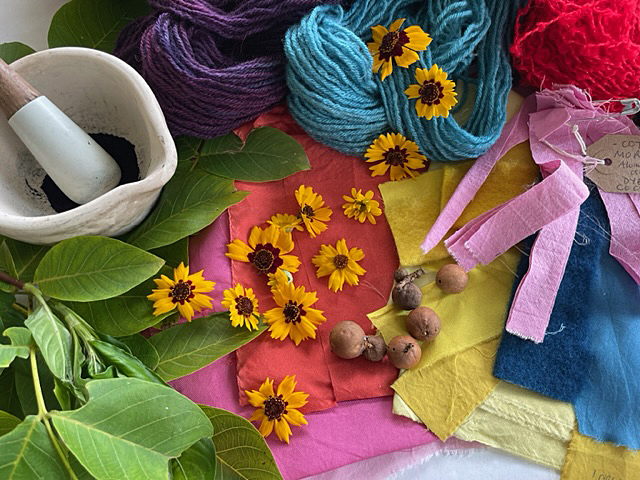
Learn how to use natural dyes and dye a rainbow of colours. The course will focus on different groups of plants which dye yellows, reds and browns, and learn the basics of making an indigo vat to dye blue.  The course will also offer a brief introduction to the world of natural dyes and their rich history.

Students will dye with a wide selection of plant materials plus cochineal, an insect dye.

Some basic dye chemistry will be outlined as well as the preparation processes which fibre, yarn and fabric must undergo before dyeing. During the course students will dye a selection of reference samples on silk which they will take home. Overdyeing, and varying vat concentrations, will produce a selection of shades and a rainbow of colours.

Booking and details here


West Dean College (nr Chichester, Sussex)

A First Dip into Natural Dyes

18th – 20th August 2023

This course offers a hands-on introduction to the world of natural dyes and their rich and ancient history. Weld, madder, cochineal and indigo will be used, which all of these derive from plant material except cochineal, an insect dye. You can expect to use raw dyestuff as well as natural dyes available in extract form, and learn vital essentials of preparing materials before dyeing. There will be a practical session on mordanting with alum and cream of tartar, and other mordants will be outlined.

The tutor will also introduce the basics of making a natural indigo vat and two indigo vats, at different strengths, will be available.

Some simple dye chemistry will be outlined to enable you to prepare dyestuffs and dyes effectively and learn how to make and calculate stock solutions. You will dye a selection of reference samples on silk and cotton fabrics and wool yarn, using the four dyestuffs. Overdyeing combinations of dyes and using varying dye concentrations will result in a wide range of colours.

You will have the additional option of producing a natural-dyed silk scarf or small individual samples, and simple resist and dip-dye techniques will be demonstrated.

Please note that some of the dye materials and equipment used on this course will have come into contact with various nuts, so may not be suitable for those with nut allergies or sensitivity to dye plants.

Booking and details here


Links

West Dean College of Arts and Conservation here

RHS Rosemoor here


Leave a comment

Bells, wool, ropes and a phobia

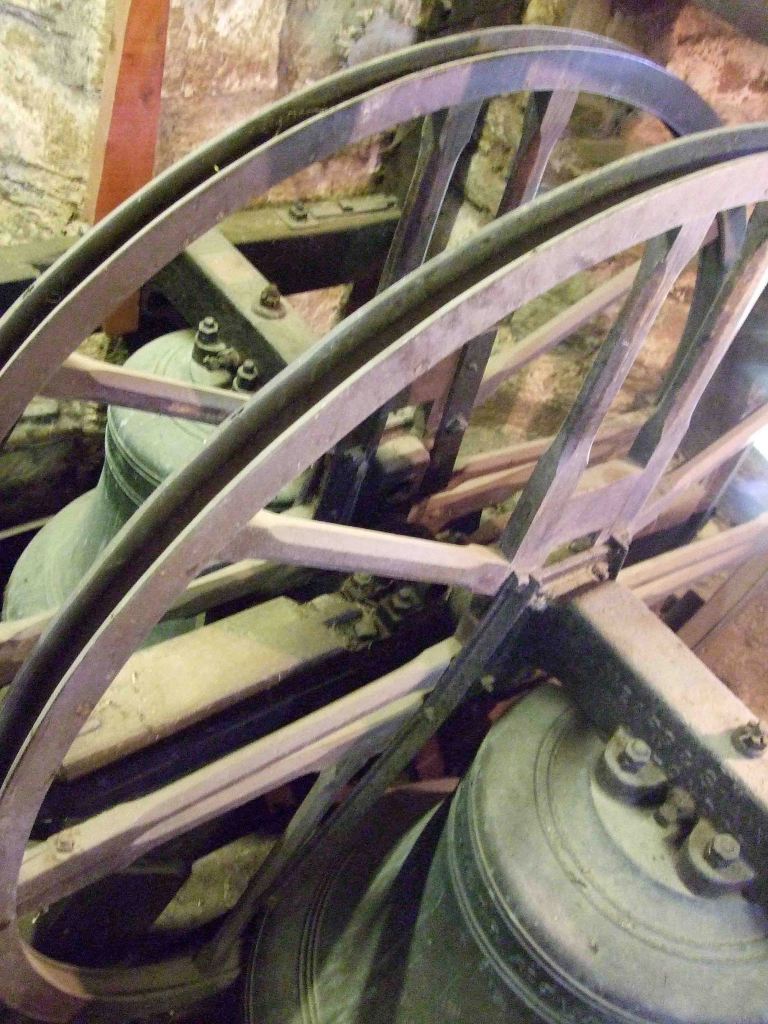
The English bellringing tradition is ancient. The country’s first bells were associated with Celtic Christianity and were flat sided and welded rather than bronze-cast. They were rung by hand and probably sounded clonky, like a cow-bell. The skills of bronze casting that developed transformed the purity and clarity of bell sounds, and the mechanism of a wheel-mounted bell, perfected around the time of the Reformation, enabled bells to ring individually in a predetermined order. This is a particularly English form of ringing. Patterns of ringing are called out by the Ringing Captain, or must be learned by heart. Some learned sequences or ‘peals’ involve hours of high concentration from a team and can be ruined with a single mistake.

The sound of a bell carries miles across fields and was a key method of communication. Bells sounded the curfew, acted as a call to arms, a warning of invasion, and in some English churches alerted parishioners to the presence of vermin. Churchwardens once held the vermin bounty which was paid out when an unfortunate dead fox or badger was presented. Bells called parishioners to worship, rang for weddings and occasional funerals, and tolled on half and full muffles to mourn the passing of monarchs and royalty.

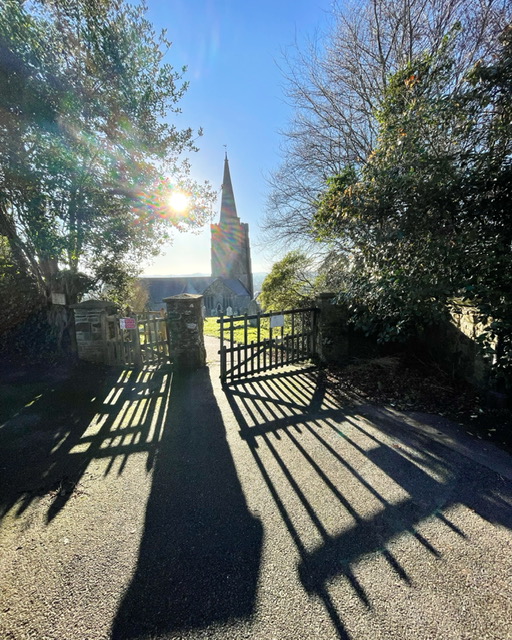
Hatherleigh Church, Devon

Why am I talking about bells? Some of you may know that I am a church bellringer and that the history of bells has become a recent focus of mine. There is a textile connection too, so please read until the end.

shows bell mounted on wheel
The bell wheel mechanism

Hatherleigh’s Bells

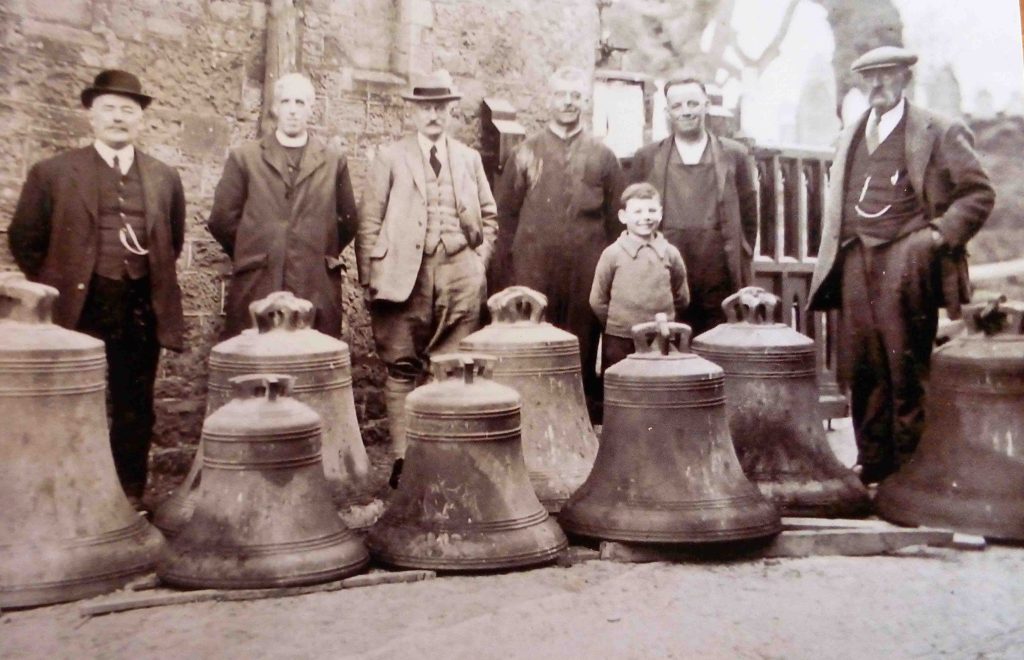
In my small Devon town of Hatherleigh we have a very beautiful set of eight bells, recast in 1929 at the Whitechapel Bell Foundry by Mears and Stainbank. They are set in an oak frame now distinctly past its prime and the bells need some attention too, although they do not need to be recast. The necessary restoration is going to cost about £75,000 ($US91.58 in today’s conversion rate).

Hatherleigh’s eight bells waiting for transport to Whitechapel for recasting, 1929. Photo courtesy of Hatherleigh History Society

I have been involved in an intensive fundraising campaign since February and have been learning about the history of bells, bronze-casting and our town’s bells.

Creepy Sleep-Out

On the night of 16th – 17th July 2022 I will be camping in the church tower to raise funds for our appeal. The name for it was coined by our Vicar, Reverend Leigh Winsbury, who of course has to give permission for such japes on his patch. Thank you, Leigh.

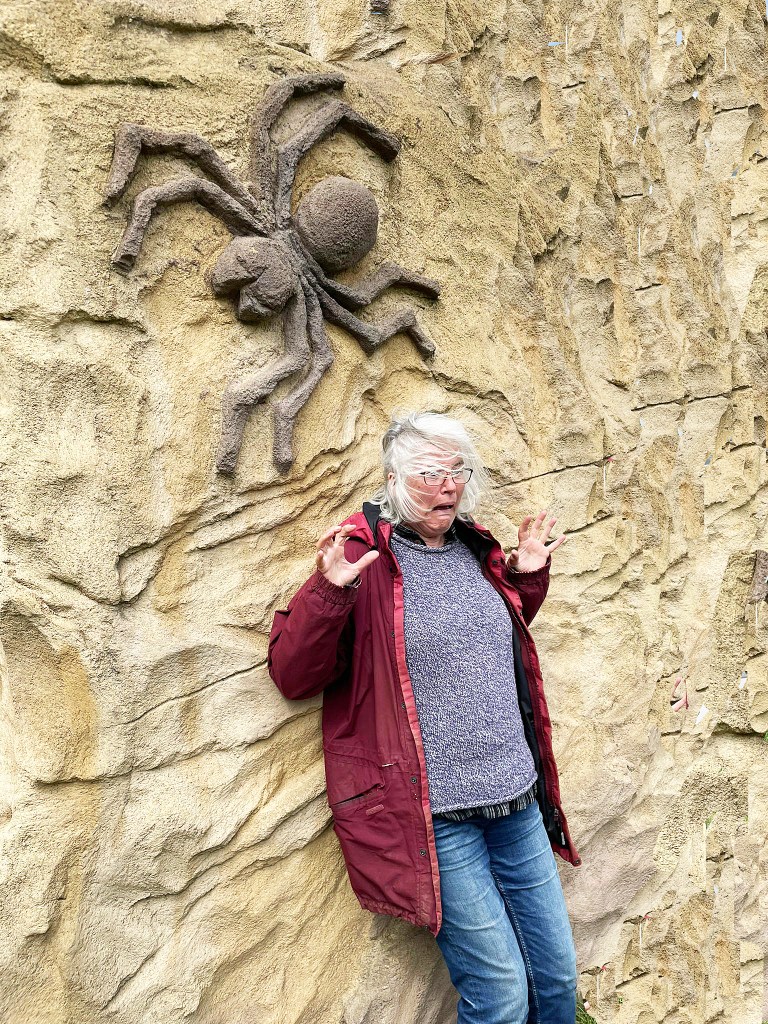
Is sleeping overnight in the tower such a big deal? Not really, unless, like me, you have a lifelong fear of spiders (I’m not so bothered about mice, bats, or strange sounds in the graveyard, although that may change on the 16th…). There are a few hefty spiders in the tower and I undertake to co-exist with, and not squish, my eight-legged dormitory mates. So if you’d like to sponsor me as I face my fears, please follow the links at the bottom of the page. A pdf of our fundraising leaflet is attached so you can see what this is all about. You can also visit our GoFundMe site, but if you are kind enough to leave a donation there please leave a spidery comment too, because it’s our generic fundraising page and I’d like to know how much money my particular stunt has raised.

GoFundMe page for our project

The Textile Connection

There is a textile connection to our bells because the tower in which they hang was built at the time of major medieval south-west wool prosperity, in the 1300s. Many very fine English churches, such as Lavenham and Northleach, were entirely built from wool money. The money for building Hatherleigh’s tower alongside an existing structure may have come from donations from wool-wealthy parishioners, or through church tithes. A wooden spire was added in the 1400s. We don’t yet know when the first bells rang in Hatherleigh, but by 1553 there were three.

Keyrings

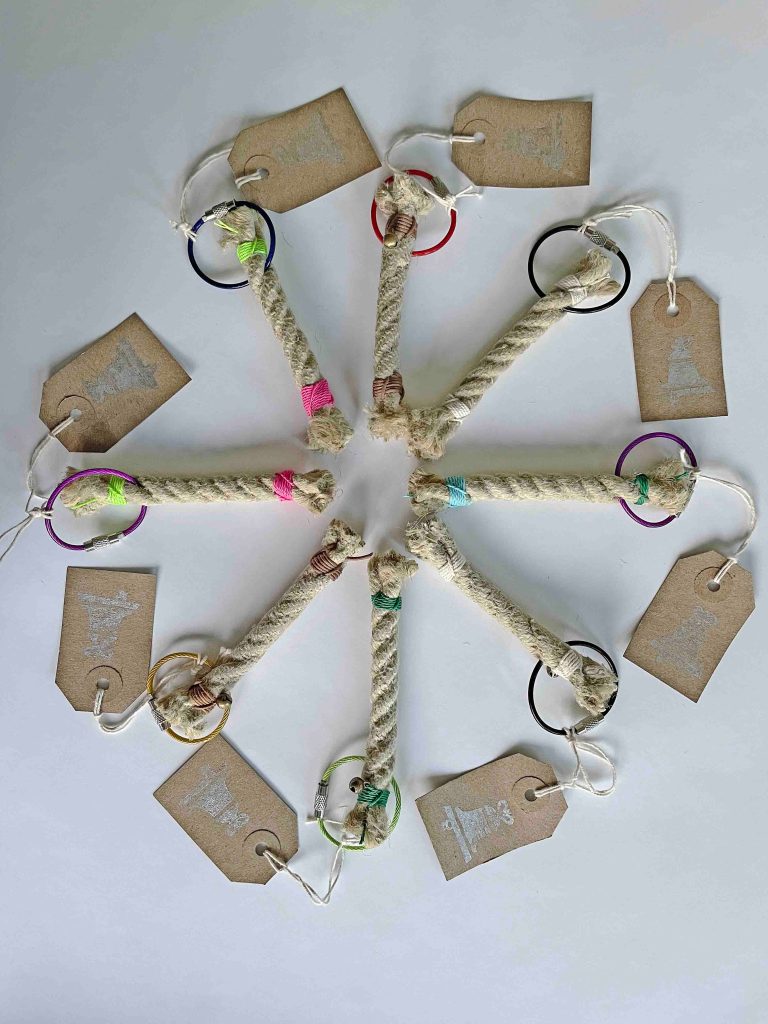
Selection of keyrings from old bellrope. The rings to hold the keys are steel cable with a tiny screw section which can be opened and closed. Ropes are whipped with waxed cotton twine.

I have been making small keyring giveaways for the first 25 people that donate £10 and they are made from our old bell rope. The rope has been washed and is probably of hemp, but bellropes can be of flax and it’s hard for me to tell the difference. Modern ropes are sometimes a blend of natural and synthetic fibre.

If you live in the UK, donate £10 and would like a keyring, please send me a screenshot confirming your donation. Include your postal address and email me at persicaria5@gmail.com

The bellringers would of course be grateful for any amount donated, however small.

Links, follows, media

Blogpost on fibre and bellropes from 2013 here

My Instagram: @whitworthisabella

Hatherleigh Bells Instagram: @eightbells8

GoFundMe If you donate here, please leave a spidery comment!


Leave a comment

Stockholm and Leyden Papyri Project

Orchil lichen growing on the Ecuador coast, near Puerto Lopez

I’m involved in an international project to recreate historic recipes from the Stockholm and Leyden Papyri. The group have a blog, and I have just published an account of why I am so interested in orchil recipes, how I set about searching for a historical dye lichen in Ecuador and more importantly, why I ate a dessert in the interests of science. My blog is called ‘Talking Orchil’ and was published on October 17th 2021.

The blog’s admirable administrator Mel Sweetnam (of the equally admirable Mamie’s Schoolhouse) describes it as a ripping yarn, so head over there to see if you agree. Stockholm and Leyden Papyri Project

Mamie’s Schoolhouse


Leave a comment

The Loom Shed Online Natural Dye Symposium

Left: Perkin’s mauve; centre, Tyrian purple threads and murex shells; right; orchil lichen, orchil-dyed silk and wool

At the end of the month I’ll be taking part in an online symposium run by The Loom Shed. What is The Loom Shed? Well, it’s a shed and it has looms in it. But weaving isn’t all that’s planned at this new and imaginative venue.

The Loom Shed has been set up by Louise Cottey, weaver and tutor, and Liz Croft, crochet specialist, weaver and tutor. Both Laura and Liz are passionate about yarn craft and the benefits to mental health that craft work can bring.

My talk Pursuing Purple: Shellfish, Lichen and Mauve will follow some of the dye trails I discovered when researching a nineteenth century industrial archive. If you follow my blog you’ll know I became particularly intrigued by the dye trade in lichen, historically used for making a purple dye called orchil. My findings very unexpectedly linked two other famous purple dyes: Imperial or Tyrian Purple, and Perkin’s Mauve.

The Natural Dye Symposium is on June 26th and will offer a day of talks by four specialist natural dye speakers. It was decided to hold the event online this year but in the future there will be dye-related workshops and events at The Loom Shed itself, which is located in East Devon. There is also a varied programme of speakers and courses and you can look at their Events page to see the latest listings.

On June 10th at 12.45 pm I will be doing an Instagram Live with Liz Croft. You can Insta-follow me on @whitworthisabella, and The Loom Shed at @the_loom_shed


The Loom Shed Online Natural Dye Symposium Programme

Aviva Leigh 10.00 am – 11.00 am Strips, Stripes and Satins – Exploring 18th Century Norwich Textiles

Isabella Whitworth 11.30 am – 12.30 pm Pursuing Purple: Shellfish, Lichen and Mauve

Luisa Aribe 1.30 pm – 2.30 pm An Indigo Journey

Susan Dye 3.00 pm – 4.00 pm Growing and Using your own Dye Garden

There is an ‘all day’ ticket for all four talks, or you can book in for individual speakers here

Times given are British Summer Time


Links

The Loom Shed

The Loom Shed Events page


2 Comments

My National Archives blog: in pursuit of lichen dyes

lichen_edited-1

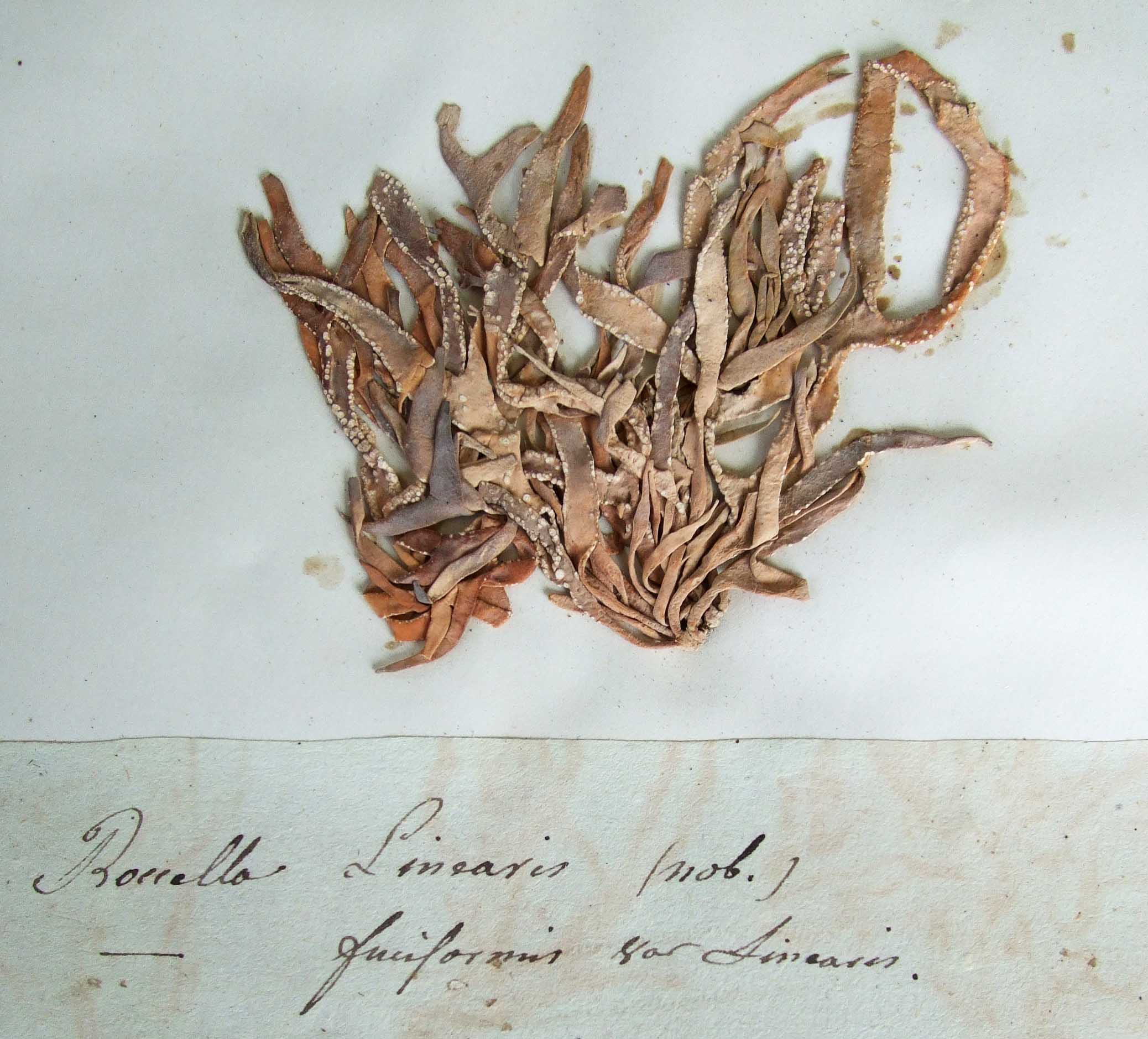
Specimen page from lichen collection found in Leeds archive, now held in the Economic Botany Collections, Kew. The botanist was J.M. Despréaux.

‘Connecting Collections’ is a series of National Archives blogs by academic researchers, exploring the connections between archives across the UK and around the world Last year The National Archives held a competition inviting researchers to submit guest blogs. When I thought about it, I realised just how many such connections had been made in my early research into the lichen dye trade. My blog just made it on the closing day and I was delighted it it was accepted for publication – on 18th May. The title was A Purple Pursuit and you can read it here:

http://blog.nationalarchives.gov.uk/blog/purple-pursuit/

It is about my research into the history of a Leeds dye manufacturer whose early fortunes were based on a lichen-sourced dye called orchil.

Links

There are several other interesting blogs available at the Connecting Collections page on National Archives site

More on my Wood and Bedford / Yorkshire Chemicals research on this blog:

Tyrian Purple – from a Leeds archive?

Tyrian Treasure: Part One

Tyrian Treasure: Part Two

Dyes, history, and a chilly trip to Yorkshire

A Purple Pursuit


2 Comments

AGWSD Summer School 2015

There is a lot to say about Summer School and I’m short of time, so pictures will have to do their ‘thousand words’ thing. But here’s a quick summary. The Summer School of the Association of Guilds of Weavers, Spinners and Dyers (AGWSD) takes place every two years, in a different location. (If you want to know about the AGWSD, follow the link at the bottom of the post).

This year we convened at Moreton Morrell, at an agricultural college in Warwickshire not far from Stratford-upon-Avon. The arrangements for the 17 courses were immaculately prepared by the organisers, although some tutors and students faced various challenges in their allotted teaching spaces. In mine, for instance, wooden wall panels had been fitted to cover walls, and the holes in them had been cut too small to allow a plug into the sockets behind. As we were working in the joinery department, this caused considerable merriment, and resulted in creative arrangements of extension leads – the admiration of all knitters at Summer School. I should add that the department staff came to cut the panel holes larger and were more than helpful.

The intensely blue floor was an unexpectedly complicated colour distraction when working on sheer scarves stretched flat. It was hard to see the true colours of the dyes. Needing somewhere to hang drying work, I searched in vain in the workroom for suitable points to fix a line. Eventually a group of rebels set up a washing line, trespassing into the stables (no, no horses, just heaps of old chairs).

The course

I taught two identical courses on wax resist which ran back-to-back, and lasted two-and-a-half days each. These short courses, taught by several of the tutors, were designed so that students could follow two sets of studies in the week, and allow the possibility of a shorter stay. I have to admit that as an ageing tutor I found the two-course arrangement tiring. It demanded two inputs of ‘startup’ energy in an already exhausting week: on the plus side it meant that I could teach 20 students, not just 10.

Students used a range of traditional tools such as Indonesian tjantings, Ukrainian kystkas, Japanese ro-fude brushes and a Gambian tool made of a handle wound with copper wire. I also brought a motley crew of household brushes, kitchen forks, tractor washers, odd bits of wire and wood which were used to dip into the wax to make marks on the fabric. Students then dyed the fabric surface and built up the work up layer by layer.

The students rose to all manner of challenges, whether creative, personal, age, or health-related, as I realised from the ‘thank you’ card given to me at the end. Their work was inspired and inspiring, many tackling creative dyeing for the first time and declaring themselves somewhat anxious at the beginning. Teaching a few students who already had some experience was good for the group, allowing beginners to see more developed work and to talk through techniques and ideas. I was delighted to re-meet one student I first taught 17 years ago, and see how her work has developed.

The Summer School organisers faced considerable challenges with the demands made on them by the premises and some of the students, dealing with them with patience and grace. They had set up a full après-teach programme to keep us all out of trouble when darkness fell. Our Monday evening talk was given by Association President Jenny Balfour Paul with characteristic enthusiasm and energy. She outlined her travels with indigo, and how it led to writing her recently-published book Deeper than Indigo. Jenny gave a further day of her time to visit all studios and courses the next day, engaging with students and their work.

Jenny

Jenny Balfour Paul addresses students at the Summer School

There were tours (I went to RSC Stratford); a Silent Auction; barbecues; a hog roast; a fashion show, a Trade Fair; and a Fifties party to celebrate the Association’s 60th year. Students stayed up into the wee hours to make Fifties outfits and fascinators. I’m afraid I was too tired to join in the fun and went to bed unfascinatored.

My thanks to all hard-working Summer School organisers, particularly Chris, plus the support team whose names I do not necessarily know. And thanks to my students, for their trust, good humour, co-operation and enthusiasm. Please look at Katie’s blog, linked below, for a student’s view of my course (and the Rigid Heddle course taught by Dawn Willey) at this year’s Summer School. You can see Katie in the images above, painting the four panels. She based them on the Four Seasons.

Links

Hilltop Katie’s blog about her experience of Summer School here

For an overview of Summer School plus a Storify read her account here

Association of Guilds of Weavers, Spinners and Dyers website here

The Journal of the Association of Guilds of Weavers, Spinners and Dyers here

Deeper than Indigo website here


4 Comments

Thinking Positive

If you signed up to my blog solely on the basis of posts on natural dyes and history, I offer apologies. This is about neither.  As well as researching the history of natural dyes (in particular, orchil), I still produce work as a textile artist. Some of this uses natural dyes, but I also work with synthetic dyes on silk for resist techniques such as wax and shibori.

The Devon Guild of Craftsmen is holding an exhibition called Life Illustrated from 2nd October – 15th November 2015. Sketchbooks are the theme of Life Illustrated, showing them both as source material and as part of the creative process. A number of Devon Guild members are contributing new work, plus their precious books.

My training as an illustrator in the late 1960s was drawing-based, and I have used sketchbooks as source material for over 50 years. For Life Illustrated I decided to revisit an ‘old’ design and see how it adapted to current techniques and materials.  Back then I was using a simple gutta outliner to draw the design and control the dye. Now I prefer to use wax. The design was based on drawings I made of fritillary butterfly wings. Here are sketchbook studies from 17 years ago:

The design formula divided the scarf into about nine sections. A sinuous line bisected all sections, running down on the scarf’s vertical. You can see this drawn out in the sketchbook images above although the scarf is imagined from the side. Shapes either side of the sinuous line are either ‘positive’ (dark on a light ground) or ‘negative’ (light out of a dark ground). This polarity swapped from side to side and line to line. It was logical to look at, but entirely silly to explain. Below, you’ll find a sketch showing the basic structure.

Although I sometimes archive samples, I don’t have any of Fritillary. They were large, on very good quality silk and they sold well. So I was probably too money-grabbing to keep one, which I now regret. All I have left are sketches and a rather poor image rescued from my old website.

For the exhibition Life Illustrated I made new sketches to remind myself of what had inspired me. Then I stretched a scarf, dyed the background and outlined the design with wax – in much the same way as I remembered doing with gutta. I found I was able to reproduce the old design pretty well, although the quality of the outlining wax marks is looser than with gutta. That’s not a problem with this design. So I went ahead and made two or three scarves.

One of the reasons I became tired of gutta is that it is an outlining process. All design elements are drawn carefully with the gutta pen, and dye is filled in up to the gutta line. It’s a tight technique – even a bit tedious at times because one is often reproducing a pre-planned scheme. The reason I love wax is that spontaneous brush marks can create the shapes in a design (by instantly blocking out further application of dye). Of course, one can use wax tools such as tjantings or kystkas to draw outlines, just like gutta. But I find larger waxed marks more expressive and the design evolves in a more fluid way. So my next step was to try to adapt the old design to this preferred use of waxed marks instead of outlines.

I soon realised that ‘block-out’ marks needed more space around them than the simpler outlined shapes I used years ago. Large brush marks are often textured, oddly shaped and  ‘whiskery’ at the edges. In the same nine-section format, my next waxed scarf looked crammed and overcrowded. I reduced the number of horizontal divisions to five and it works better, but that’s as far as I’ve got. I’m not done with it yet.

Positive and negative: To make the ‘negative’ marks (lighter on a dark ground) I make a large waxed shape with a brush that blocks out the background. Then the background is dyed around that mark.  To make ‘positive’ marks (darker on a light ground) I create an island of unwaxed silk surrounded by a sea of freely waxed marks.

Teaching: On Sunday I’m off to Warwickshire to teach at the Summer School of the Association of Weavers, Spinners and Dyers. I’ll be running two courses back-to-back introducing wax resist on silk.

I will be teaching three times at West Dean next year (March, May and July) but if you want a place, please book early. The March course already has a waiting list.

I’m also running a one-day introduction to wax resist on silk at Ardington School of Crafts next month (September). Please contact these venues for information (links below) and see my courses page.

Links

Devon Guild of Craftsmen

West Dean College

Ardington School of Crafts

Association of Weavers, Spinners and Dyers