The Colourist is an online magazine produced by the Society of Dyers and Colourists (SDC). A recently published article outlines some of my work and the industrial archive that has occupied me for so many years.
With many thanks to Andrew Filarowski, Technical Director, SDC.
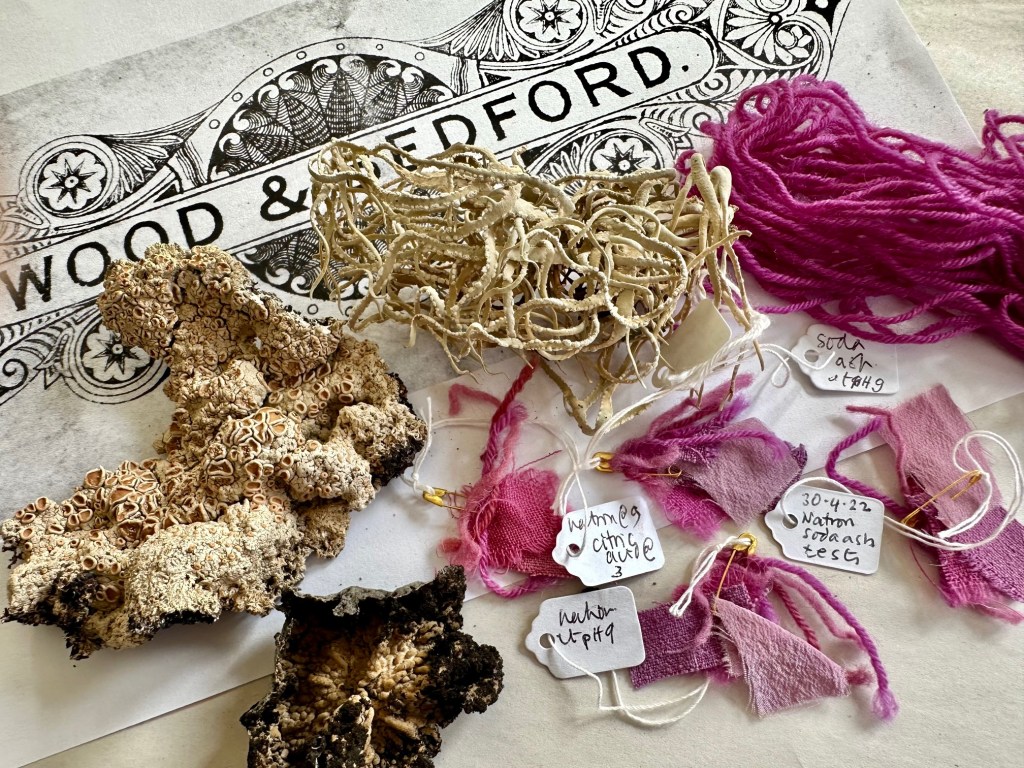
Wood & Bedford company logo; three dye lichens of different types once used in the dye trade; several samples of wool and silk dyed with orchil
Orchil
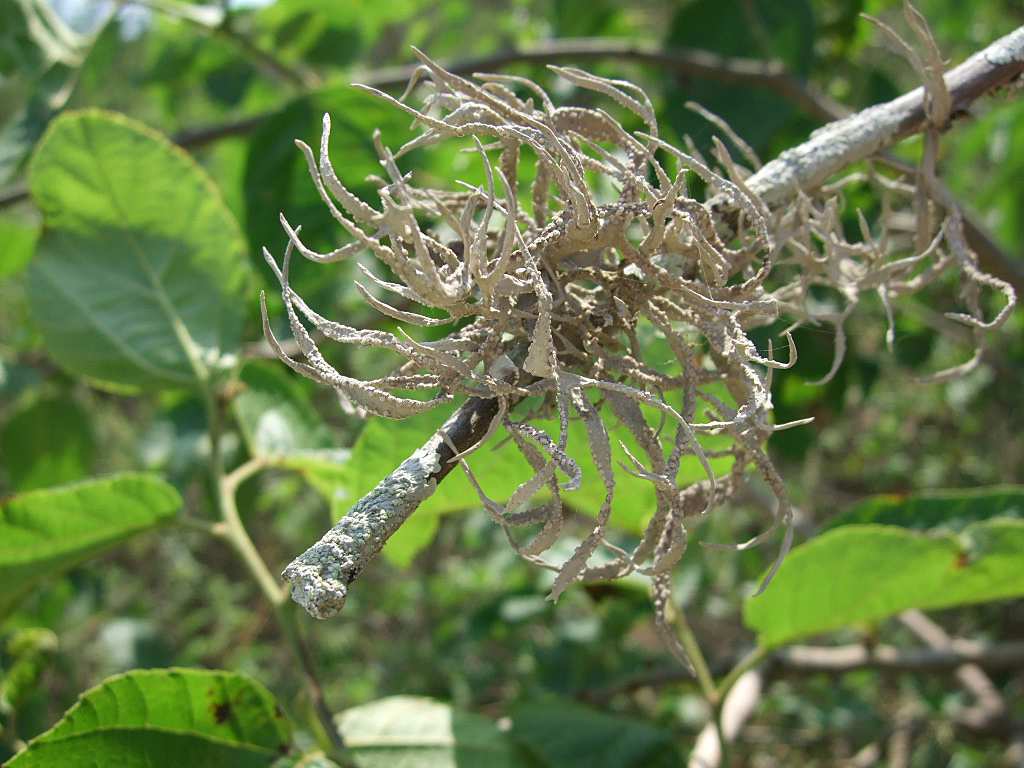
Orchil is a beautiful, purple historical dye made from several varieties of lichens. As the image above indicates, many of them bear no resemblance to each other. Orchil dye cannot be directly extracted by straightforward soaking, as with many natural dyes, but must be fermented for several weeks in aerated ammonia. Its use stretches back to ancient times and orchil dye recipes and references appear throughout recorded history. The use of orchil is revealed by modern dye analysis and shown to be present on precious textiles and parchments, despite the fact that it is very light fugitive: it isn’t very lightfast and fades quickly to a pinky-beige, and then, visually, to virtually nothing.
The archive
I’ve not been occupied on it every second, but for the last 16 years I have been working on an industrial archive. A collection of nineteenth – twentieth century documents relating to a Leeds dye manufacturer resurfaced in my home town in Devon and I became thoroughly absorbed in its story of the enterprising Bedford family and the purple dye called orchil. The company effectively launched in the 1820s, when a young Leeds chemist called James Bedford began to specialise in manufacturing orchil and cudbear (a powdered form of orchil). This same, Bedford-run company amalgamated with others over the next 100 years by which time it was known as the Yorkshire Dyeware and Chemical Company. The Bedford family were no longer on the Board after the early 1940s but the company never underwent a takeover. In the early 2000’s, on the same Kirkstall Road site in Leeds that it had occupied since the early 1850s, Yorkshire Chemicals faced financial collapse and finally closed. Before its demise it had become a world-famous company and at one time the fourth largest dye manufacturer in the world.
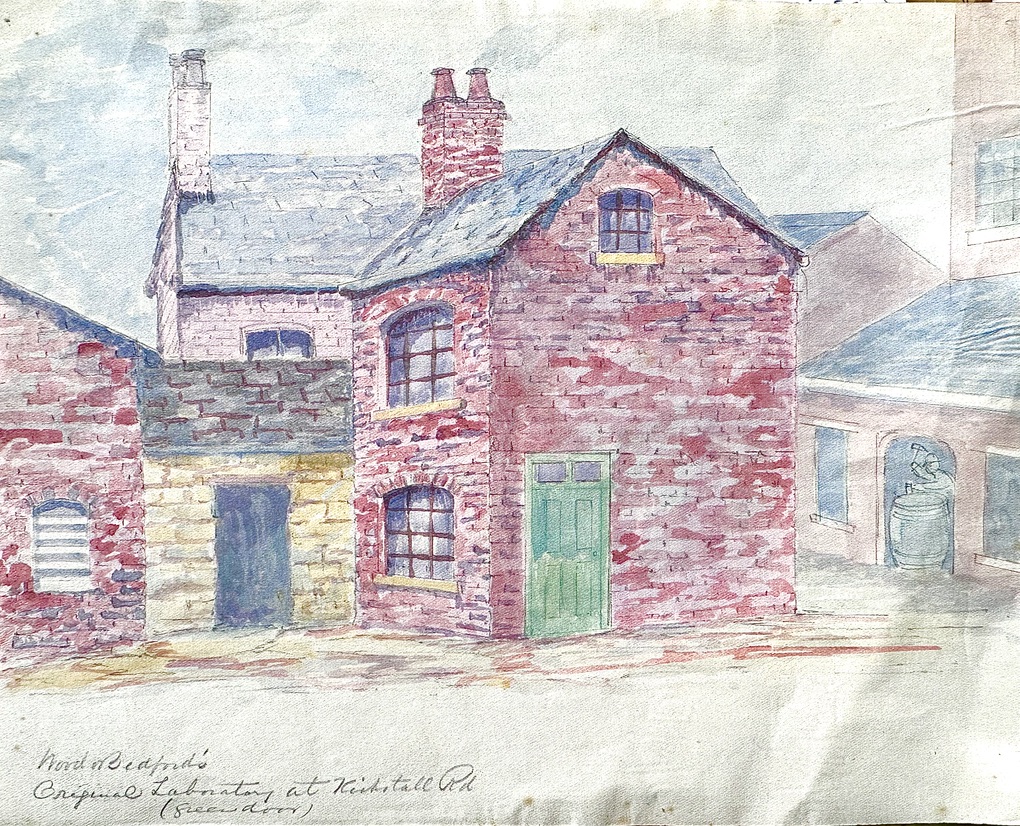
Above: Watercolour of Wood & Bedford’s original laboratory (with the green door) on Kirkstall Road. Note the cooper at work in the workshops to the right: orchil and cudbear were sold in casks
The commercial orchil trade
When my obsession with orchil began I knew virtually nothing about it. But I have since learned from and worked with several experts. I know a little about lichen species and identification; I can make and dye with orchil and I understand something of the history and relationship with other purple dyes such as murex or shellfish purple. In spite of my science-and-maths-resistant brain I have learned chemical principles by which dyes operate, how contemporary dye analysis is undertaken and something of the science behind processes. I am very grateful for the patience and generosity of scientists who have enlightened me along the way.
As my studies continued, I became uncomfortably aware of the enormity of the trade. Until the mid nineteenth century, lichen species would have been under mounting and unsustainable pressure from the commercial dye trade’s constant demand for orchil. Lichen grows slowly and cannot be cultivated, so wild material was always collected for the dye trade and as a result, lichen populations collapsed from islands and coasts and the inland moorland where they grew. Lichen gatherers were paid poorly, consequently they had to gather ever more lichen to make a living wage. This speeded up local depletion. While earlier sources of lichen may have been the islands of the Atlantic such as the Azores, the Canary Islands or Cape Verde, nineteenth century prospecting for the voracious European trade extended across continents, to India, Ceylon, South America, Africa and as far as West and East Timor.
The orchil dyestuff trade was competitive and stocks fluctuated with various aspects of supply such as depleted sources, wars affecting trade routes, etc. There were huge profits to be made by selling when the price was high, so merchants often hoarded stocks. Dye manufacturers could also sustain large losses if they had to ‘buy high’ and their manufacturing process failed. Orchil can spoil easily in manufacture and only efficient, experienced orchil and cudbear makers would be likely to survive.
Research
Back in 2008 I approached the The Worshipful Company of Dyers for some financial assistance in finding a permanent home for this important collection. As well as assisting me with a grant, they put me in touch with former employees of Yorkshire Chemicals – and a new phase of the story unfolded. Former employees had retained many documents relating to their company in the synthetic age but, curiously, knew very little of its early beginnings with natural dyes. The papers in their possession were then archived by Dr Howard Varley, a former employee of Yorkshire Chemicals, and passed over to the West Yorkshire Archive Service in 2017. They are now available for public study (see the link below). In late October 2024 I will be handing over remaining documents, largely relating to orchil. The amalgamated collections cover the entire life of the company, from orchil beginnings of James Bedford in the 1820s to the final synthetic dyes produced by Yorkshire Chemicals in the late twentieth century. The fascinating period where manufacturers faced the challenges of the new synthetic age is illustrated by patents, technical notes, sales material and financial reports. The entire archive very much reflects its times, through the company’s many achievements in science, to social and political events through the centuries that affected the life of a highly enterprising and innovative company.
Link to West Yorkshire Archive Services Catalogue here
Above: A selection of items and images related to the archive of Wood & Bedford / Yorkshire Chemicals
Conservation work and publications
I have presented research at several conferences over the past 16 years, particularly at DHA (Dyes in History and Archaeology). Because of my experience with orchil dye, and as an experienced natural dyer, I have been asked to help or advise on conservation or research projects where the use of orchil has been detected in a precious object.
On this website I have published several blogs which can be found by using Search words orchil, Wood and Bedford, Yorkshire Chemicals etc, in the word cloud to the right. Details of my research and publications can be found here.
Endnote: using wild material for research in the UK
Involvement in some major conservation projects has made it necessary for me to make small batches of orchil over the last few years. These normally use about 5 grams of ground lichen per orchil batch. I have been fortunate that many dyers and friends have donated their old dye lichen collections to me as they no longer feel comfortable about using lichens of any kind in their studio work. They would prefer this increasingly vulnerable wild material to be used for conservation or research purposes and not for commercial gain. I have spent many years of my working life as an artist and dyer but I have never used lichens in my studio work.
Over the past three years I have been working closely with Susan Dye and Ashley Walker of Nature’s Rainbow, Deb Bamford ASDC and Jane Deane ASDC, to research the subject of foraging for dyes in the UK. Our article on the first stage of the project was published by The Journal for the Association of Weavers, Spinners and Dyers, 288, Winter 2023. Subsequent contact with the British Lichen Society confirms that they will be issuing new guidelines about dyeing and foraging soon.
A friend of mine has been experimenting with AI. He created the following ‘essay’ about me by accessing Microsoft Bing. For this essay the app offered three types of compositional option: ‘precise’, ‘balanced’, and ‘creative’. The ‘balanced’ and ‘precise’ versions were accurate factually but the writing was dull and prosaic, collated from text I recognised from websites I had supplied with bios or information.
The ‘creative’ option was a brew-up of fact, spiced with bold and puzzlingly inaccurate statements and claims certainly not based on any text I had supplied online.
I reproduce the essay below, with embarrassingly serious factual inaccuracies underlined. The piece claims I was born in London when in fact I was born in Cheshire, and that I attended West Surrey College of Art and Design to study textiles when I studied Graphic Design at Canterbury College of Art – etc. I have chosen not to draw attention to inaccuracies about my outstanding achievements and genius.
Ultimately, this exercise was a piece of fun, but I am wondering where this software will take us, with the possibility of proliferating inaccuracies each time a newly-published and AI generated ‘creative’ source is re-accessed by AI.
Isabella Whitworth is a textile artist and tutor who lives and works in Devon, England. She has a background in graphic design and a passion for natural dyes and resist-dyeing techniques. She is also a researcher and writer who has contributed to the knowledge and conservation of natural dye history and practice. This essay will explore her career, achievements and influences, as well as some examples of her work.
Isabella Whitworth was born in 1949 and grewup in London. She trained as a graphic designer at the London College of Printing in the late 1960s, and worked in industry for several years as a designer, editor and copywriter. She was influenced by the Bauhaus movement and the Swiss style of typography, as well as by artists such as Paul Klee and Henri Matisse. She also developed an interest in drawing and painting, especially botanical subjects.
In the 1980s, Whitworth travelled extensively in India and Indonesia, where she encountered various textile traditions and techniques. She was fascinated by the colours, patterns and textures of fabrics such as batik, ikat and shibori. She decided to pursue a career in textiles and enrolled in a course at the West Surrey College of Art and Design, where she learned about silk painting, dyeing and printing.
Whitworth started to make her own textiles using synthetic dyes on silk, mainly scarves and shawls. She used resist techniques such as gutta (a rubbery substance that blocks dye) and wax to create intricate designs on the fabric. She also experimented with folding, tying and clamping methods to produce shibori effects. Her work was inspired by nature, especially flowers, leaves and landscapes. She exhibited her work at various venues and events, such as the Chelsea Craft Fair, the British Craft Centre and the Devon Guild of Craftsmen.
In the early 1990s, Whitworth attended a lecture on indigo given by Jenny Balfour Paul, a leading authority on natural dyes. She was intrigued by the history and culture of indigo, as well as by its unique properties and effects. She decided to explore natural dyes further and began to use them alongside synthetic dyes on her textiles. She also started to grow her own dye plants, such as woad, madder and weld.
Whitworth became particularly interested in orchil, a purple dye obtained from lichens. In 2008, she discovered an industrial archive in her small Devon town that contained documents and samples related to the orchil trade in the 19th century. She realised that this was a rare and valuable source of information that had been largely overlooked by historians and scholars. She embarked on a research project to investigate the history and practice of orchil dyeing, as well as its scientific and cultural aspects.
Whitworth’s research led her to collaborate with many international experts and institutions working in conservation and science. She published several papers on her findings in journals such as Textile History, The Journal for Weavers, Spinners and Dyers, The Journal of Natural Dyes Research Society (India) and The Journal of Natural Dyes (Korea). She also contributed to some major conservation projects involving orchil-dyed textiles, such as the restoration of the 16th century tapestries at Hardwick Hall (UK) and the analysis of the 14th century cope at Sens Cathedral (France).
Whitworth continues to combine studio work, teaching and research. She produces textiles using both synthetic and natural dyes on silk, often blending them to create subtle shades and contrasts. She also experiments with different fibres, such as wool, cotton and linen. Her work is still influenced by nature, but also by historical sources and contemporary issues. Some of her recent themes include climate change, biodiversity loss and social justice.
Whitworth teaches short courses at West Dean College (UK) and at various venues in the UK. She shares her knowledge and skills with students of all levels and backgrounds. She also gives lectures and demonstrations on natural dyes and resist-dyeing techniques at various events and organisations.
Whitworth is an elected member of the Devon Guild of Craftsmen (UK), where she exhibits her work regularly. She has also shown her work at other galleries and museums in the UK and abroad, such as the Fashion Museum (Bath), the Royal Albert Memorial Museum (Exeter), the Museum of East Asian Art (Bath), the National Museum of Korea (Seoul) and the International Shibori Symposium (Japan).
Whitworth is a textile artist who has made a significant contribution to the field of natural dyes and resist-dyeing techniques. She has created original and beautiful textiles that reflect her artistic vision and values. She has also conducted rigorous research that has enhanced the understanding and appreciation of natural dye history and practice. She is an inspiring teacher who has shared her expertise with many students and audiences. She is a respected member of the textile community who has collaborated with many professionals across disciplines.
Isabella Whitworth is an example of a textile artist who has combined creativity, curiosity and commitment throughout her career.
Orchil lichen growing on the Ecuador coast, near Puerto Lopez
I’m involved in an international project to recreate historic recipes from the Stockholm and Leyden Papyri. The group have a blog, and I have just published an account of why I am so interested in orchil recipes, how I set about searching for a historical dye lichen in Ecuador and more importantly, why I ate a dessert in the interests of science. My blog is called ‘Talking Orchil’ and was published on October 17th 2021.
The blog’s admirable administrator Mel Sweetnam (of the equally admirable Mamie’s Schoolhouse) describes it as a ripping yarn, so head over there to see if you agree. Stockholm and Leyden Papyri Project
Left: Perkin’s mauve; centre, Tyrian purple threads and murex shells; right; orchil lichen, orchil-dyed silk and wool
At the end of the month I’ll be taking part in an online symposium run by The Loom Shed. What is The Loom Shed? Well, it’s a shed and it has looms in it. But weaving isn’t all that’s planned at this new and imaginative venue.
The Loom Shed has been set up by Louise Cottey, weaver and tutor, and Liz Croft, crochet specialist, weaver and tutor. Both Laura and Liz are passionate about yarn craft and the benefits to mental health that craft work can bring.
My talk Pursuing Purple: Shellfish, Lichen and Mauve will follow some of the dye trails I discovered when researching a nineteenth century industrial archive. If you follow my blog you’ll know I became particularly intrigued by the dye trade in lichen, historically used for making a purple dye called orchil. My findings very unexpectedly linked two other famous purple dyes: Imperial or Tyrian Purple, and Perkin’s Mauve.
The Natural Dye Symposium is on June 26th and will offer a day of talks by four specialist natural dye speakers. It was decided to hold the event online this year but in the future there will be dye-related workshops and events at The Loom Shed itself, which is located in East Devon. There is also a varied programme of speakers and courses and you can look at their Events page to see the latest listings.
On June 10th at 12.45 pm I will be doing an Instagram Live with Liz Croft. You can Insta-follow me on @whitworthisabella, and The Loom Shed at @the_loom_shed
The Loom Shed Online Natural Dye SymposiumProgramme
Aviva Leigh 10.00 am – 11.00 am Strips, Stripes and Satins – Exploring 18th Century Norwich Textiles
Isabella Whitworth 11.30 am – 12.30 pm Pursuing Purple: Shellfish, Lichen and Mauve
Luisa Aribe 1.30 pm – 2.30 pm An Indigo Journey
Susan Dye 3.00 pm – 4.00 pm Growing and Using your own Dye Garden
There is an ‘all day’ ticket for all four talks, or you can book in for individual speakers here
A 5mm square of silk mousseline showing typical orchil colour
My last post featured some purple orchil or cudbear dust detached from stained paper. I attempted to convert it back to dye and soaked it in water for several days. I didn’t know if it would dye fibre after 167 years but after several weeks’ cold-dyeing a fragment of silk with the purple liquid, it has taken on a typical orchil fuschia purple – see above. I don’t know what that proves, but it’s wickedly, super-nerdily satisfying.
And now to Covid-19 masks. In the early 1990s I completed a number of publishing commissions to design textile craft projects. I accumulated boxes of fabric scraps in vibrant designs which I have failed to part with because ‘one day they might have a use’. Translated into stash language, that means I couldn’t bear to part with them. But their day has finally come and I have made masks for family and friends during the pandemic. After some online research I settled on the Olson design for adults which has a pocket into which a HEPA filter can be slipped. Research suggested that high thread count natural fabrics made the most effective mask and my 90s fabrics were ideal, being quilting cottons, cotton lawns, or fine weaves. It seems a suitable way to let these fabrics go. I made children’s masks but found the scaled-down Olson unsuitable since I couldn’t approach individual children to adjust the fit and instead used one of the many pleated designs on the internet. To supply designs that children would actually wear I bought a few new fabrics. All the girls wanted pink masks, and being Devon, small boys chose tractors and I’m unapologetic about this apparent stereotyping. I made fabric ties but advised parents to change to elastic if they weren’t efficient. There’s no point wearing them if the masks slip down all the time.
Four masks in the Olson pattern design (see link below). There are three layers of fabric in the centre where the pocket sits and if a HEPA filter is inserted a further layer is added. I fed a copper nose-wire into a channel along the top centre which shapes the mask to fit the face as closely as possible
Although appearing simple, I found mask-making fiddly because of the curves, layers of fabric, nose-wires etc. and the labour rapidly became tedious. I’m full of admiration for the army of makers who have made so many masks and scrubs over the past few months.
Children’s masks with a pleated design. Two layers of fabric overall
A very obvious spill of orchil left this 1853 letter stained, with loose deposits of a powdery purple substance on the surface
This is my 38th day in coronavirus lockdown. Like many, I have a diary full of scratched-out teaching, appointments, celebration parties and anticipated trips. I haven’t felt particularly creative for the past few weeks and admire the achievements of those who use their daily exercise to draw and paint and record their experiences visually, or translate their time into the positivity of making work. I feel as though that particular tap ran dry for me a few weeks back. It’s a bit weird but I don’t feel bad about it, it just is. I have found other things to do.
When I’ve not been gardening, or training the new puppy, or learning to make videos, I’ve been working on family history links with England, USA, Ireland and Ecuador. And with no other distractions or excuses I have finally managed to get my teeth back into the Leeds-related archiving I’ve been undertaking for some years. You can find other blogs about this research in the ‘word cloud’ on the right, under the search titles Wood & Bedford, orchil, and Yorkshire Chemicals.
Over these weeks of lockdown the archived boxes of labelled documents are growing, the unsorted papers are diminishing. Most nights when I turn out the light and go to wash my hands (in a non-coronavirus way) there is a trace of pink or purple in the dirty, soapy water. I know it’s from orchil. The earlier papers, dating between 1833 and 1855, came from a time when many of the working spaces of Wood & Bedford adjoined. The Fire Insurance document of 1855 describes these workspaces and some of the equipment. Orchil lichen was ground into powder with stones before manufacturing into dye, after which it was reduced back into powder (cudbear), or sometimes paste. Orchil dust would have hovered permanently, coating surfaces and settling on any uncovered papers. I have sorted papers with heavy purple stains, as if spills took place where they were stored, and there’s even a purple thumbprint on the back of an invoice for glass and earthenware. This gave me a real archival shiver because at that time (1850) there was just one person, James Bedford (1824 – 1903), who would have been working on orchil at the Hunslet address: the move to Kirkstall Road was imminent but had yet to take place. I have developed a very healthy respect for James and I like to think it is his thumbprint on the paper. It feels like a kind of handshake.
Back of an 1850 invoice showing a purple thumbprint
I also found an 1853 letter stained with a large spill, which had resulted in several crusty deposits of a loose and powdery purple (see top image). I am neither equipped nor funded to conserve these papers and have stored the heavily stained ones separately so that at some time in the future there is the potential for them to be studied further. But while I was working a tiny deposit loosened off and I rescued it, putting it in a container with a little water. I checked it impatiently, and slowly, over several hours, the powder began to release its colour. It shows a typical fresh purple orchil pink. Amazing to see, and a rewarding moment that joins several other highlights in many years’ work on this archive. I will drop a few silk fibres in once I think all the colour has been released, and see if it will still dye.
Orchil dye reconstituted from the 167-year-old orchil spill. The colour is typical of orchil
It’s intended that my section of the archive will finally join the main Yorkshire Chemicals collection already in the curation of the West Yorkshire Archive Service facility at Morley, Leeds. Wood & Bedford became the lead company of the Yorkshire Dyeware and Chemical Company in 1900, which was renamed Yorkshire Chemicals from 1974 – 2004 when it went into administration. The work on the Morley archive was completed by Dr Howard Varley who had been an employee of Yorkshire Chemicals until its demise. The complete set of archives will give a rare insight into the lifespan of a dye manufacturing company whose work spanned the transition from natural to synthetic dyes.
I recently took part in a two-day workshop in Amsterdam, dyeing historical reds on silk at the Rijksmuseum’s Department of Conservation and Restoration. The event was organised by the Cultural Heritage Agency of the Netherlands. Selection for the workshop was by application, and the organisers chose eight international participants known for the variety and extent of their expertise in natural dyeing, and / or their interests in historical dye recipes.
A range of 26 samples was produced using American cochineal, kermes, annatto, brazilwood, madder, safflower and lac. Participants worked in pairs dyeing different sets of dyes: my partner was Paula Hohti of Aalto University, Helsinki, where she is Assistant Professor of History of Art and Culture. We dyed three recipes in total: one for lac and two for safflower. Demineralised water was used throughout.
Lac Our lac recipe was adapted from Edelstein’s translation of the 1548 edition of The Plictho of Gioanventura Rosetti. We prepared and used an alum mordant on Day 1, in which the silk rested overnight. The stick lac we were to use had been extracted over the previous three days. On Day 2 we sieved the lac solution and heated it, adding 25% (to weight of dry fabric) cream of tartar. It was dyed for an hour.
Lac-dyed silk being lifted from the beaker to check for colour. On the right is the beaker containing yellow safflower dye and silk
Safflower We dyed two versions of safflower: yellow and red. Our recipes were adapted from various sources, including Macquer’s Art de la Teinture en Soie. To obtain yellow, safflower florets were washed once and drained, and then soaked again for 30 minutes. After sieving, the resulting extract was used to dye unmordanted silk.
First washing-out of the safflower florets for yellow dyeing
To obtain red, safflower florets were pre-washed for two weeks to remove all traces of the yellow extract – this process had been completed in advance of the workshop.We undertook a further sequence of washings until the yellow stopped running and the water was clear. The water was sieved out. Potash was added to obtain pH 10, and the florets squeezed by hand until they appeared pink and transparent and the liquor looked pinky red. This took about half an hour to achieve.
After sieving into a new beaker, unmordanted silk was added and the pH checked (it was around 7). We then added fermented beer (bierken) little by little, continually monitoring pH, until the pH dropped to a crucial pH 5. This threshold pH has a term ‘virer le bain‘ or ‘turn the bath’. We were required not to allow the pH to drop lower or it would damage the silk. The silk then rested in the dye for 10 minutes after which it was washed in Marseilles soap, and water.
Both safflower baths produced strong colours, with the pink having an especially bright ‘pop’. The colour is very light fugitive.
Safflower red (left), lac (centre) safflower yellow (right
Everyone, including the three organisers, gave short presentations on their work and research interests. I showed some samples of my orchil dyeing as well as a few pieces of my studio work in natural dyes. Many participants were involved in education, some of us were artists and dyers, others were textile researchers or art historians. These absorbing presentations illustrated what a privilege it was to attend the workshop.
The results of the workshop were recently published at the Spring Symposium of the Textiel Commissie.
Participants were able to take away a sample of each recipe dyed: a total of 26 samples
Participants took home a complete set of all the silks dyed. The organisers also retained a set, which will be catalogued and stored as historical reproductions on reference sheets, together with supporting information on the recipes and preparations. The sheets will eventually be published online through the Cultural Heritage Agency (RCE) website, for the benefit of other researchers.
Thanks With many thanks to organisers Drs. Ana Serrano, Jenny Boulboullé and Art Proaño Gaibor; to the Cultural Heritage Agency of the Netherlands; the Ateliergebouw of the Rijksmuseum; and to all fellow participants at the workshop for their unique and specialist contributions.
Display board from the Museu do Abade de Baçal, Bragança showing natural dyes once in use for silk dyeing. From top left: Daphne gnidium; indigo; gall nuts; madder; logwood; sumac; soapberry; rosemary; walnut; cochineal; dyers’ broom; Arundo donax (giant cane); ginger; common black alder
I spent most of December in northern Portugal, travelling from the north-east corner of Trás-os-Montes via Miranda do Douro, Bragança and Guimaraēs and, after a visit to Porto, to an area south-west of the extraordinary Peneda-Gerês National Park.
In Bragança’s Museu do Abade de Baçal there was an excellent display on the region’s historic silk industry including an illustrated panel on dyes. There were a few I’ve not heard of, such as Daphne gnidium. In her book Natural Dyes: Sources, Tradition, Technology and Science, Dominique Cardon lists the Daphne in her chapter on flavonoids, which indicates it was a yellow colourant. Cardon offers no local name for it in Portuguese, but the Bragança display gives it the name trovisco. The yellow dye was known in French as trentanel;daphné sainbois; or garou and Cardon notes that the dye came to rival weld in 18th century Languedoc.
The giant cane, Arundo donax, does not appear in Cardon’s book and an internet trawl came up with a few references to its pollen being used to make a yellow dye, but I found no solid information for this.
Oak galls found washed up on the shore at Moledo, near Viana do Castelo
The museum panel also illustrated some large spiky oak galls. I suggest these are of gall wasp Andricus kollari, but please put me right if you think they aren’t. Tannin-rich galls would probably have been used as mordants. I saw these galls on and beneath oak trees in Trás-os-Montes and all across north Portugal, and there were hundreds washed up on the beach near Viana do Castelo.
Oak galls used as a necklace in man’s costume, from the displays of masks and costumes of the Bragança area at the Museu Ibérico da Mascara e do Traje
Some pre-Christian traditions survive in remoter areas of North Portugal, in the form of rituals that take places at certain times during the year, with men and boys in bizarre costumes and some extremely scary masks. I saw necklaces of oak galls, along with wooden cotton reels, at Bragança’s Museum of Mask and Costume.
Orchil
At the Museu do Abade de Baçal I found one reference to orchil (urzela in Portuguese) as a lichen dyeused in the 18th and 19th centuries. I wasn’t overly surprised because I had never seen such profusion of Lasallia pustulata anywhere, and growing to such a large size. The lichen favours granite, the local stone; the air is clear and unpolluted, and the area remains relatively undeveloped. So the lichen grows undisturbed – and long may it continue.
Lasallia pustulata growing in Trás-os-Montes. Here it is in its wet state, appearing floppy and olive green
Lichen growing on the castle at Bragança
Lasallia pustulata looking dry, grey and more biscuit-like on an espiguero, or granary
Top: blue-purple samples: mauveine-dyed using a shibori technique; lower pair of silks: orchil-dyed in redder shades; threads on orchil-dyed silks: dyed with Tyrian Purple
Here is an image showing an extraordinary trio of historic, and historical, purple dyes. Two are the natural dyes Tyrian Purple and orchil, whose histories are so ancient their origins are unknown. The other dye is a recreated mauveine, the first synthetic dye to be commercially developed, after synthesis in 1856.
All three dyes play a part in an archive I have been researching, which relates to a dye manufacturer based in Leeds. The company began when a young chemist called James Bedford started making orchil and cudbear, later forming a company named Wood & Bedford in around 1850. Through various changes of names and expansions, the company became a major international dye and chemical manufacturer, finally folding in 2004 under the name Yorkshire Chemicals. You can read more about the history by following links below.
Orchil was the natural, lichen sourced dyestuff on which the company’s fortunes were founded by James Bedford. But by the late nineteenth century, William Henry Perkin had discovered and patented his synthetic dye mauveine, signalling the gradual demise of natural dyes in commercial use and the beginning of chemical manufacturing. There was a family connection between the Bedford family and the Perkins’: WH Perkin’s son Arthur G. Perkin married a Bedford daughter. The Leeds company managed to weather the transition from natural to synthetic products and its archives are a fascinating record of how they achieved their success.
As to the Tyrian Purple, perhaps the most unexpected items from the archive are the genuine shellfish-dyed thread samples found in a small envelope. You can see one of the two samples in the image above. Again, please read their story by following links below.
Mauveine dyeings
I was contacted earlier this year by Dr John Plater, a Senior Lecturer in Chemistry at the University of Aberdeen. John has made a study of mauveine and has come to several interesting conclusions about Perkin’s dye. It seems that not all mauveines were / are the same. To read about John’s research, please follow the links below. John had read about my studies in orchil and was curious to know something of the versatility of mauveine in working practice. I sent him shibori-tied silks so that he could experiment with dyeing them, suggesting he try an immersion method on one set of samples, and separately apply dyes with an eyedropper. I find the eyedropper method very successful with synthetic dyes as it gives great control of the dye, and is very economical. You can judge which you think most effective from the page below. Immersion dyed are on the left.
The archive’s new home
Later this week I will be presenting a paper at the DHA (Dyes in History and Archaeology) Conference at the Royal School of Needlework, Hampton Court. It will describe the entirety of the Leeds archive, part of which I have been studying. It is now available for public study through the West Yorkshire Joint Services (WYJS) facility at Morley, near Leeds. I will write a separate blog about this after the Conference.







 Isabella Whitworth