Isabella Whitworth

probably more than natural and synthetic dyes, wax, resists, and history


Leave a comment

Calculating cochineal: using Lanzarote dyestuff

The historical dye research Jane Deane and I are working on at Leewood (see previous post) involves comparing ‘like with like’. For the initial weld research we used a stock solution of weld extract and divided it equally into five separate jars to dye samples of five fleece types.

Last year I undertook a dye costing with a stock solution. It was for a Somerset-based company called The Woolly Shepherd which promotes the sustainable use of wool, particularly waste fleece that would normally be thrown away. It is producing  needle-felted insulation materials, horticultural products and acoustic panels and also sells a range of small items such as wine coolers and phone covers.

The Woolly Shepherd’s felt is a darkish grey overall, being a mixture of several fleece colours and thus far they had sold all their products undyed. The company asked me to find out if its felt could be natural-dyed to achieve a certain shade of dark pink. It had obtained a sample dyed pink with synthetic dyes and I offered to try to match it as nearly as possible using cochineal, and in such a way that a costing for natural dyes plus the dyeing process could be calculated.

Dye calculations are normally made on percentage of dyestuff to fibre, yarn or fabric, so I needed to work with a known weight of dry felt and a known weight of cochineal. By increasing the amount of measured dyestuff in a sequence of individual vats, I planned to dye a set of samples to calculate a percentage weight of dye to weight of felt. Cutting a precise weight of thick felt has ‘pound of flesh’ Merchant of Venice connotations. It isn’t as easy as it sounds. In the end I cut a piece that was slightly too heavy and then sliced pieces off the side so that I was working with a 200 g weight. I cut this into four so I could work with 50 g samples.

All the felt was mordanted in alum and cream of tartar. I used 12% alum and 8% cream of tartar – although I normally use less. The wool smelled so strongly of lanolin that I wasn’t sure if it had been sufficiently scoured for dyeing, so I erred on the side of a stronger mordant.

Because working with very small weights of ground cochineal is extremely fiddly I made a stock solution.

I used Lanzarote cochineal for The Woolly Shepherd project. Some time ago I undertook quality tests for the  Asociación Milana, found their cochineal to be excellent and I continue to use it.

I ground 50 g dried cochineal to fine powder and tied it firmly  into a silk gauze bag. This helped prevent cochineal fragments entering the dye and avoided the need to strain the dyestuff. The bag was put into a stainless steel vessel with about 500 ml water and heated to simmer point (80C) for about 10 minutes. The decocted liquor was decanted into a container. Repeats of this process followed until there was hardly any colour coming out of the bag. The series of decoctions made up a stock solution of 50 g cochineal in 4 litres of water.

I calculated that I could draw off the equivalent of 1 g cochineal in each 80 ml of water  – if I kept the solution swirling while decanting so that it would be well-mixed.

The dyeing was fairly straightforward although I had an initial panic with the first sample: it appeared that the dye was not ‘taking’. Was the wool too greasy? But after the first half hour I saw the felt begin to turn pink. I slowly raised the temperature to 80C and held it for an hour, then allowed it to cool and sit overnight before rinsing. The colour was nearly exhausted in the vat after the long soak. I prepared three samples starting with a 4% proportion of dye to fibre and then increasing the percentage. With the felt being grey, the dye was always having to work against the base colour and in the end the percentage of dyestuff required for the dark pink was higher than I anticipated.

In a spirit of pessimistic self-knowledge I noted precise quantities, weights, times and individual calculations in my dye notebook. If my actual calculations were later found to be faulty (not uncommon with my maths), I could still make sense of the dyed samples because the maths could be reworked.

When undertaking my research into orchil I’ve studied historical dye notebooks, invoices, orders and the occasional sniffy nineteenth century letter of complaint. A high standard of colour accuracy was expected of past dyemakers by their clients. My exercise with cochineal gave me a small insight into how consistent results, competitive purchase and selling prices were achieved, using natural materials which can vary in quality.

Then as now, good results would depend on careful note-taking, accurate calculations, rigorously consistent dyeing and efficient retention of standard dyed samples.

The Woolly Shepherd: http://www.woollyshepherd.co.uk/

Asociación Milana http://www.tinamala.com

A version of this article was first published in the Journal for Weavers, Spinners and Dyers, Issue 242, Summer 2012, pp 24 – 25


Leave a comment

Natural dye extracts with wax

There’s a lot going on. A deadline for the Journal for Weavers, Spinners and Dyers meant last-minute articles had to be reviewed and proof-read. This coming weekend I am teaching at West Dean in West Sussex, the course is full,  and there is a lot to do in advance. Immediately after getting back from West Dean I start a series of structured historical dyeing experiments at Leewood with colleague Jane Deane – more about the project on this page. The house smells of hot sheep at the moment as I have been scouring fleece. Next week I deliver new work for the spring exhibition at Redearth Gallery… and so it goes on.

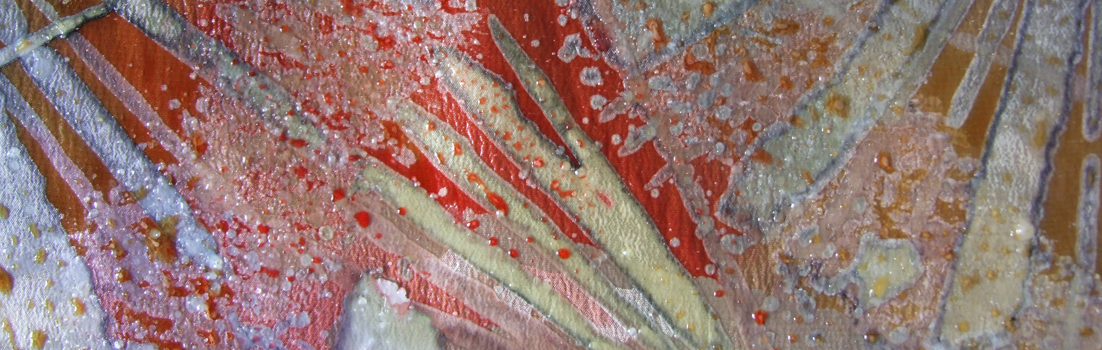
Reading that lot, I am not quite sure how I found time to do a little work with Aquarelle liquid extract natural dyes (see my blog post on them here). But I used spare hours to paint the extracts directly onto mordanted silk, using wax as a resist between the layers of dye. The instructions for Aquarelle give details on heated dye baths for fixation but this is not an option with wax resist, because the heat of the dye bath would melt the wax. My plan has been to place dye-painted and partially dewaxed work in the fabric steamer to replicate the heat and damp of a dye-bath. To start with I just used two of the dyes: the liquid indigo ‘Saxon Blue’ and the Himalayan Rhubarb.

NOTE: My comments on the outcome must be read as they stand: they are emphatically not a comment on the effectiveness of the dyes themselves but on the dyes used in this unconventional way.  There is a lot more work I need to do having seen the results.

My working method was as follows:

  • Silk scarf blanks mordanted in 8% alum 2% cream of tartar
  • Dried scarves stretched on a frame
  • Wax applied – in this case and in each layer simple stripes and lines across the scarf
  • Different dilutions of Himalayan Rhubarb (HR) and Liquid Indigo Saxon Blue (SB)  applied to create variations of blue – green
  • After several layers using a similar technique, wax partially removed by ironing cloth between newspapers
  • Work rolled in paper and steamed for one hour (note: I don’t have a thermometer in the steamer. It is brought to the boil every two minutes and turns off for about two minutes)
  • Work dipped in White Spirit to remove residual wax, and rinsed several times

Observations:

The good news is that the dyes have set in the steaming process. Repeated rinses after the White Spirit dip run entirely clear. I lost some of the SB in the first rinses, but this was almost certainly because I notched up the SB concentration to extremely high levels in some areas and probably overdid it. I always think of dyes and dye-sites like a game of Musical Chairs. When the chairs run out, the dye has nowhere to sit, molecularly speaking. It’s more to do with the fibre than the dye.

This experiment shows that it is possible to build quite dark tones by increasing the concentration of dye in selected areas. There are some deep greens. I had wondered if this would be possible, and it looks as though it is.

However, the HR has lost its lovely golden hue (see the original colour centre top) and has dulled to ochre. If you look at the images you can see some in which the steaming paper has picked up a lots of pink from the HR painted areas. The dyed steaming paper is lovely in itself: the red component of the dye has leached into the paper and didn’t fix to the silk. I have no idea why. It could be the mordanting. It could be the paper. It could be that I steamed too long, or steamed too hot. It could be that it would always happen, whatever the steam-time and heat. I now need to  dye silk with all the Aquarelle colours, using their recommended dye bath, to evaluate their ‘true’ colours.

The centre image shows small blotches on a brownish area. These are created by small spots of dye on a wax surface which I failed to wipe off. These are travelling through to the silk surface as remaining wax melts in the steamer, and they then fix. In this case it is not too big a blemish, but it can look smudgy and ruin a design.

On the centre right image there are ugly blue splashes. These weren’t present when the fabric went into the steamer. I think loose dye may have travelled all the way through the steaming paper and I shall use two layers next time.

More puzzling is the bleeding of the SB into areas that had been waxed onto white. You can see these top right and centre left in the images. This can happen with synthetic dyes if the work has been placed too close to the outside of the paper roll. If you imagine the rolled paper in the steamer (see here for an idea of how it looks) there is more moisture reaching the roll on the outer surface when it is in the steamer. If the steamer isn’t up to heat, work on the outer part of the roll receives a lot of moisture, doesn’t begin to fix and starts to wander around – playing Musical Chairs. The solution is to wrap additional paper around the outside of a steaming roll. I didn’t do it this time. I am not sure whether the bleeding is a result of the steaming process or an issue to do with the dyes themselves. This didn’t seem to happen with dyes on the inner part of the roll, so I tend to blame my lack of foresight.

Conclusion

There is a lot to do but I am enthusiastic about the potential for working with Aquarelle with wax. The colours I achieved aren’t particularly exciting because of the dullness of the HR after steaming, and I need to research this aspect. But they have fixed efficiently via the steamer, it does seem possible to use wax as a resist, and to achieve some strong, dark tones. So I am optimistic; I just need a 36 hour day.


Leave a comment

In the second post…

It’s time to open the blogdoor and let the first visitors into the studio. Actually, I haven’t been in the studio much today because the red pen is out, which means it’s proofreading time for Journal issue number 245. On Saturday there is a Journal committee meeting in London – always a long and packed day with a trip from rural Devon to buzzing central London and back again. But it’s mentally stimulating, it’s fun and I enjoy seeing friends from far-flung places and eating too many biscuits. We always fight the clock but our chairman wields her claymore and we normally finish the agenda on time.

In the studio I have wax-resist / steam-fixed dye work on the frame in a new series called Between Worlds. I am working on a silk crêpe de Chine and the finished scarf will be 134 cm x 20 cm, or 8″ x 54″ in English. The image on the right above is a scarf that was selected for the National Exhibition of the Guilds of Weavers, Spinners and Dyers last July; on the left, the detail shows a new scarf in early stages of making. I have been using different-shaped wax brushes to create the marks. The design is worked freehand except for a light pencil mark, just visible, which I need to follow in order to define the shapes of the dark pools (or are they shadows?)  beneath the trees.


Leave a comment

Starting afresh

I first designed and managed my own website over ten years ago.  I set it up with certain aims in view at a time when silk painting was often poorly regarded. There was an abundance of salt-flinging at wet dyes on cheap silk, poorly-drawn scarves using clumsy water-based resists that bled dye, and derivative design. The medium developed a bad name and it wasn’t always wise to introduce yourself to a gallery as a silk painter. At that time I hoped to illustrate some of the medium’s potential on my website.

Since then, my working priorities have developed, as have teaching venues and the technology to write and publish online. These days I still work with wax-resist on silk but I also produce natural-dyed silk and wool scarves and grow some of my own dyestuff. With colleagues and friends I have been researching methods of using natural dyes with wax resist, which has proved a very complex problem.


For four years I have been researching historical dyes in a more academic form, which can involve intense and concentrated writing; I also assist with the editing of  the Journal of Weavers, Spinners and Dyers. The old site is no longer relevant to my wider aims. The final straw for my website camel was that the Dreamweaver program I used is no longer compatible with my computer system. It’s now incredibly tedious to update and I find all sorts of excuses not to get around to it.

During a seven week trip to Australia in autumn 2012, we set up and maintained a blog (from some very unlikely upload locations) and I realised that the format of a blog plus a few static pages would probably work well for a new site.

I’ve launched this new site in the last hours of 2012 – in the spirit of optimism we are expected to adopt at this time of year – before the Talisker properly takes hold.