Dyeing at Leewood on Dartmoor continues next week and on 11th April Jane Deane and I will be working on the same five fleeces as last month (see here), but this time using madder. Visitors are welcome and it’s free, but please phone Leewood before you make the journey.
I can now announce that our historical dye project has been granted financial support from the Worshipful Company of Dyers, one of the historic London Livery Companies. I have been grateful for their assistance with research into the Wood & Bedford / Yorkshire Chemicals archive over the past years, but this is the first time I have requested support for a practical project. The Dyers Company has a long history of charitable giving which you can read about here.
Next weekend I’ll be in London for the AGM of the Association of Weavers, Spinners and Dyers followed, on the Sunday, by our quarterly Journal committee meeting. This whole weekend of meetings coincides with the major Huguenot of Spitalfields events and The Big Weave on the 13th, also in London. It’s most unlikely I will be able to bunk off meetings to inspect the Huguenots, however – it’s a shame there is so much on at once.
Despite a whole new bunch of lively committee members, there will be a sad goodbye to Cally Booker (whose blog you can see here) and Belinda Rose , who have now completed their terms on the Journal committee. They have contributed hugely to a range of ever-changing Journal demands and I’ll really miss their intelligence, cheerfulness and good humour.
Plans for Fusion, West Dean’s summer event, proceed. This week I was asked for a ‘top tip’ by the organisers for a publicity campaign. I don’t have a practical one about dyeing dog hair or boiling sheep dung so I thought of a piece of Eastern philosophy I find revealing and useful. I first heard it when I read that Peter Collingwood had it fixed to his loom.
The simple only reappears once the complex is exhausted
It comes from Nigel Richmond’s Language of the Lines, written about the I Ching. The word I appreciate most is ‘reappears’. It’s because I recognise the simplicity of an idea in the inspiration stages, but endless, exhausting ‘stuff’ gets in the way and I struggle to pare everything down to try to find what I first saw. In so doing, I frequently take the wrong things out. It’s a process I often go through – in fact, I am doing it now, with work based on our trip to Australia last October.
Work in progress: wax makes he silk translucent
Wax and dye: Australian colours
Bookings for Fusion can be made through West Dean’s Fusion page here. I will be demonstrating wax resist on silk on Saturday 22 June and running three workshops on Sunday 23rd. These will be beginners’ workshops, but if you have done some work with wax before it should be equally enjoyable.
Two weekends ago I tutored a new course at West Dean called Silk Scarves: Brilliant with Pattern. I taught a number of pattern-making ideas which combined various elements of wax resist work with shibori. Most students were new to both techniques and I was initially concerned that I had tried to squeeze too much material into too short a time; however they told me at the end of the course that they didn’t agree. As always, I tend to learn as much as I teach and it was fascinating to see different results achieved with the same information – but processed by different creative minds.
Sample of student’s work in which accordion pleated silk was dipped into wax and then dyed
A variety of students’ work including wax resist and shibori
Sample square using wax resist applied with brushes, stamps and found objects
Variety of itajime (clamped) shibori scarves worked on silk gauze by students
Below is a sequence I worked out for creating what I call a double scarf. By working the scarf folded double, you automatically create a symmetrical design. It will only work effectively on a sheer or very light silk as the wax needs to penetrate through the double layers easily.
Finished scarf
Scarf folded in half and stretched on frame.
First layer of wax
One layer of dye, second layer of wax
Second layer of dye
If you want to try it:
Press the scarf in half along its length
Pin the scarf to a frame. For the piece above I pinned the rolled edges of the blank to the frame edge. The fold was aligned down the open centre of the frame
Support the folded edge with clips and masking tape. Do not put pins through the centre fold or it will mark with holes. You can only see the clips in the final two images
Once the folded scarf is firmly attached you can work a wax design through both layers. Remember that you can work half a design element across the fold (in this case, a semi circle)
Work several layers of wax and dye. In the example above I gradually altered the dye colour for the background to work from one colour to another
When dry, de-wax and steam the scarf. Very important: do not attempt to open up the scarf until the de-wax process. The heat of the iron will allow you to peel the layers apart; otherwise you may irreparably damage the silk
West Dean will be hosting an entirely new creative event on June 22 – 23 called Fusion. Details and booking info here. There will be demos of craft and cookery, garden tours, a shed trail (the Poetry and Knitting Sheds sound intriguing), performance, music, a family area, visits to the internationally renowned Tapestry Studio, and so on. And there will be craft workshops. I will be demonstrating my wax resist work on the Saturday and offering three 90 minute workshops in wax resist on the Sunday. Bookings through West Dean, and there’s an Early Bird advance discount. See you there?
There’s a lot going on. A deadline for the Journal for Weavers, Spinners and Dyers meant last-minute articles had to be reviewed and proof-read. This coming weekend I am teaching at West Dean in West Sussex, the course is full, and there is a lot to do in advance. Immediately after getting back from West Dean I start a series of structured historical dyeing experiments at Leewood with colleague Jane Deane – more about the project on this page. The house smells of hot sheep at the moment as I have been scouring fleece. Next week I deliver new work for the spring exhibition at Redearth Gallery… and so it goes on.
Reading that lot, I am not quite sure how I found time to do a little work with Aquarelle liquid extract natural dyes (see my blog post on them here). But I used spare hours to paint the extracts directly onto mordanted silk, using wax as a resist between the layers of dye. The instructions for Aquarelle give details on heated dye baths for fixation but this is not an option with wax resist, because the heat of the dye bath would melt the wax. My plan has been to place dye-painted and partially dewaxed work in the fabric steamer to replicate the heat and damp of a dye-bath. To start with I just used two of the dyes: the liquid indigo ‘Saxon Blue’ and the Himalayan Rhubarb.
NOTE: My comments on the outcome must be read as they stand: they are emphatically not a comment on the effectiveness of the dyes themselves but on the dyes used in this unconventional way. There is a lot more work I need to do having seen the results.
My working method was as follows:
Silk scarf blanks mordanted in 8% alum 2% cream of tartar
Dried scarves stretched on a frame
Wax applied – in this case and in each layer simple stripes and lines across the scarf
Different dilutions of Himalayan Rhubarb (HR) and Liquid Indigo Saxon Blue (SB) applied to create variations of blue – green
After several layers using a similar technique, wax partially removed by ironing cloth between newspapers
Work rolled in paper and steamed for one hour (note: I don’t have a thermometer in the steamer. It is brought to the boil every two minutes and turns off for about two minutes)
Work dipped in White Spirit to remove residual wax, and rinsed several times
Four Aquarelle dyes
Work in progress showing wax over white areas; gold areas are Himalayan Rhubarb;greens are created by dilutions of Saxon Blue
Saxon Blue has bled into waxed area
The maroon bands in the ochre/yellow areas appear to be a chemical split in the dyestuff during steaming
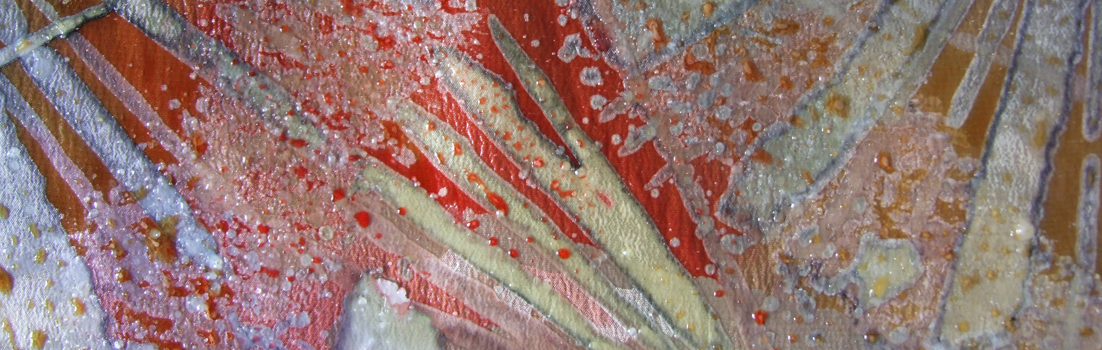
Spots of dye on the surface of waxed areas transfer to silk surface during steaming
Splashes of Saxon Blue seem to have travelled through the steaming paper
Interesting range of greens and blues with pale dilutions of both dyes
Scarf showing its steamer paper
Scarf showing its steaming paper
Observations:
The good news is that the dyes have set in the steaming process. Repeated rinses after the White Spirit dip run entirely clear. I lost some of the SB in the first rinses, but this was almost certainly because I notched up the SB concentration to extremely high levels in some areas and probably overdid it. I always think of dyes and dye-sites like a game of Musical Chairs. When the chairs run out, the dye has nowhere to sit, molecularly speaking. It’s more to do with the fibre than the dye.
This experiment shows that it is possible to build quite dark tones by increasing the concentration of dye in selected areas. There are some deep greens. I had wondered if this would be possible, and it looks as though it is.
However, the HR has lost its lovely golden hue (see the original colour centre top) and has dulled to ochre. If you look at the images you can see some in which the steaming paper has picked up a lots of pink from the HR painted areas. The dyed steaming paper is lovely in itself: the red component of the dye has leached into the paper and didn’t fix to the silk. I have no idea why. It could be the mordanting. It could be the paper. It could be that I steamed too long, or steamed too hot. It could be that it would always happen, whatever the steam-time and heat. I now need to dye silk with all the Aquarelle colours, using their recommended dye bath, to evaluate their ‘true’ colours.
The centre image shows small blotches on a brownish area. These are created by small spots of dye on a wax surface which I failed to wipe off. These are travelling through to the silk surface as remaining wax melts in the steamer, and they then fix. In this case it is not too big a blemish, but it can look smudgy and ruin a design.
On the centre right image there are ugly blue splashes. These weren’t present when the fabric went into the steamer. I think loose dye may have travelled all the way through the steaming paper and I shall use two layers next time.
More puzzling is the bleeding of the SB into areas that had been waxed onto white. You can see these top right and centre left in the images. This can happen with synthetic dyes if the work has been placed too close to the outside of the paper roll. If you imagine the rolled paper in the steamer (see here for an idea of how it looks) there is more moisture reaching the roll on the outer surface when it is in the steamer. If the steamer isn’t up to heat, work on the outer part of the roll receives a lot of moisture, doesn’t begin to fix and starts to wander around – playing Musical Chairs. The solution is to wrap additional paper around the outside of a steaming roll. I didn’t do it this time. I am not sure whether the bleeding is a result of the steaming process or an issue to do with the dyes themselves. This didn’t seem to happen with dyes on the inner part of the roll, so I tend to blame my lack of foresight.
Conclusion
There is a lot to do but I am enthusiastic about the potential for working with Aquarelle with wax. The colours I achieved aren’t particularly exciting because of the dullness of the HR after steaming, and I need to research this aspect. But they have fixed efficiently via the steamer, it does seem possible to use wax as a resist, and to achieve some strong, dark tones. So I am optimistic; I just need a 36 hour day.


 Isabella Whitworth