Last week I tutored a day-course in shibori techniques at Ardington School of Crafts. Ardington is a village on the edge of the Berkshire Downs. The venue is housed in a Victorian school, and its large windows ensure good light at all times. It has been imaginatively and calmly adapted for its current incarnation as a craft school and overlooks a traditional English landscape of farmland and trees. This week, with fine weather and leaves at the multiple-greens stage, everything looked at its best.
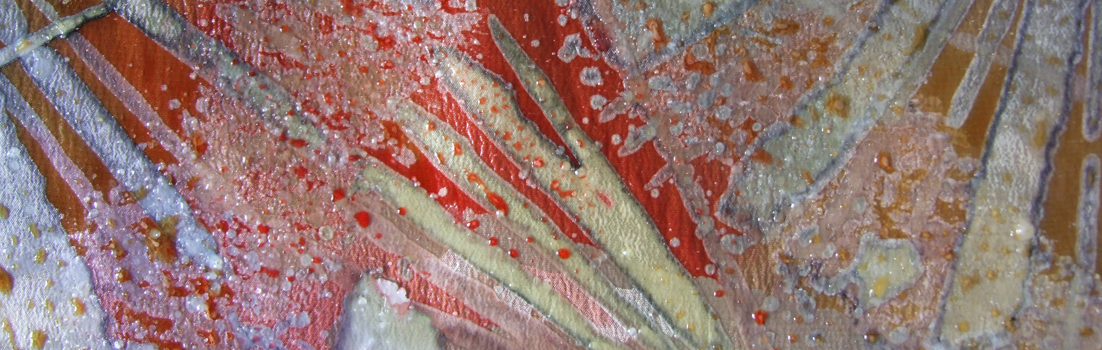
Students were introduced to the basic principles of shibori and how patterns will build in the fabric through what is a mathematical logic of repeating folds and layers. We worked principally with the equilateral triangular fold which creates hexagon-based patterns through its geometry of six equilateral triangles. I prepared a set of triangular card units showing how this repeat principle works. The positioning (and shape) of the clamped and identical wooden blocks either side of the folded fabric is represented by the white areas in my patterns. The clamping inhibits the flow of dye through the fabric. The wood blocks can be any shape – there is a pattern created by the green-painted triangular blocks below – and placed in any practical position. Block position will dictate the basics of the pattern. You can see from the image (below right) that the blocks do not necessarily prevent dye from entering the fabric beneath the clamped area. They just affect the character of the final pattern which is based on dye dilutions, deliberate drying of work, overdyeing etc.


Students ironed vertical folds in a scarf length and converted the strip to a stack of triangular folds. They checked the wood blocks and protected them with new clingfilm. This enables a clean start each time the blocks are used: wood absorbs dye readily and will mark work that follows. I advise beginners to work with three colours only, plus dilutant, to avoid shades of mud. Some students admitted they had been sceptical that their seemingly random application of dye would create something so ordered and I think all were pleased with their results.
Below, you can see me opening up the steamer. This has to be done with considerable care, hence the somewhat stressed expression. You can see the roll of paper and scarves, which has been protected with foil at top and bottom to prevent drips entering the folds and spoiling the work. Note that the top piece of foil was dislodged as I lifted the chamber from the boiler.
Many thanks to the students for allowing me to post these pictures and to Faith at Ardington for taking the photos.


Other news: On Thursday 13th June, Jane Deane and I will be working on our dye research at Leewood for the final open-to-the-public time. We haven’t finished our research, but from Thursday on you can’t come to watch us. To check on details, see here.
With shearing time in Devon arriving, local flocks are looking cooler and in the summer-ish sun my nest of mason bees (Osmia) is hyperactive. The bees don’t make honeycombs (that’s another hexagon-based subject) but are laying eggs in the tubes and sealing them in various shades of Devon clay. We are lucky to have culm meadow locally which is filling with textured grasses in some summer sun. But tomorrow it is going to rain.


 Isabella Whitworth