The Colourist is an online magazine produced by the Society of Dyers and Colourists (SDC). A recently published article outlines some of my work and the industrial archive that has occupied me for so many years.
With many thanks to Andrew Filarowski, Technical Director, SDC.
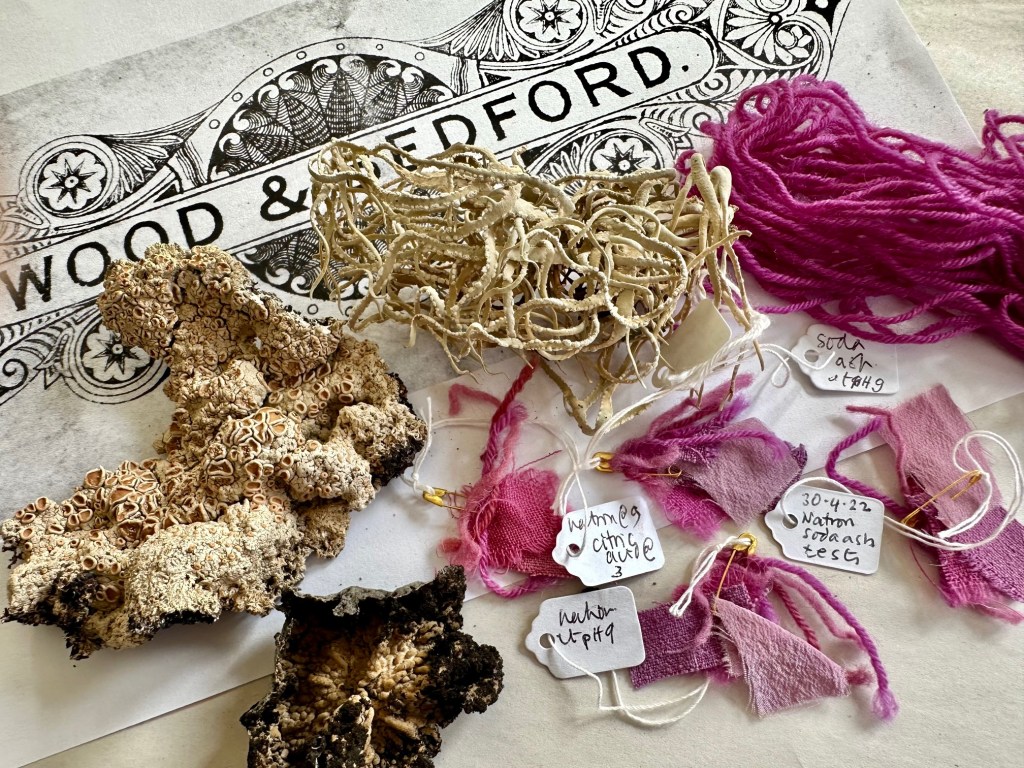
Wood & Bedford company logo; three dye lichens of different types once used in the dye trade; several samples of wool and silk dyed with orchil
Orchil
Orchil is a beautiful, purple historical dye made from several varieties of lichens. As the image above indicates, many of them bear no resemblance to each other. Orchil dye cannot be directly extracted by straightforward soaking, as with many natural dyes, but must be fermented for several weeks in aerated ammonia. Its use stretches back to ancient times and orchil dye recipes and references appear throughout recorded history. The use of orchil is revealed by modern dye analysis and shown to be present on precious textiles and parchments, despite the fact that it is very light fugitive: it isn’t very lightfast and fades quickly to a pinky-beige, and then, visually, to virtually nothing.
The archive
I’ve not been occupied on it every second, but for the last 16 years I have been working on an industrial archive. A collection of nineteenth – twentieth century documents relating to a Leeds dye manufacturer resurfaced in my home town in Devon and I became thoroughly absorbed in its story of the enterprising Bedford family and the purple dye called orchil. The company effectively launched in the 1820s, when a young Leeds chemist called James Bedford began to specialise in manufacturing orchil and cudbear (a powdered form of orchil). This same, Bedford-run company amalgamated with others over the next 100 years by which time it was known as the Yorkshire Dyeware and Chemical Company. The Bedford family were no longer on the Board after the early 1940s but the company never underwent a takeover. In the early 2000’s, on the same Kirkstall Road site in Leeds that it had occupied since the early 1850s, Yorkshire Chemicals faced financial collapse and finally closed. Before its demise it had become a world-famous company and at one time the fourth largest dye manufacturer in the world.
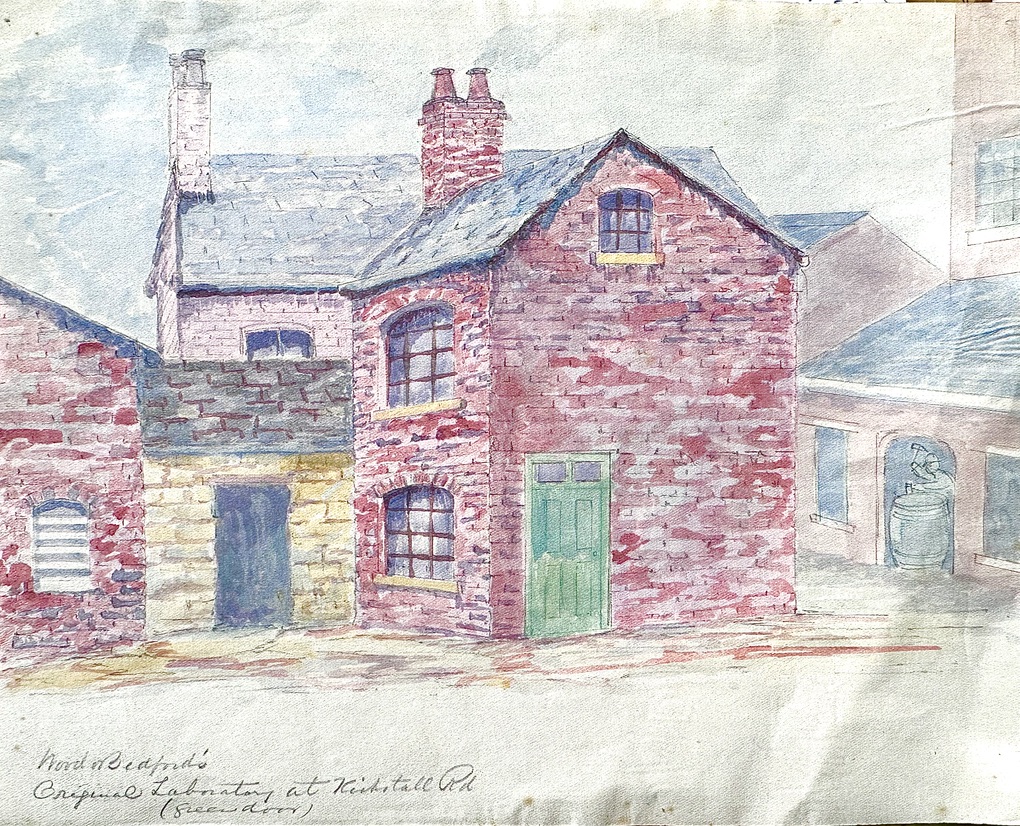
Above: Watercolour of Wood & Bedford’s original laboratory (with the green door) on Kirkstall Road. Note the cooper at work in the workshops to the right: orchil and cudbear were sold in casks
The commercial orchil trade
When my obsession with orchil began I knew virtually nothing about it. But I have since learned from and worked with several experts. I know a little about lichen species and identification; I can make and dye with orchil and I understand something of the history and relationship with other purple dyes such as murex or shellfish purple. In spite of my science-and-maths-resistant brain I have learned chemical principles by which dyes operate, how contemporary dye analysis is undertaken and something of the science behind processes. I am very grateful for the patience and generosity of scientists who have enlightened me along the way.
As my studies continued, I became uncomfortably aware of the enormity of the trade. Until the mid nineteenth century, lichen species would have been under mounting and unsustainable pressure from the commercial dye trade’s constant demand for orchil. Lichen grows slowly and cannot be cultivated, so wild material was always collected for the dye trade and as a result, lichen populations collapsed from islands and coasts and the inland moorland where they grew. Lichen gatherers were paid poorly, consequently they had to gather ever more lichen to make a living wage. This speeded up local depletion. While earlier sources of lichen may have been the islands of the Atlantic such as the Azores, the Canary Islands or Cape Verde, nineteenth century prospecting for the voracious European trade extended across continents, to India, Ceylon, South America, Africa and as far as West and East Timor.
The orchil dyestuff trade was competitive and stocks fluctuated with various aspects of supply such as depleted sources, wars affecting trade routes, etc. There were huge profits to be made by selling when the price was high, so merchants often hoarded stocks. Dye manufacturers could also sustain large losses if they had to ‘buy high’ and their manufacturing process failed. Orchil can spoil easily in manufacture and only efficient, experienced orchil and cudbear makers would be likely to survive.
Research
Back in 2008 I approached the The Worshipful Company of Dyers for some financial assistance in finding a permanent home for this important collection. As well as assisting me with a grant, they put me in touch with former employees of Yorkshire Chemicals – and a new phase of the story unfolded. Former employees had retained many documents relating to their company in the synthetic age but, curiously, knew very little of its early beginnings with natural dyes. The papers in their possession were then archived by Dr Howard Varley, a former employee of Yorkshire Chemicals, and passed over to the West Yorkshire Archive Service in 2017. They are now available for public study (see the link below). In late October 2024 I will be handing over remaining documents, largely relating to orchil. The amalgamated collections cover the entire life of the company, from orchil beginnings of James Bedford in the 1820s to the final synthetic dyes produced by Yorkshire Chemicals in the late twentieth century. The fascinating period where manufacturers faced the challenges of the new synthetic age is illustrated by patents, technical notes, sales material and financial reports. The entire archive very much reflects its times, through the company’s many achievements in science, to social and political events through the centuries that affected the life of a highly enterprising and innovative company.
Link to West Yorkshire Archive Services Catalogue here
Above: A selection of items and images related to the archive of Wood & Bedford / Yorkshire Chemicals
Conservation work and publications
I have presented research at several conferences over the past 16 years, particularly at DHA (Dyes in History and Archaeology). Because of my experience with orchil dye, and as an experienced natural dyer, I have been asked to help or advise on conservation or research projects where the use of orchil has been detected in a precious object.
On this website I have published several blogs which can be found by using Search words orchil, Wood and Bedford, Yorkshire Chemicals etc, in the word cloud to the right. Details of my research and publications can be found here.
Endnote: using wild material for research in the UK
Involvement in some major conservation projects has made it necessary for me to make small batches of orchil over the last few years. These normally use about 5 grams of ground lichen per orchil batch. I have been fortunate that many dyers and friends have donated their old dye lichen collections to me as they no longer feel comfortable about using lichens of any kind in their studio work. They would prefer this increasingly vulnerable wild material to be used for conservation or research purposes and not for commercial gain. I have spent many years of my working life as an artist and dyer but I have never used lichens in my studio work.
Over the past three years I have been working closely with Susan Dye and Ashley Walker of Nature’s Rainbow, Deb Bamford ASDC and Jane Deane ASDC, to research the subject of foraging for dyes in the UK. Our article on the first stage of the project was published by The Journal for the Association of Weavers, Spinners and Dyers, 288, Winter 2023. Subsequent contact with the British Lichen Society confirms that they will be issuing new guidelines about dyeing and foraging soon.
A 5mm square of silk mousseline showing typical orchil colour
My last post featured some purple orchil or cudbear dust detached from stained paper. I attempted to convert it back to dye and soaked it in water for several days. I didn’t know if it would dye fibre after 167 years but after several weeks’ cold-dyeing a fragment of silk with the purple liquid, it has taken on a typical orchil fuschia purple – see above. I don’t know what that proves, but it’s wickedly, super-nerdily satisfying.
And now to Covid-19 masks. In the early 1990s I completed a number of publishing commissions to design textile craft projects. I accumulated boxes of fabric scraps in vibrant designs which I have failed to part with because ‘one day they might have a use’. Translated into stash language, that means I couldn’t bear to part with them. But their day has finally come and I have made masks for family and friends during the pandemic. After some online research I settled on the Olson design for adults which has a pocket into which a HEPA filter can be slipped. Research suggested that high thread count natural fabrics made the most effective mask and my 90s fabrics were ideal, being quilting cottons, cotton lawns, or fine weaves. It seems a suitable way to let these fabrics go. I made children’s masks but found the scaled-down Olson unsuitable since I couldn’t approach individual children to adjust the fit and instead used one of the many pleated designs on the internet. To supply designs that children would actually wear I bought a few new fabrics. All the girls wanted pink masks, and being Devon, small boys chose tractors and I’m unapologetic about this apparent stereotyping. I made fabric ties but advised parents to change to elastic if they weren’t efficient. There’s no point wearing them if the masks slip down all the time.
Four masks in the Olson pattern design (see link below). There are three layers of fabric in the centre where the pocket sits and if a HEPA filter is inserted a further layer is added. I fed a copper nose-wire into a channel along the top centre which shapes the mask to fit the face as closely as possible
Although appearing simple, I found mask-making fiddly because of the curves, layers of fabric, nose-wires etc. and the labour rapidly became tedious. I’m full of admiration for the army of makers who have made so many masks and scrubs over the past few months.
Children’s masks with a pleated design. Two layers of fabric overall
A very obvious spill of orchil left this 1853 letter stained, with loose deposits of a powdery purple substance on the surface
This is my 38th day in coronavirus lockdown. Like many, I have a diary full of scratched-out teaching, appointments, celebration parties and anticipated trips. I haven’t felt particularly creative for the past few weeks and admire the achievements of those who use their daily exercise to draw and paint and record their experiences visually, or translate their time into the positivity of making work. I feel as though that particular tap ran dry for me a few weeks back. It’s a bit weird but I don’t feel bad about it, it just is. I have found other things to do.
When I’ve not been gardening, or training the new puppy, or learning to make videos, I’ve been working on family history links with England, USA, Ireland and Ecuador. And with no other distractions or excuses I have finally managed to get my teeth back into the Leeds-related archiving I’ve been undertaking for some years. You can find other blogs about this research in the ‘word cloud’ on the right, under the search titles Wood & Bedford, orchil, and Yorkshire Chemicals.
Over these weeks of lockdown the archived boxes of labelled documents are growing, the unsorted papers are diminishing. Most nights when I turn out the light and go to wash my hands (in a non-coronavirus way) there is a trace of pink or purple in the dirty, soapy water. I know it’s from orchil. The earlier papers, dating between 1833 and 1855, came from a time when many of the working spaces of Wood & Bedford adjoined. The Fire Insurance document of 1855 describes these workspaces and some of the equipment. Orchil lichen was ground into powder with stones before manufacturing into dye, after which it was reduced back into powder (cudbear), or sometimes paste. Orchil dust would have hovered permanently, coating surfaces and settling on any uncovered papers. I have sorted papers with heavy purple stains, as if spills took place where they were stored, and there’s even a purple thumbprint on the back of an invoice for glass and earthenware. This gave me a real archival shiver because at that time (1850) there was just one person, James Bedford (1824 – 1903), who would have been working on orchil at the Hunslet address: the move to Kirkstall Road was imminent but had yet to take place. I have developed a very healthy respect for James and I like to think it is his thumbprint on the paper. It feels like a kind of handshake.
Back of an 1850 invoice showing a purple thumbprint
I also found an 1853 letter stained with a large spill, which had resulted in several crusty deposits of a loose and powdery purple (see top image). I am neither equipped nor funded to conserve these papers and have stored the heavily stained ones separately so that at some time in the future there is the potential for them to be studied further. But while I was working a tiny deposit loosened off and I rescued it, putting it in a container with a little water. I checked it impatiently, and slowly, over several hours, the powder began to release its colour. It shows a typical fresh purple orchil pink. Amazing to see, and a rewarding moment that joins several other highlights in many years’ work on this archive. I will drop a few silk fibres in once I think all the colour has been released, and see if it will still dye.
Orchil dye reconstituted from the 167-year-old orchil spill. The colour is typical of orchil
It’s intended that my section of the archive will finally join the main Yorkshire Chemicals collection already in the curation of the West Yorkshire Archive Service facility at Morley, Leeds. Wood & Bedford became the lead company of the Yorkshire Dyeware and Chemical Company in 1900, which was renamed Yorkshire Chemicals from 1974 – 2004 when it went into administration. The work on the Morley archive was completed by Dr Howard Varley who had been an employee of Yorkshire Chemicals until its demise. The complete set of archives will give a rare insight into the lifespan of a dye manufacturing company whose work spanned the transition from natural to synthetic dyes.
Summary of my presentation to the DHA (Dyes in History and Archaeology) Conference, Hampton Court, October 27th, 2017.
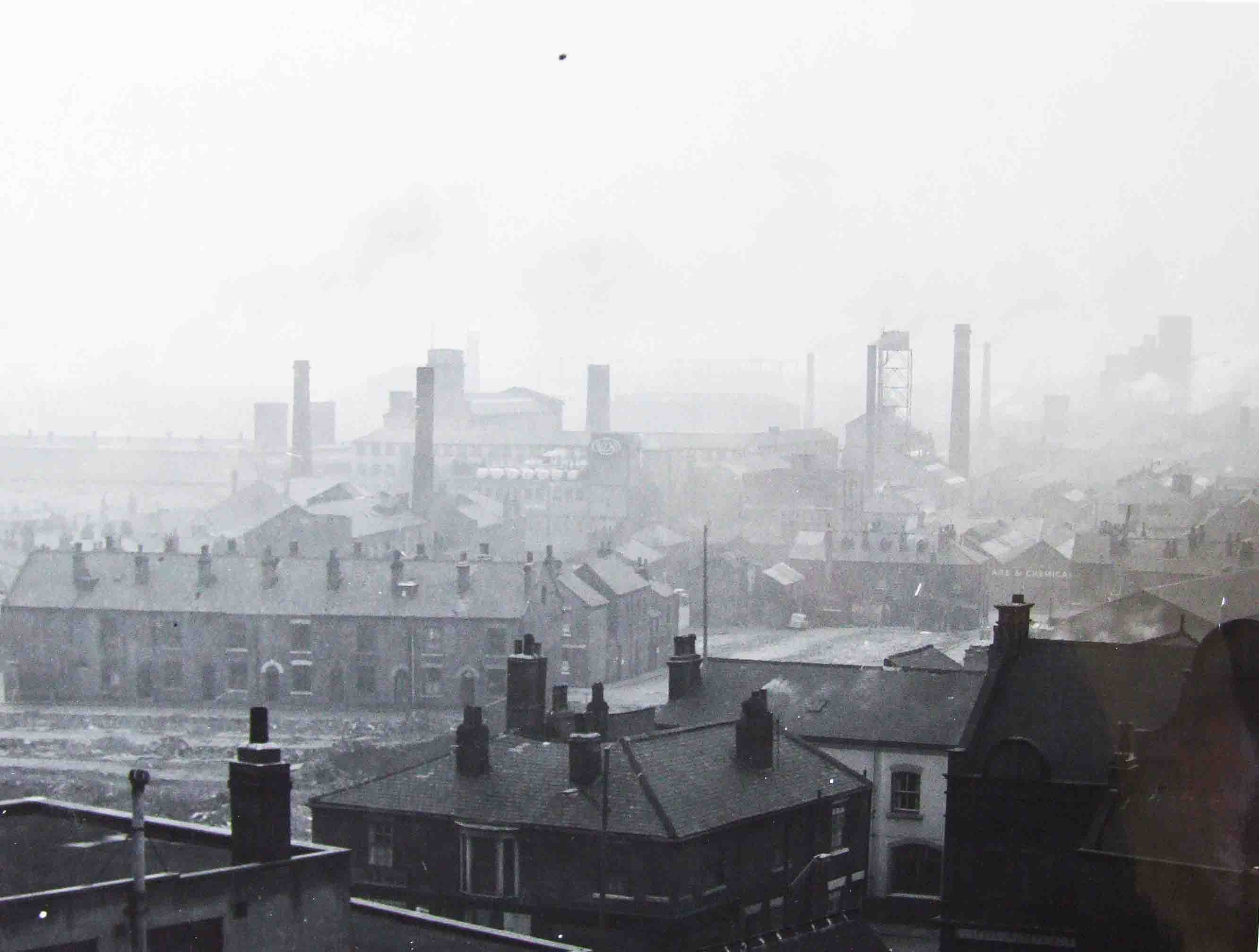
The Airedale Chemical Works (Wood & Bedford) around 1850
For the last nine years I have been researching an archive relating to dye manufacture in nineteenth and twentieth century Leeds. In September 2017 a large portion of it was handed over to West Yorkshire Archive Service (WYAS). The archive represents 186 years of a dye manufacturing company’s existence, and covers its life from cradle to grave.
The founding Bedford family has a long and distinguished history of political, social and commercial significance in and around Leeds. The archive is concerned chiefly with their commercial activities, and illustrates how successive generations played an important role in business developments which contributed to the emergence of Leeds as a commercial centre during the nineteenth and early twentieth centuries.
BeginningsIn around 1810, a 15-year old James Bedford became apprenticed to a chemist and druggist in Leeds. In 1821 he was involved in oil refining but by 1827 was solely engaged in making cudbear and orchil. The company ‘Wood & Bedford’ was founded in the 1850s, manufacturing natural dyes and tannins. Wood & Bedford became a leading manufacturer in Leeds, based at premises on Kirkstall Road.
Colophon from after 1850
Wood & Bedford brought together eleven leading local companies in 1900 to form the Yorkshire Dyeware and Chemical Company Limited (YDC). Over the next hundred years this company evolved from being predominantly dependent on natural dyes and extracts to becoming one of the major synthetic dye manufacturers in the world, known for creative ideas and innovative products.
Photo from the archive showing YDC lorry. Note the telegram address ‘Dyewood Dewsbury’ on the door!
Yorkshire ChemicalsIn the twentieth century the company operated under the name ‘Yorkshire Chemicals plc’, signifying its diversification into other chemical classes and acquiring the plc designation when the business floated on the stock exchange in the 1970s.
The textiles industry migrated to Asia, and in the late 1990s the company over-reached itself by acquisition of new companies. Yorkshire Chemicals went into rapid decline, and into administration in 2004. It struggled for another year as Yorkshire Colours under a management buyout, and collapsed again in 2005 when the Leeds factories finally closed. In 2008 the main Leeds sites site were demolished.
The Yorkshire name and brands survive, with the business now under Chinese ownership and continuing to trade in Europe as Yorkshire Farben GmbH based in Germany, and in Asia as Yorkshire Asia Pacific, with headquarters in China.
Kirkstall Road site under demolition, 2008
Archive sourcesThe archive, which is now housed at WYAS’ Morley facility near Leeds, preserves documentary records and photographs spanning the complete history of a company whose changing fortunes broadly parallel those of the UK and European textiles industry. The collection comprises items from three main sources.
Devon sourceI live in a small Devon market town. In 2008, a neighbour (who is descended from the Bedfords) invited me to look at a large quantity of family papers and documents. Recognising their historical value, I undertook to find them a permanent home. The items from this Devon source are of the earliest in date, assembled around 1914 by James E. Bedford, at that time Lord Mayor of Leeds.
Demolition SourceIn 2008 I visited the demolition site in Kirkstall Road and asked to take some photos, explaining my research to the foreman. A fortnight later he called me as his team had found a set of photo albums sealed in to partition wall. These invaluable records now form part of the archive. There are 11 albums, with photographs dating from the 1920s until around 1990.
Photo from one of the 11 albums with a view of Yorkshire Chemicals, 1960s. It has the caption ‘Where’s there’s muck, there’s brass’.
Ex-employee SourceThrough my research I made contact with a large group of Yorkshire Chemicals ex-employees. Many of them had retained papers, photographs and other documents relating to the latter days of the company which they were happy to donate to the archive. One of these employees has undertaken the colossal task of indexing, annotating and cataloguing the collection. Future scholars will be indebted to him for his knowledge and insight as a chemist, as a long-serving employee who knew the various sites, subsidiaries and employees, and as an intelligent and often critical bystander to the final company collapse.
Edited 17th January 2018 The catalogue is now online through WYAS. You can start your Search here
West Yorkshire Archive Services is part of West Yorkshire Joint Services. This is the Morley facility
Reading room at Morley
Archive in storage
A quote from West Yorkshire Archive Service
‘The West Yorkshire Archive Service are delighted to be the new custodians of the Yorkshire Dyeware and Chemical Company Archive, playing our part in preserving the memory of a comprehensive archive of a local business. The records gives a fantastic insight into the creation, development, success and eventual decline of the company over a 150 year period which will be of great interest to anyone researching the history of manufacturing natural dyes and the evolution of the textile industry in Leeds and we look forward to facilitating public access to the records now, and for generations to come’.
Links
You will find other information on my research, and the archive, by searching the blog using the word cloud.
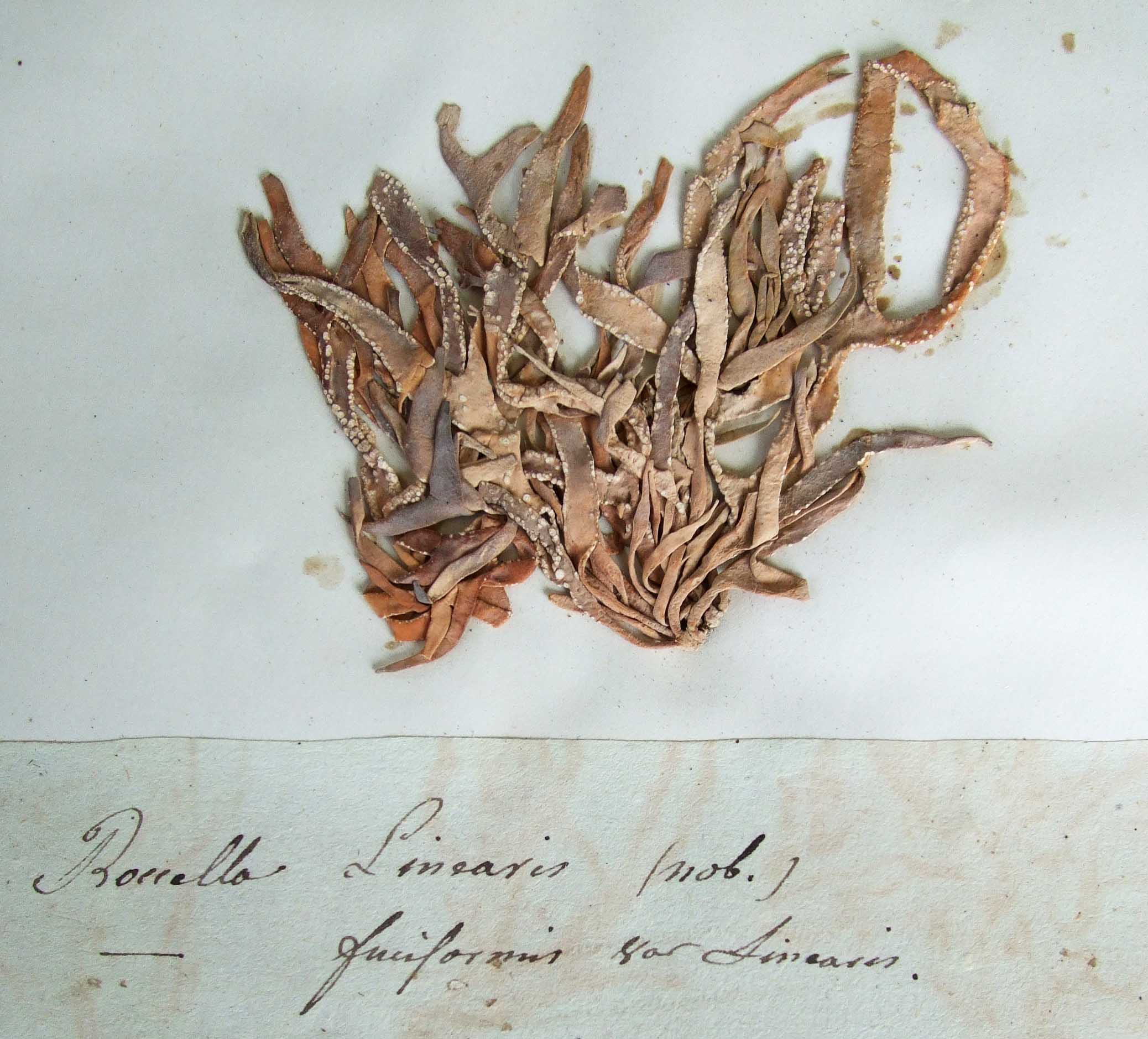
Specimen page from lichen collection found in Leeds archive, now held in the Economic Botany Collections, Kew. The botanist was J.M. Despréaux.
‘Connecting Collections’ is a series of National Archives blogs by academic researchers, exploring the connections between archives across the UK and around the world. Last year The National Archives held a competition inviting researchers to submit guest blogs. When I thought about it, I realised just how many such connections had been made in my early research into the lichen dye trade. My blog just made it on the closing day and I was delighted it it was accepted for publication – on 18th May. The title was A Purple Pursuit and you can read it here:
About five years ago life veered off in a new and unexpected direction.
My neighbours asked me to look at a dye-related company archive they were liberating from their attic. They were selling their house, thought they had a ‘firm offer’ and there wasn’t a lot of time. There would be no space for the archive in their new home and I offered to rescue anything important from its potential new resting place – an unconverted stone barn. I imagined I’d see a small, disparate heap of documents and books descend the attic stairs with little supporting contextual information; honestly, I did wonder how interesting that might be. Because I knew a little about dyes I hoped to advise my neighbours if anyone would be interested in any of the collection before it made its acquaintance with the barn.
Six weeks later (the ‘firm offer’ wasn’t) I had opened and listed the contents of dozens of boxes and trunks containing documents, books, ledgers, patents, dye samples, photographs, letters, diaries, Minutes, catalogues, invoices, plans, maps, contracts, botanical samples, watercolours, chemicals, medals and awards…. and even a mousetrap, devoid of mouse.
Are you beginning to get the idea? Neither disparate, nor without context.
This is some of what I initially learned. The archive had been handed down through my neighbour’s family. He is a direct descendant (the great-great grandson) of a chemist called James Bedford who was born in 1795 and apprenticed to a chemist and druggist in Briggate, Leeds, in 1810. James Bedford was the first in a descending series of three James’, all of whom worked in the family business, which started its life as Wood & Bedford. The same company, though it amalgamated with others and changed names, never underwent a takeover and occupied the same premises in Leeds, on Kirkstall Road, until it went into administration in 2004. It was by then the internationally-known Yorkshire Chemicals.
About half the archive in the attic..
Orchil samples on wool flannel; early 1800s
Somewhere beneath this spot was Bedford’s first business
James Bedford (2), 1824 – 1903
Sheafs of shipping documents
The Airedale Chemical Works (Wood & Bedford) around 1850
Silk dyed with orchil: a particularly red shade
View of Leeds from Knowsthorpe
The Wood & Bedford / Yorkshire Chemicals archive was largely assembled in the early twentieth century by the third of the James’, although it included material from the early 1800s. There was little after 1945 as later material was largely retained by the company and not kept within the family. I published an article in the Journal for Weavers, Spinners and Dyers in 2008 (it can still be downloaded here) which gives a summary of the early days of my research. I was amazed to discover that, contrary to what I had read and often heard, the use of natural dyes persisted long after 1856 when mauveine was discovered by the young William Henry Perkin. Logwood, orchil lichen and various tannins featured in the archive well into the twentieth century, although the company also worked successfully on the development of synthetic dyes.
It’s hard to pin down why I became particularly intrigued by the orchil trade, but an early 1800s dyers’ notebook (there’s a page shown above) certainly helped. My orchil-dyed path, proceeding from the heap of rusty trunks, has since led me to Galicia in Spain, to Posnan in Poland, to Leeds, Lisbon and to Ecuador. In October it’s taking me to La Rochelle, and last week it took me back to Yorkshire. I will be giving a talk on the orchil trade to the ‘6 Guilds’ group of Weavers, Spinners and Dyers at the end of this month in Stratford; at DHA (Dyes in History and Archaeology) in La Rochelle in October I am delivering a joint research paper with Professor Zvi Koren on samples labelled ‘Tyrian Purple’. I can’t say any more about those until after the event – or I would have to leap through the screen and kill you. It’s Classified.
Yorkshire Grit
The Wood & Bedford / YC archive has been accepted by the West Yorkshire Archive Service (WYAS) through the generosity of my one-time neighbours; a ‘firm offer’ did eventually materialise. So the collection has gone back to Leeds where it belongs. WYAS were excited by the fact that the archive covered long periods of the same company’s history. It isn’t yet available for study as archiving is being undertaken by a dye chemist; through a coincidental set of circumstances I was put in touch with a large group of ex-employees of Yorkshire Chemicals (YC), of which he is one. This contact led to my giving ex YC employees several presentations as they knew nothing about Wood & Bedford’s beginnings. Most professed great affection for their time at YC, and one referred to it as ‘the best days of my working life’.
A (sadly) dwindling band of ageing YC folk meet up from time to time and I sometimes join them for the annual outdoor charity Band Concert given by the Elland Silver Youth Band. That’s why I have just been back to Yorkshire. The rest of the country sweltered in tropical heat, but Halifax wasn’t having that. It was practising Yorkshire Winter. The wind Heathcliffed down from the moors with such enthusiasm that tents and gazebos couldn’t be put up to protect the young Band members – who played valiantly in shirtsleeves. A knocky-kneed and freezing set of ex YC attendees cowered under woolly blankets and discussed cryogenic concerts. There’s nout like Yorkshire Grit.
I’ll be writing more about the archive in future blogs, once I thaw out.
Farfield Mill
Some years ago when Farfield Mill reopened as an arts centre, I used to sell work there but I have never visited until this week. The impressive Mill centre is set on four floors which include exhibition spaces, a retail area, the best second-hand textiles bookshop ever, a historical display about wool, weaving and knitting and small workshop / display units. A large industrial working loom weaves blankets and throws next to the Weavers Café – a refuelling stop after the rigours of viewing everything at Farfield. I enjoyed seeing but particularly, handling, Laura Rosenzweig’s Howgill Range which I have only read about in the Journal (issue 243). As Laura’s Loom, Laura runs one of the work and display units. With my next Yorkshire concert in mind, I bought a Shetland wool hat from Angela Bradley‘s shop.
On the top floor we found a welcoming group of weavers, some of whom I know through the Online Guild. They had a variety of looms and equipment on show and in use, and were clearly a valuable asset offering explanations to visitors, many of whom, it seems, don’t know the difference between weaving and knitting.
Lichen dyed yarns in historical display
Second-hand textile books
Laura’s Loom display unit, showing her article in the Journal










 Isabella Whitworth